Jennifer Fuller – Test 2

Administrative Procedures
ILLINOIS BOARD OF HIGHER EDUCATION
431 E. Adams, Second Floor
Springfield, IL 62701-1481

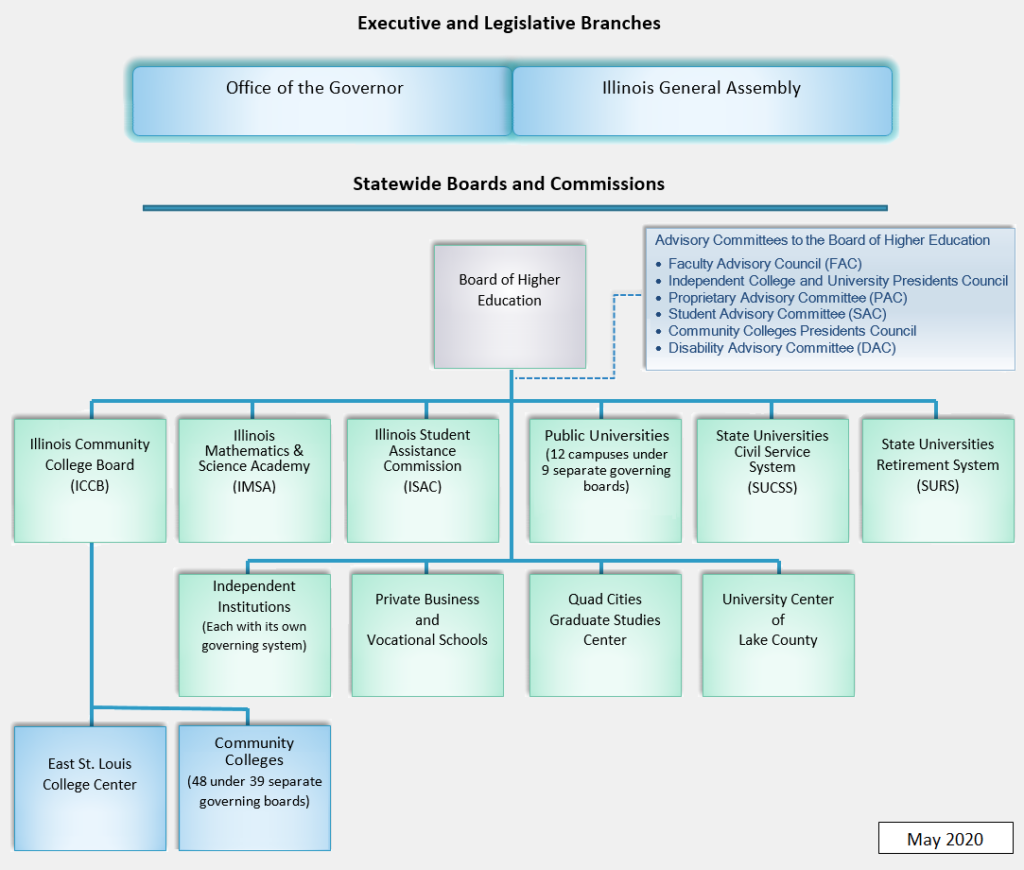
The Illinois Board of Higher Education (IBHE) is the state coordinating agency for Illinois’ system of public and private higher education institutions. Established by state law, the IBHE provides leadership in statewide planning, policy development, and coordination to ensure accessibility, quality, and
accountability across higher education in Illinois.

The Board is composed of members appointed by the Governor, along with representatives from higher education governing boards and student members. The IBHE works in coordination with agencies such as the Illinois Community College Board to support statewide educational goals.

For current Board membership and additional information, visit:

  • ADOPTED: AUGUST 6, 1974
  • REVIEWED: JUNE 30, 2026
  • AMENDED: JULY 1, 2026
  • LEGAL REF.: 110 ILCS 205
  • CROSS REF.: BOARD POLICY 1110

ILLINOIS COMMUNITY COLLEGE BOARD
401 East Capitol Ave.
Springfield, IL 62701-1711

The Illinois Community College Board (ICCB) is the state agency responsible for coordinating and supporting Illinois’ system of 45 public community colleges. Established by the Illinois General Assembly, the ICCB provides leadership in policy development, system planning, funding, and accountability in accordance with the Public Community College Act (110 ILCS 805).

The Board consists of Governor-appointed members, along with a student representative, and meets regularly throughout the year in compliance with the Illinois Open Meetings Act. Local community colleges are governed by their own boards of trustees, which align institutional priorities with state goals.

For current Board membership and additional information, visit:

  • ADOPTED: April 1, 1980
  • REVIEWED: JUNE 30, 2026
  • AMENDED: JULY 1, 2026
  • LEGAL REF.: 110 ILCS 805
  • CROSS REF.: Board Policy 1120

Purpose

The purpose of this administrative procedure is to establish the framework for the Shared Governance Council (SGC) at John A. Logan College, ensuring that it operates in a manner that promotes collaboration, transparency, and effective decision-making across the campus.

Scope

This procedure applies to all members of the John A. Logan College community, including faculty, staff, administrators, and students, who are involved in or affected by the activities of the Shared Governance Council.

Procedure

  1. Role of Shared Governance
    • The SGC facilitates collaboration, transparency, and purposeful action by providing a platform for discussions on policies, procedures, and the work of campus-wide committees and task forces.The SGC ensures that decisions reflect the perspectives, expertise, and best interests of all stakeholders.
    • The SGC serves as an advisory body to the President’s Cabinet and as a repository for committee and task force work to prevent redundancy.
  2. Membership
    • Membership includes representatives from each employee group and student representatives.
    • Representatives are selected through a nomination process for Senior Administrators, Administrators, Managers, Professionals, and Executive Support staff.
    • Student body and campus bargaining unit representatives are selected based on their established processes.
    • Additional employee groups, if defined, will have a representative and an alternate added.
  3. Functions of the Shared Governance Council
    • Facilitate transparency, communication, and accountability on campus.
    • Act as the liaison for all constituency groups.Prepare formal recommendations to the President’s Cabinet.Facilitate action on feedback received from the President’s Cabinet.
    • Maintain a repository of committee and task force work and manage requests for new committees and task forces.

Report regularly to the Board of Trustees on outcomes achieved through SGC intervention.


  • ADOPTED: APRIL 1, 1980
  • AMENDED: NOVEMBER 8, 1982; MARCH 30, 1992; JULY 1, 2024 (REPLACES COMMITTEE STRUCTURE OF COLLEGE COUNCIL); SEPTEMBER 25, 2025
  • REVIEWED: SEPTEMBER 3, 2025
  • LEGAL REF.: ILLINOIS OPEN MEETINGS ACT (5 ILCS 120/); FAMILY EDUCATIONAL RIGHTS AND PRIVACY ACT (FERPA); TITLE IX OF THE EDUCATION AMENDMENTS OF 1972; AMERICANS WITH DISABILITIES ACT (ADA)
  • CROSS REF.:

I. Purpose 

John A. Logan College is committed to delivering high-quality, affordable, and flexible learning opportunities. This procedure establishes a balanced framework for curriculum development, implementation of Competency-Based Education (CBE), and ongoing program review to ensure continuous improvement and alignment with institutional, state, and federal standards.  

II. Definitions 

  • Curriculum Development: The process of designing, revising, and aligning courses and programs to meet institutional goals, workforce needs, and regulatory requirements. 
  • Competency-Based Education (CBE): An instructional model where students progress by demonstrating mastery of defined competencies.  
     

III. Curriculum Development Process 

  • Curriculum is developed collaboratively with subject matter experts, faculty, advisory panels, and administrative leadership (Provost, Assistant Provost, supervising Dean, Director of Academic Programs and Accreditation). 
  • All courses and programs must align with institutional learning outcomes, industry standards, and regulatory requirements. 
  • The development team researches comparable programs, consults with Institutional Research, and engages external stakeholders to determine feasibility, need, cost, and quality, as required by the ICCB Program Approval Manual and any applicable accrediting bodies.  
  • The initiator must use the Curriculum & Instruction Submission Handbook, which outlines required processes, forms, reviews, and approvals.  
  • All curriculum development must comply with:  
    • Illinois Public Community College Act (110 ILCS 805/) (esp. 110 ILCS 805/2-15) 
    • ICCB Administrative Rules (23 Ill. Adm. Code § 1501.507(b)(11)) 
    • ICCB Program Review Manual FY2022–2026 
    • Higher Learning Commission (HLC) Standards 
    • Title IV of the Higher Education Act of 1965 (20 U.S.C. § 1001 et seq.) 
    • Family Educational Rights and Privacy Act (FERPA) (20 U.S.C. § 1232g; 34 CFR Part 99) 
    • Any relevant external accrediting entities.  
       

IV. Competency-Based Education (CBE) 

  • CBE programs allow students to progress at their own pace by mastering competencies. 
  • Competencies are supported by performance standards and assessed through rigorous, criterion-referenced summative assessments. 
  • Credit is awarded only upon mastery of all required competencies. 
  • CBE programs are designed to support non-traditional learners, including adult, part-time, and working students, with flexible pacing and integrated support services. 
  • CBE courses define clear competencies, connect them to measurable performance standards, and award credit only when mastery is demonstrated. 
  • Development of CBE programs follows standard curriculum processes, with additional attention to:  
    • Establishing competencies that are Measurable, Observable, and Valuable 
    • Defining performance standards and mastery criteria 
    • Ensuring alignment with institutional learning outcomes, workforce needs, and accreditation requirements 
    • Implementing mechanisms that support self-paced student progression.  
       

V. Changes to Existing Curriculum 

  • Faculty proposing changes must consult with the supervising Dean and use the Curriculum & Instruction Handbook. 
  • Only components relevant to the proposed change must be completed. 
  • For CBE programs, modifications to competencies, performance standards, or assessment strategies must maintain alignment with program outcomes and institutional quality standards. 
  • The Higher Learning Commission requires reapproval if cumulative changes exceed 25% within a 10-year period. 
  • The Curriculum & Instruction Handbook includes a rubric for estimating the percentage of change; faculty should consult this regularly. 
      

VI. Withdrawing or Inactivating Curriculum 

  • Faculty must consult with the supervising Dean and follow the processes outlined in the Curriculum & Instruction Handbook. 
  • Only components relevant to withdrawal or inactivation must be completed.  
     

VII. Approval Processes 

  • All curriculum development proposals require submission to the Curriculum & Instruction Committee (C&I) for Information Only or Approval. 
  • New programs require approval from the Board of Trustees and submission to the ICCB and IBHE. Programs outside traditional disciplinary offerings must also be submitted to the HLC. Additional approvals may be required for externally accredited programs. 
  • New courses are submitted to the ICCB. Courses eligible for Illinois Articulation Initiative (IAI) approval undergo evaluation to ensure transferability. 
  • Changes to existing curriculum require appropriate approvals based on type and extent, potentially including ICCB, IBHE, HLC, and external accrediting organizations. 
  • Workforce Education, Adult and Secondary Education, and Community Education may submit new courses to governing boards as needed to meet community demand, then submit to C&I as Information Only the following month.  
     

VIII. Quality Assurance and Continuous Improvement 

  • Measurable outcomes are identified for each program and tracked over time. 
  • Data from assessments, student feedback, and external benchmarks are used to guide improvements. 
  • Programs are updated regularly to reflect changes in industry standards, accreditation requirements, and student needs. 
  • All active programs participate in the College’s student learning assessment cycle, as outlined in the Assessment Handbook. 
  • For CBE programs, additional practices include:  
    • Ensuring competencies are tied to measurable performance standards 
    • Tracking student outcomes over time 
    • Comparing outcomes to traditional programs when applicable 
    • Conducting annual internal reviews, the ICCB five-year program review, and external accreditation reviews as required 
  • IAI courses are typically reviewed every five years by subject panels. 
  • Active programs undergo annual internal review and a five-year ICCB review; action items are implemented in collaboration with the supervising Dean.  
     

IX. Equity and Access 

  • All programs are designed to promote equity and access for diverse learners. 
  • Support services and flexible learning options are integrated to ensure student success.  

  • ADOPTED: NOVEMBER 8, 1982
  • AMENDED: JULY 8, 1985; JULY 1, 1996; MARCH 4, 2016; OCTOBER 1, 2021 (TITLES); NOVEMBER 28, 2022; JANUARY 28, 2026
  • REVIEWED: JANUARY 15, 2026
  • LEGAL REF.: ILLINOIS PUBLIC COMMUNITY COLLEGE ACT: 110 ILCS 805/ (ESP. 110 ILCS 805/2-15); ICCB ADMINISTRATIVE RULES: 23 ILL. ADM. CODE § 1501.507(B)(11); ICCB PROGRAM REVIEW MANUAL FY2022–2026; HIGHER LEARNING COMMISSION (HLC) STANDARDS; TITLE IV OF THE HIGHER EDUCATION ACT OF 1965: 20 U.S.C. § 1001 ET SEQ.; FAMILY EDUCATIONAL RIGHTS AND PRIVACY ACT (FERPA): 20 U.S.C. § 1232G; 34 CFR PART 99
  • CROSS REF.: BOARD POLICY 3210

Purpose 

The purpose of this Administrative Procedure is to establish a consistent, transparent, and legally compliant process for the annual review and update of the Administrative Procedure Manual and other governing documents at John A. Logan College (JALC). This procedure ensures that College procedures remain current, aligned with applicable federal and state laws and regulations, Illinois Community College Board (ICCB) requirements, accreditation standards, and recognized best practices in higher education governance. 
 

This procedure further ensures that corresponding handbooks, including but not limited to the Student Handbook and Employee Handbook, are updated as necessary to reflect approved policy or procedural changes, thereby maintaining consistency across all official College governance documents. 

 
Scope 

This procedure applies to: 

  • The Administrative Procedure Manual, which provides operational guidance and implementation details for College policies. 
  • All corresponding College handbooks and related guidance documents, including the Student Handbook, Employee Handbook, and other official manuals that derive authority from Board policy or administrative procedure. 

This procedure applies College-wide and affects all employees, students, administrators, and governing bodies who rely on or are subject to College policies, procedures, and handbooks. 

Guiding Principles 

The annual review and update process shall be guided by the following principles: 

  • Statutory and Regulatory Compliance: Ensuring alignment with current federal and state laws, administrative rules, and regulatory guidance. 
  • Governance Clarity: Maintaining a clear distinction between Board-level policy (the “what” and “why”) and administrative procedures (the “how”). 
  • Consistency and Accuracy: Ensuring consistency across policies, procedures, and handbooks. 
  • Transparency and Accountability: Documenting review actions and providing clear communication regarding updates. 

Annual Review Process 

Review Cycle 

  1. The Administrative Procedure Manual and the Board Policy Manual shall be reviewed at least annually. 
  1. The annual review shall include: 
    • Verification of statutory and regulatory compliance (including, but not limited to, Illinois statutes, ICCB rules, and applicable federal laws). 
    • Review for alignment with current Board actions, administrative practices, accreditation requirements, and institutional priorities. 
    • Identification of obsolete, redundant, or conflicting provisions. 

Coordination and Analysis 

  1. The review process shall include consultation, as appropriate, with: 
    • College legal counsel; 
    • Senior administrators and subject-matter experts; 
    • Offices responsible for implementation of specific policies or procedures. 
  1. Recommended changes shall be documented, including the legal or operational rationale for each proposed update. 

Approval and Adoption 

  1. Updates to the Administrative Procedure Manual may be approved administratively, consistent with compliance, federal and state law, ICCB regulations, accreditation standards, and applicable organizational guidance. 
  1. Upon approval, updated manuals shall be published and made accessible through official College channels. 

Alignment of Handbooks and Related Documents 

  1. Following approval of any policy or procedural change, corresponding handbooks and related documents—including the Student Handbook and Employee Handbook—shall be reviewed and updated as necessary to ensure alignment and compliance. 
  1. Handbook updates shall: 
    • Accurately reflect current Board policies and administrative procedures; 
    • Be clearly cross-referenced to the controlling policy or procedure, where appropriate; 
    • Be communicated to affected audiences in a timely manner. 

Responsibility 

Primary Responsibility 

The Office of Legislative Affairs shall have primary responsibility for: 

  • Coordinating the annual review of Administrative Procedure Manual; 
  • Monitoring changes in applicable laws, regulations, and governance standards; 
  • Facilitating consultation with legal counsel and relevant College offices; 
  • Preparing and maintaining documentation of proposed and approved updates; 
  • Ensuring that corresponding handbooks are reviewed and updated to reflect approved changes. 

Shared Responsibility 

College administrators, department heads, and subject-matter experts shall cooperate in the review process by: 

  • Providing timely input and feedback; 
  • Identifying operational impacts of proposed changes; 
  • Assisting with implementation and communication of approved updates. 

Documentation and Recordkeeping 

Records of annual reviews, proposed revisions, approvals, and publication dates shall be maintained in accordance with College record retention requirements and applicable law. 


  • ADOPTED: MARCH 31, 2026
  • AMENDED:
  • REVIEWED: MARCH 30, 2026
  • LEGAL REF.: 110 ILCS 805/ – PUBLIC COMMUNITY COLLEGE ACT; 5 ILCS 120/ – OPEN MEETINGS ACT; 5 ILCS 140/ – FREEDOM OF INFORMATION ACT; 5 ILCS 160/ – STATE RECORDS ACT; 775 ILCS 5/ – ILLINOIS HUMAN RIGHTS ACT; 820 ILCS 40/ – PERSONNEL RECORD REVIEW ACT; 23 ILL. ADM. CODE PART 1500 – PUBLIC COMMUNITY COLLEGE ADMINISTRATION (ILLINOIS COMMUNITY COLLEGE BOARD); 23 ILL. ADM. CODE PART 1501 – APPROVAL OF ASSOCIATE DEGREE PROGRAMS; 23 ILL. ADM. CODE PART 1506 – STUDENT TUITION, FEES, AND OTHER CHARGES (AS APPLICABLE TO HANDBOOK AND POLICY ALIGNMENT); 20 U.S.C. § 1232G; 34 C.F.R. PART 99 – FAMILY EDUCATIONAL RIGHTS AND PRIVACY ACT (FERPA); 20 U.S.C. § 1681 ET SEQ.; 34 C.F.R. PART 106 – TITLE IX OF THE EDUCATION AMENDMENTS OF 1972; 20 U.S.C. § 1092(F) – JEANNE CLERY DISCLOSURE OF CAMPUS SECURITY POLICY AND CAMPUS CRIME STATISTICS ACT; 42 U.S.C. § 12101 ET SEQ.; 28 C.F.R. PARTS 35–36 – AMERICANS WITH DISABILITIES ACT (ADA); 29 U.S.C. § 201 ET SEQ.; 29 C.F.R. PARTS 500–899 – FAIR LABOR STANDARDS ACT (FLSA); HIGHER LEARNING COMMISSION (HLC) – CRITERIA FOR ACCREDITATION AND RELATED INSTITUTIONAL POLICIES ON GOVERNANCE, INTEGRITY, AND COMPLIANCE;
  • CROSS REF.: BOARD POLICY MANUAL

The following advisory committees are composed of citizens from within the College district and the surrounding region.  They have regular meetings and make various recommendations to the appropriate College official concerning their areas of interest.  They are appointed by invitation with approval of the President of the College:
 

  1. Accounting/Business 
  1. Cardiac Diagnostic Medical Sonography 
  1. Automotive Services/Auto Collision Technology 
  1. Certified Nursing Assistant/Medical Assisting 
  1. Computer Information Systems 
  1. Construction Management Technology 
  1. Cosmetology 
  1. Criminal Justice 
  1. Dental Assisting 
  1. Digital Media Technology 
  1. Early Childhood Education  
  1. Electronics Technology 
  1. Emergency Medical Services 
  1. Heating and Air Conditioning 
  1. Surgical Technology 
  1. Nursing 
  1. Welding 

  • Adopted: April 1, 1980 
  • Amended: January 10, 1985; July 15, 1996; September 14, 2001; May 5, 2016; October 9, 2024 
  • Cross Ref.:  Board Policy 2710; 3220 

Purpose Statement 

The purpose of the John A. Logan College Athletic Program is to provide opportunities for students to enhance their athletic skills, develop personal relationships, and promote school spirit. The program aims to serve as a public relations tool for the College and to foster good health and fitness among the student body. 
 

Scope Statement 

This administrative procedure applies to all athletic activities, personnel, and facilities associated with John A. Logan College. It encompasses the employment of athletic directors and coaches, allocation of resources, development of athletic facilities, and coordination with other College departments. 
 

Objectives 

  1. Enhance Athletic Skills: Provide opportunities for students to further their athletic skills and abilities. 
  1. Educational Experiences: Furnish laboratory experiences for those wishing to major in physical education and coaching. 
  1. School Spirit: Develop unity and school spirit among the student body through intercollegiate athletics. 
  1. Personal Development: Serve as a means for building personal relationship skills and character among the student body. 
  1. Public Relations: Serve as a public relations tool for the College and provide a means through which the general public can identify with the College. 
  1. Competitive Teams: Develop teams in all sports that can successfully compete with other colleges in the Great Rivers Athletic Conference and other Illinois community colleges. 
  1. Facility Improvement: Develop and improve athletic facilities to be recognized as among the best in southern Illinois. 
  1. Health Promotion: Promote good health and fitness among the student body. 

Suggested Processes for Obtaining Objectives 

  1. Employment: Employ an athletic director and coaches knowledgeable in their respective sports. 
  1. Resource Allocation: Provide adequate resources for personnel, travel, recruiting expenses, and publicity. 
  1. Facility Funding: Allocate funds for facility improvements. 
  1. Conditioning Program: Develop a conditioning program for athletes during fall and spring semesters. 
  1. Coordination: Coordinate the athletic program with other College areas, such as physical education and adult education. 
  1. Student Participation: Establish student participation through scheduling games, utilizing pep bands, booster clubs, and combining athletic events with other College events. 
  1. Sportsmanship: Employ personnel who teach sportsmanship and exemplify desirable character traits. 
  1. Public Relations: Undertake a publicity/public relations program to involve the public in the athletic program. 
  1. Recruitment: Make a special effort to recruit in-district athletes. 
  1. Scholarships: Use the NJCAA Athletic Letter of Intent to sign athletes to scholarships. 

Guidelines for Coaches 

  1. Team Development: Develop the best athletic team possible while adhering to College goals. 
  1. Compliance: Adhere to NJCAA rules and regulations and policies outlined by the Great Rivers Athletic Conference and John A. Logan College. 
  1. Integrity: Promote honesty, integrity, and loyalty among students. 
  1. Safety: Refrain from sacrificing principles or the safety and well-being of players for the sake of winning. 
  1. Courtesy: Show common courtesies to visiting teams and players. 
  1. High School Engagement: Make contacts and visits to area high schools and athletic events. 
  1. Recruitment: Concentrate on recruiting student-athletes in the College District and avoid initiating recruitment from the districts of conference members. 
  1. Financial Aid: Assist potential student-athletes in obtaining available financial aid. 
  1. Education Focus: Recruit athletes to help them receive a college education as well as compete in intercollegiate athletics. 
  1. Resource Sharing: Cooperate with other College areas in the use of physical education facilities and equipment. 
  1. Communication: Develop a line of communication with area high school coaches. 
  1. Respect: Deal with all players and participants in a spirit of mutual respect, fairness, and loyalty. 

  • Adopted: February 7, 1978 
  • Amended: April 1, 1980; July 1, 1996; October 1, 1999; September 25, 2025 
  • Reviewed: September 3, 2025 
  • Legal Ref.: Title IX: 20 U.S.C. §§ 1681-1688; Illinois Human Rights Act: 775 ILCS 5; ADA: 42 U.S.C. §§ 12101-12213; FERPA: 20 U.S.C. § 1232g 
  • Cross Ref.: Board Policy 3360 

In accordance with Board Policy 4313 and 7210, the President may approve the use of alcoholic beverages for special events held on the College campus.  Such events are anticipated to be semi-formal activities where a sit-down meal is served in the conference and banquet center area.  It is further anticipated that such events may be sponsored by the foundation of the College.  The following guidelines are subject to change and interpretation by the President and will serve as a guideline for the use of alcoholic beverages at special events on campus:

  • 1. Events eligible for consideration to serve alcoholic beverages will be at the discretion of the College President.
  • 2.    Beer and wine will be available as a choice at approved events, with additional options as approved by the College President.
  • 3.    There is no limit on the number of events the College will schedule each year.
  • 4.    The College will purchase no alcoholic beverages.  Alcoholic beverages must be procured by the vendor and served by the vendor, and the College President may approve the ability to charge for the beverages.
  • 5.    Only events of a semi-formal nature with a sit-down meal will be considered as special events.
  • 6.    Alcohol may be served no more than one hour prior to or after the scheduled meal time.  At no time will alcohol be served after 10:00 p.m.
  • 7.    Any request to provide alcoholic beverages at an event must be provided in writing to the President or thePresident’s designee prior to the event being scheduled and must include, as a minimum, the following:
    • a.     a description of the nature of the event;
    • b.     a waiver signed by the user to indemnify the College and release the College from any liability resulting from any injury or legal action as a result of our activity on the College campus;
    • c.     a Certificate of Insurance verifying the user has secured insurance meeting the College’s minimum coverage to include coverage for the serving of alcoholic beverages listing the College as Additional Insured; and
    • d.     payment of $100 to offset additional maintenance, security, and costs that are associated with events that serve alcohol.  This fee is mandatory and not subject to any waiver provisions.

  • Adopted:            
  • Amended:           March 22, 2005; July 1, 2007; November 4, 2013; August 29, 2018; January 9, 2025
  • Cross Ref.:          Board Policy 4313; 7210; 7230

Purpose: The purpose of this administrative procedure is to establish guidelines for the posting of signs and distribution of materials on the campus of John A. Logan College. This ensures that all postings are appropriate, approved, and contribute to an orderly and informative campus environment.

Scope: This procedure applies to all students, faculty, staff, and visitors who wish to post signs or distribute materials on the campus of John A. Logan College. It covers all internal and external postings, including temporary and permanent signs, as well as materials distributed in common areas.

Procedure:

  • Approval Requirement: All signs must be approved by the Assistant Vice President for Marketing, Public Relations, and Communications, with an official signature or stamp.
  • Posting Restrictions: Signs cannot be attached to painted surfaces, wall coverings, brick, tile, or main entrance doors, except for temporary signs (48 hours or less) for directions or emergencies.
  • Responsibility for Removal: The Office of Marketing, Public Relations, and Communications is responsible for removing it and any adhesive once the event or activity concludes.
  • Specific Locations: Signs may be posted on glass, plastic surfaces, and office windows for appropriate periods.
  • Classroom Notices: Temporary notices related to classroom instruction can be taped to door number plaques and should be removed immediately after the class or activity.
  • Improperly Posted Signs: These will be removed by custodians, staff, or administrators.
  • Vehicle Restrictions: No signs or flyers may be placed on vehicles at any time.
  • Distribution of Materials: Brochures, flyers, or other materials for College-sponsored events can be placed on tables in lounges, cafeterias, or similar areas with approval.
  • Bulletin Boards: Corridor and other public bulletin boards are managed by the Office of Marketing, Public Relations, and Communications, and postings require approval.
  • Digital Signage and Electronic Messaging: Digital flyers, signs, and messages displayed on campus monitors, electronic boards, or other digital platforms must be approved by the Office of Marketing, Public Relations, and Communications prior to publication. Content must align with College values and policies, and must not contain material that is discriminatory, defamatory, or otherwise inappropriate under the U.S. Constitution, the Americans with Disabilities Act (ADA), or the Illinois Human Rights Act.

Approved digital content may be scheduled for display based on relevance, timeliness, and available space. Priority will be given to College-sponsored events and official communications. Unauthorized use of digital signage systems is prohibited and may result in removal of content and disciplinary action.


  • Adopted:      May 8, 1987
  • Amended:    November 20, 1987; July 1, 1996; April 12, 2012; October 31, 2024; September 25, 2025
  • Reviewed:     September 3, 2025
  • Legal Ref.:   U.S. Constitution, First Amendment; Americans with Disabilities Act (ADA), 42 U.S.C. § 12101 et seq.; Illinois Human Rights Act, 775 ILCS 5/1-101 et seq.
  • Cross Ref.:   Board Policy 7210

Purpose

The purpose of this administrative procedure is to establish a formal process to honor outstanding athletes at John A. Logan College who meet the approved criteria.


Scope

This procedure applies to all athletes who have participated in sports at John A. Logan College and meet the specific and general criteria for nomination to the Volunteer Hall of Fame.


Criteria for Nomination

  • Special Criteria: An athlete must satisfy one of the following criteria to be nominated:
    • Professional athlete with a parent organization or club.
    • First or second place in individual competition at the state level.
    • First or second-team All-American (excluding Academic All-American).
    • Member of the United States Olympic Team.
  • General Criteria: An athlete must satisfy all of the following criteria to be nominated:
    • Competed for a minimum of two years and awarded a varsity letter in at least one of those years.
    • Outstanding achievements such as All-American status, national champion, various athletic awards, school records, etc.
    • Exhibited acceptable standards of conduct during competition.
    • Graduation is preferred but not required; if not graduated, the athlete must have ended their community college career at John A. Logan College.
    • Must have been out of school for a minimum of five years.

Nomination Process

  • Nominations should be directed to the Hall of Fame Committee or the Athletic Director by an appropriate deadline determined by the committee.
  • Any interested person(s) may submit the names of one or more nominees.
  • If a nominee meets the recommended criteria, the Athletic Advisory Committee will present the nominees to the President of the College and the Board of Trustees. Nominees may be returned to the Advisory Committee for further recommendation.
  • The Board of Trustees will consider nominees and make the final selection and induction through regular administrative channels.

Removal Clause

A person may be removed from the Hall of Fame if:

  • Evidence to merit the removal is presented in writing to the committee by any person(s).
  • If the committee deems the recommendation to have substance, it may recommend removal through regular administrative channels.
  • The President may then recommend removal to the Board of Trustees.

  • Adopted:          June 13, 1988
  • Amended:         September 25, 2025
  • Reviewed:         September 3, 2025
  • Legal Ref.:        Title IX: 20 U.S.C. §§ 1681–1688; Illinois Human Rights Act: 775 ILCS 5/; FERPA: 20 U.S.C. § 1232g; 34 CFR Part 99
  • Cross Ref.:

The College receives credit hour grant funding from the Illinois Community College Board (ICCB) for all active courses approved as reimbursable on the ICCB course master file listing.  Credit hour grants are covered by ICCB rules section 1501.507 and are commonly referred to as apportionment.  In addition, the College receives funding known as equalization.  This funding is dependent upon the data from the S3 report, as well as information compiled on students enrolled in approved cooperative agreements.  To ensure the accurate, complete and timely reporting of credit hour grants via the S3, all divisions of the College have a burden of responsibility.  However, the major responsibility falls on the Office of the Provost.  The S3 report is due thirty days after each semester.

APPORTIONMENT STEPS

Instructional Services

           A.   obtain ICCB approval for all courses producing credit hour grants;

           B.   input correct course data on the following:

                  (1)  DCM;

                  (2)  DCD, DCD2; and

                  (3)  (check title, credit hours, reimbursement code)

           C.   return of midterms in a timely manner;

           D.   work with MIS staff to ensure computer parameters are correct;

           E.   conduct midterm check of midterm class lists with grades posted;

           F.    change staff to actual instructor by 3rd week of semester;

           G.   complete final check of class lists;

           H.   compare S3 with figures from check of class lists; and

           I.    check all columns of S3 for inconsistencies.

Student Services

           A.   Admissions

                  (1)  enroll students;

                  (2)  withdraw students;

                  (3)  input midterm and final grades accurately; and

                  (4)  request midterm and final grades from faculty

           B.   Special Programs

                  (1)  submit forms for special courses in a timely fashion (do not hold); and

                  (2)  input information into system on time.

Business Services

           A.   program computer;

           B.   assist with questions;

           C.   provide support;

           D.   provide S3;

           E.   file S3; and

           F.    identify concerns to instructional personnel.

Schedule yearly meetings during the summer with key personnel in each division.


  • Adopted:          May 25, 1995
  • Amended:        
  • Cross Ref.:

Purpose

The purpose of this administrative procedure is to establish a standardized method for calculating classroom contact hours for various types of instructional activities at John A. Logan College. This ensures compliance with Illinois Community College Board (ICCB) regulations and federal laws.

Scope

This procedure applies to all credit-bearing courses offered at John A. Logan College, including lecture/discussion courses, laboratory/clinical-laboratory-oriented instruction, nonclinical internships, practicums, on-the-job supervised instruction, and clinical practicums.

Procedure

  1. Course Credit Hours Calculation:
    • Credit hours for courses are established in accordance with Section 1501.309 of the System Rules Manual of the Illinois Community College Board (ICCB).
    • Credit hours are determined based on an expected 45 hours of combined classroom/laboratory and study time for each semester hour or 30 hours for each quarter credit hour.
  2. Lecture/Discussion Courses:
    • One semester credit hour is assigned for each 15 classroom contact hours (750 minutes) of instruction per semester.
    • It is assumed that students will invest at least two hours of outside study for each classroom contact hour.
 Lecture/Discussion Instruction (1 credit hour = 750 minutes of instruction per semester)
Credit HourClassroom Contact Hours  Required per Credit HourWeeks in SemesterTotal Minutes of Instruction*Ratio Classroom Contact Hours to Credit Hours
11 classroom contact hour = 50 minutes157501:1

*total minutes of instruction remain the same for courses with modified start/end dates.

  1. Laboratory/Clinical-Laboratory-Oriented Instruction:
    • One semester credit hour is assigned for each 30-45 classroom contact hours (1500-2250 minutes) of instruction per semester.
    • It is assumed that one hour of outside study will be invested for each two laboratory contact hours.
 Laboratory/Clinical-Laboratory-Oriented Instruction              (1 credit hour = 1500-2250 minutes of instruction per semester)
Credit HourClassroom Contact Hours  Required per Credit HourWeeks in SemesterTotal Minutes of Instruction*Ratio Classroom Contact Hours to Credit Hours
12 classroom contact hours = 100 minutes up to 150 minutes151500 up   to 22502:1 up to 3:1

*total minutes of instruction remain the same for courses with modified start/end dates.

  1. Nonclinical Internship, Practicum, On-the-Job Supervised Instruction:
    • One semester credit hour is assigned for each 75-149 contact hours (3750-7500 minutes) per semester.
    • It is assumed that one hour of outside study time will be invested for each two clinical practicum contact hours.
 Nonclinical Internship, Practicum, On-the-Job Supervised Instruction      (1 credit hour = 3750-7500 minutes of instruction per semester)
Credit HourClassroom Contact Hours  Required per Credit HourWeeks in SemesterTotal Minutes of Instruction*Ratio Classroom Contact Hours to Credit Hours
15 classroom contact hours up to 10 classroom contact hours = 250 minutes up to 500 minutes153750 up to 75005:1 up to 10:1

*total minutes of instruction remain the same for courses with modified start/end dates.

  1. Clinical Practicums:
    • One semester credit hour is assigned for each 30-60 contact hours (1500-3000 minutes) per semester.
 Clinical Practicums (1 credit hour = 1500-3000 minutes of instruction per semester)
Credit HourClassroom Contact Hours  Required per Credit HourWeeks in SemesterTotal Minutes of Instruction*Ratio Classroom Contact Hours to Credit Hours
12 classroom contact hours up to 4 classroom contact hours = 100 minutes up to 200 minutes151500 up to 30002:1 up to 4:1

*total minutes of instruction remain the same for courses with modified start/end dates.


  • Adopted:          August 15, 2018
  • Amended:         September 25, 2025
  • Reviewed:        September 3, 2025
  • Legal Ref.:       Section 1501.309, System Rules Manual of the Illinois Community College Board; U.S. Higher Education Act
  • Cross Ref.:       Board Policy 8230

Purpose

The purpose of this administrative procedure is to outline the services and resources provided by the Teaching & Learning Center (TLC) at John A. Logan College. The TLC aims to support the College’s instructional programs by offering a range of services to students, faculty, staff, and the community.

Scope

This procedure applies to all users of the Teaching & Learning Center, including students, faculty, staff, and community members. It covers orientation and training, reference and research assistance, circulation of materials, interlibrary loan services, production of bibliographies, consultation services, distance learning coordination, and college archive management.

Services Provided

  • Orientation and Training
    • Orientation for students, faculty, and staff to the TLC.
    • Faculty/staff development activities.
  • Reference and Research Assistance
    • Individual reference assistance.
    • Online database searching.
    • Bibliographic instruction (classroom and individual).
  • Circulation of Materials
    • Registration of borrowers (library cards).
    • Charging out materials.
    • Overdue notices.
    • Book reserve service.
    • Copy machines.
    • Microfilm/fiche reader/printer.
    • Computer workstations and printers.
    • Government documents.
    • Audiovisual material.
  • Interlibrary Loan Services
    • State and nationwide library sharing.
    • Online catalog.
    • Transmission of periodical articles.
  • Production of Bibliographies to support instruction.
  • Consultation Services
    • Selection of materials for course application.
    • Assistance in using computers and other teaching materials in the classroom.
    • Assistance in using Scantron.
  • Distance Learning
    • Coordination of online courses.
  • College Archive
    • Collect and organize the College archive.

  • Adopted:            April 1, 1980
  • Amended:           January 10, 1985; October 22, 1996; August 15, 2006; December 7, 2015; August 31, 2018; September 25, 2025
  • Reviewed:          September 3, 2025
  • Legal Ref.:         Family Educational Rights and Privacy Act (FERPA) (20 U.S.C. § 1232g; 34 CFR Part 99); Americans with Disabilities Act (ADA) (42 U.S.C. § 12101 et seq.); Illinois Library System Act (75 ILCS 10/); Illinois Freedom of Information Act (FOIA) (5 ILCS 140/)
  • Cross Ref.:           

Purpose

To provide a structured approach for developing and implementing customized training programs that align with the College’s mission and philosophy, ensuring compliance with Illinois and federal laws.

Scope

This procedure covers all aspects of customized training programs, including initiation, facilities usage, staffing, compensation, funding, and evaluation.

Definition:
Customized Training Programs are specialized educational services developed in collaboration with employers to address specific workforce needs. These programs are tailored to the skills, schedules, and operational requirements of individual businesses or industries, and may include non-credit, short-term, or modular instruction formats.

Procedure:

            Initiating a Training Program

  • Complete a Training Proposal and obtain necessary approvals before making formal commitments.

            Facilities

  • Schedule College facilities through the Scheduling Office. Fees for use of facilities will be established in accordance with College policy (Facilities Usage Board Policy 7210).

            Staffing

  • Selection, training, and evaluation of faculty will be handled by the workforce development and adult education department through normal College procedures .
  • Faculty participating in workforce training programs must teach on their own time.

            Conflict of Interest

  • Employees cannot provide training within the College district without arrangement by the workforce development office.

            Staff Compensation

  • Compensation rates for on-campus grant training programs: $15 to $65 per hour.
  • Compensation rates for off-campus grant training programs: $15 to $100 per hour.
  • Compensation for industrial training through private contractual arrangements: $100 per hour plus prep time.
  • Extra compensation limited to 20% of the employee’s regular monthly salary.

            Funding

  • Prepare a budget showing sources of funding and projected expenditures. Involve the Business Office to determine documentation and audit requirements.

            Evaluation

  • Develop appropriate evaluation methods in collaboration with the instructor. Report results to the deans, assistant provost, President, and Board of Trustees.

  • Adopted:           October 24, 1995
  • Amended:          July 25, 1996; November 4, 1996; October 25, 2006; October 1, 2007; October 31, 2016; September 24, 2025
  • Reviewed:          September 3, 2025
  • Legal Ref.:        Illinois Public Community College Act (110 ILCS 805/3-42.1); Fair Labor Standards Act (FLSA) (29 U.S.C. § 201 et seq.); Illinois Human Rights Act (775 ILCS 5/1-101 et seq.); Family Educational Rights and Privacy Act (FERPA) (20 U.S.C. § 1232g)
  • Cross Ref.:       Board Policy 7210;

John A. Logan College is committed to expanding access to high-quality, affordable, and flexible learning opportunities. Competency-Based Education (CBE) supports this mission by allowing students to progress at their own pace through mastery of clearly defined competencies. This policy establishes the framework for the development, implementation, and evaluation of CBE programs at the College.

1. Definitions

  • CBE Program: A program in which students progress at their own pace, primarily through competency-based courses, and which is recognized by an accrediting body.
  • CBE Course: A course where learning outcomes are defined as competencies, assessed through summative strategies, and credit is awarded only upon mastery.
  • Well-Formed Competency: A measurable and observable skill that supports student success and workforce readiness.
  • Performance Standard: A rubric-based framework that defines the criteria for demonstrating mastery of a competency.

2. Program Development

  1. Curriculum must be developed with competent subject matter experts.
  2. All competencies must be aligned with industry needs and institutional learning outcomes.

3. Curriculum and Assessment

  1. Competencies must be clearly defined and supported by performance standards.
  2. Summative assessments must be rigorous, criterion-referenced, and aligned with each competency.
  3. Students must demonstrate mastery of all competencies to earn credit.

4. Quality Assurance and Evaluation

  1. Programs must identify measurable outcomes (e.g., certification rates, employment data).
  2. Outcomes will be tracked longitudinally and compared to traditional program benchmarks if applicable.
  3. Programs will undergo regular review by advisory panels and academic leadership.

5. Equity and Access

  1. CBE programs will be designed to support non-traditional learners, including adult, part-time, and working students.
  2. Flexible pacing and support services will be integrated to promote student success.

  • Adopted:            September 24, 2025
  • Amended:          
  • Reviewed:          September 3, 2025
  • Legal Ref.:         Family Educational Rights and Privacy Act (FERPA) (20 U.S.C. § 1232g); 34 C.F.R. Part 99; 34 C.F.R. § 600.2; 34 C.F.R. § 668.10; 20 U.S.C. § 1091; Illinois Public Community College Act (110 ILCS 805); Public Act 100-0599; 23 Ill. Adm. Code § 1501.101, 1501.114, 1501.201, 1501.116, 1501.104
  • Cross Ref.:         Board Policy 3240; HLC Accreditation Criterion 3a, 3d, 4a, 4b, 4c; C-RAC Guidelines; C-BEN Guidelines; WIDS Definitions

Purpose
The Program Review process supports strategic planning and informed decision-making regarding instructional, student services, and academic support programs. It ensures accountability in maintaining locally responsive, cost-effective, and high-quality offerings. While mandated every five years by the Illinois Public Community College Act, program review is primarily a local process integrated with campus planning, accreditation, and quality improvement initiatives.
 
Scope
This policy applies to all instructional programs and student and academic support services at the college, including:

  • Academic Disciplines
  • Career & Technical Education Programs
  • Cross-Disciplinary Programs (e.g., general education, adult education, remedial/developmental education, vocational skills, transfer programs)
  • Student & Academic Support Services

Procedure
1. Review and Evaluation of Programs

  • The college shall have a systematic, comprehensive program review process for evaluating all of its instructional, student services, and academic support programs at least once within a five-year cycle as required by ICCB.
    • The minimum review criteria for program review shall be program need, program cost, and program quality.
    • Submission of a local summary report to the Illinois Community College Board (ICCB) is required by September 1st of each year.
  • Additionaly, the college will conduct an Annual Program Review to monitor performance and guide planning.
    • Review criteria are scaled to align with ICCB Program Review requirements, which include program need, program cost, and program quality.

2. Timeline

  • Program review preparation begins in August of each academic year.
    • Institutional Effectiveness compiles course success data and populates program review templates.
    • Business Services compiles cost data and submits it to program review administrators for inclusion in the templates.
    • Program review administrators oversee the creation of templates and ensure the accurate recording of data.
    • Program review templates are finalized by December 1 of each year.
  • Comprehensive and annual program review processes begin in January of each year.
    • Information and data are presented to faculty and staff for review.
    • Draft submissions are submitted to designated supervisors for review and returned for verification.
    • Final submissions are due in May.
  • College administrators revise the reviews in June and July.
  • College staff responsible for the program review process compile the reviews in August.
  • Finalized comprehensive reviews are submitted to the ICCB by September 1.

Documentation and Integration

  • Ensure that processes and findings are well documented.
  • Incorporate results into campus planning, quality improvement initiatives, and budget allocation decisions.

Stakeholder Involvement:

  • Engage faculty and administrators directly responsible for instruction, as well as student and academic support staff.

Data and Evidence Use:

  • Employ current and relevant information, including program assessment outcomes and comparative state-level data using the most recent audited figures.

Reporting:

  • Share results and actions with local board members, advisory committees, and community stakeholders as appropriate.

Responsibilities

  • Departments and Program Coordinators: Lead the review of individual programs and provide necessary data.
  • Business Services: Compile cost data for program reviews.
  • Institutional Research Office: Compile, analyze, and verify data for program reviews.
  • Office of Academic Affairs/Curriculum & Instruction: Ensure reviews comply with state rules and college policy.
  • Strategic Planning: All department administrators who conduct program review should integrate findings into strategic planning.
  • College Administration: Review findings and incorporate recommendations into resource allocation, program development, and quality improvement initiatives.

Compliance
The program review process will adhere to ICCB Administrative Rules and follow ethical evaluation practices to ensure transparency, accuracy, and accountability.


  • Adopted:             March 31, 2026
  • Amended:           
  • Reviewed:           March 25, 2026
  • Legal Ref.:         Illinois Public Community College Act (110 ILCS 805/2-15); ICCB Administrative Rules (23 Ill. Adm. Code § 1501.507(b)(11)); ICCB Program Review Manual FY2022–2026; Higher Education Act (20 U.S.C. § 1001 et seq.); Family Educational Rights and Privacy Act (FERPA) (20 U.S.C. § 1232g; 34 CFR Part 99)
  • Cross Ref.:         

The Learning Resource Center will publish educational material and establish training to educate faculty and staff about the provisions of US copyright law and to provide more specific guidance for those seeking to use copyrighted material. Information will be published on copyrighted material already licensed by the College and on sources of non-copyrighted materials for educational use. However, it is the responsibility of the user to determine the copyright status of materials or works used. 

There are three instances in which copyrighted works may be used when the copyright is held by a third party:

  1. License the use of material (e.g., course packs);
  2. Obtain permission from the copyright holder;
  3. Use under the “Fair Use” Provision of Title 17, Section 107 of the United States Code

Whenever using copyrighted material, the best practice is to seek approval for use of the material or license the use of the work. Asking for permission often results in permission being granted without charge as long as the material is used within certain guidelines (i.e., distributed to a limited audience, used for a limited amount of time, etc.). Less preferable is to license the use of material through the appropriate market or clearing house. Print material, for example, has a robust market developed to license copyrighted works, and nearly all print material can be licensed through the Copyright Clearance Center (www.copyright.com). Student packs are also a preferred way of licensing copyrighted information for student use. The John A. Logan College Bookstore and other bookstores offer this service. Please Note:  Licensing material through either of these two ways will always result in a fee being charged, whereas seeking permission through the copyright owner often results in free use within certain guidelines. That is why seeking permission through the copyright owner often results in free use within certain guidelines. That is why seeking permission directly from the copyright holder is the preferred method.

If a license for the work is required, it should be purchased or obtained through the appropriate College purchasing/requisition procedures or a course pack should be developed through an appropriate vendor. Permission should be granted by the copyright holder or clearance of licenses should be obtained prior to using or duplicating the copyrighted material. The Copy Center reserves the right to refuse to duplicate material without the appropriate clearances. Material refused by the Copy Center should not be duplicated on other John A. Logan College copiers nor on computer printers. Furthermore, appropriate approvals and licenses are also required before copyrighted material is used electronically on one of John A. Logan College’s learning management platforms.

The fallback position is to use the material under the “fair use” provision of the United States Code. One must keep in mind, however, there is no definitive line that can be drawn between “fair use” and infringement of copyright. The “fair use” provisions are not set in stone, but rather are a set of four guidelines that create a “balancing test” that must be applied to satisfy each fair use claim. The four factors to be considered, as defined in Title 17 of the United States Code, are:

  1. The purpose and character of the use, including whether such use is of a commercial nature or is for nonprofit educational purposes;
  2. The nature of the copyrighted work;
  3. The amount and substantiality of the portion used in relation to the copyrighted work as a whole; and
  4. The effect of the use upon the potential market for or value of the copyrighted work.

These four factors must be considered in each case where fair use is to be claimed. In addition to these factors, there are other considerations that must be considered. This is especially true of online usage of copyrighted material.

Other considerations when looking at fair use claims include the following:

  1. Whether or not there is a method, or a market, for requesting or purchasing the right to use copyrighted materials;
  2. Whether or not the ownership of copyright is easily determinable;
  3. Timeliness;
  4. The guidelines established by the conference on Fair Use (CONFU); and
  5. The provisions enacted in the TEACH Act regarding fair use and distance learning.

When it is still unclear whether a work may be used under the “fair use” provision, it is best to obtain permission from the copyright holder. Faculty and staff are encouraged to attend training sessions and learn more about copyright law in order to ensure legal use of copyrighted materials.


  • Adopted:             March 23, 2010
  • Amended:           April 9, 2010
  • Cross Ref.:          Board Policy 3361                         

Purpose

To implement and enforce the College’s Weapons and Firearms Policy in a manner that ensures the safety of the campus community while complying with Illinois and federal laws.

Scope

This procedure applies to all College employees, students, volunteers, contractors, and visitors on any property owned, leased, or controlled by John A. Logan College, including vehicles and off-site College-sponsored events.

Definitions

  • Firearm and weapon: As defined in the College policy, including replicas and devices traditionally used to inflict harm.
  • Property: Includes all College buildings, grounds, vehicles, and off-site event locations.

Prohibited Conduct

No individual may carry or possess a firearm or weapon on College property or at College events, even with a valid concealed carry permit, unless an exception applies.

The possession, display, or use of simulated, replica, or fake weapons—including toy guns, prop firearms, and imitation knives—is strictly prohibited on College property and at College-sponsored events, regardless of intent. Exceptions may be granted for approved instructional or theatrical use with prior written authorization from the JALC Campus Police Department.

Exceptions

  • Commissioned law enforcement officers on duty
  • External law enforcement conducting official business
  • Authorized instructional use (e.g., weapons safety courses)
  • Display at approved College events (e.g., Hunting and Fishing Days)
  • Transport in a locked case within a vehicle in unrestricted parking areas, excluding designated no-weapon zones (e.g., child care center lots)

Reporting

All members of the College community must report any suspected violations of the Weapons and Firearms Policy to the JALC Campus Police Department Office immediately. Reports can be made in person, by phone, or through the College’s online reporting system.

Searches

Authorized College personnel or law enforcement officers may conduct searches of individuals and their personal property if there is reasonable suspicion of possession of prohibited items. Searches will be conducted in accordance with established procedures that comply with constitutional requirements and applicable laws.

Disciplinary Actions

Violations of the policy may result in disciplinary actions, including suspension, expulsion, termination of employment, or removal from College property. The College may also refer violations to local law enforcement for potential criminal prosecution.

Training and Education

The College will provide mandatory annual online training for all students, faculty, and staff on weapons awareness, reporting procedures, and emergency response protocols. In-person workshops and informational materials will also be provided to promote awareness and compliance.

Signage

The College shall post signage at all building entrances and restricted parking areas in compliance with Illinois State Police standards.

Procedure Review and Updates

The procedure will be reviewed annually by the College’s administration in collaboration with the Police Department, legal counsel, and applicable department leaders. Any proposed amendments will be subject to approval by the College’s Board of Trustees and communicated to the campus community.

Enforcement

Violators will be subject to disciplinary action or removal from campus. Non-compliant individuals may face legal penalties under Illinois law, including criminal trespass or unlawful possession of firearms.

Authority and Oversight

The JALC Chief of Police is responsible for enforcement, with oversight by the College President.

Severability

If any provision of this procedure is determined to be invalid or unenforceable under applicable law, the remaining provisions shall remain in full force and effect.


  • Adopted:             September 24, 2025
  • Amended:
  • Reviewed:           September 3, 2025
  • Legal Ref.:          Illinois Firearm Concealed Carry Act (430 ILCS 66/1 et seq.); 430 ILCS 66/65; Gun-Free School Zones Act (18 U.S.C. § 922(q)); Illinois Criminal Code (720 ILCS 5/21-6); Illinois Community College Act (110 ILCS 805/) New Jersey v. T.L.O., 469 U.S. 325 (1985)
  • Cross Ref.:          Board Policy 3373; Student Code of Conduct; JALC Employee Handbook;

Purpose:
To establish procedures for the administration of the Freedom of Information Act at John A. Logan College, ensuring compliance with Illinois and federal laws while providing public access to College records.

Scope:
This procedure applies to all requests for records submitted to John A. Logan College under the Illinois Freedom of Information Act (FOIA) and relevant federal laws.

Procedure:

  1. Submission of Requests:
    • Any person seeking records from John A. Logan College must submit a written request to the Office of the President at 700 Logan College Road, Administration Building, Carterville, Illinois, 62918.
    • Requests may also be submitted to the FOIA Officer in writing, by mail, or by email.
    • The request must include the requestor’s name, address, phone number, a description of the records requested, and the preferred method of delivery (inspection at College offices or mailed to the requestor).
  2. FOIA Officer Responsibilities:
    • The College shall designate an official or employee to act as its FOIA Officer. The FOIA Officer shall complete the electronic training curriculum required by the State of Illinois within 30 days after assuming the position.
    • The FOIA Officer shall receive requests submitted to the public body under this Act, ensure that the public body responds to requests in a timely fashion, and issue responses under this Act.
    • Any John A. Logan College employee who receives a FOIA request must forward that request to the College FOIA Officer as soon as possible.
  3. Processing Requests:
    • Upon receiving a request for a public record, the FOIA Officer shall:
      • Note the date the public body received the written request.
      • Compute the day on which the period for response will expire.
      • Maintain an electronic or paper copy of the written request.
      • Create a file for the retention of the original request, a copy of the response, a record of written communications with the requester, and a copy of other communications.
    • The FOIA Officer should submit a response within five business days after receiving the request. This period may be extended according to Illinois statute 5 ILCS 140/3(e) for an additional five business days from the original due date if:
      • The requested records are stored in whole or in part at other locations than the office having charge of the requested records.
      • The request requires the collection of a substantial number of specified records.
      • The request is couched in categorical terms and requires an extensive search for the records responsive to it.
    • If additional time is needed, the FOIA Officer will notify the requestor in writing within five business days after receiving the request of the statutory reason(s) for the extension and when the requested information will be produced.
  4. Electronic Records:
    • Records stored electronically will be printed and provided to the requestor. If requested in a disk or tape format, the requestor must provide the necessary media.
  5. Special Requests:
    • Requests requiring special computer analyses or interpretation will be handled within an appropriate timeframe determined by the President of the College.
  6. Protection of Personal Data:
    • Personal data will be provided only for specified research purposes with written agreements ensuring data confidentiality and non-disclosure to third parties.
    • Record identifiers, such as social security numbers, will be removed unless disclosure is permitted under the Family Educational Rights and Privacy Act (FERPA), 20 U.S.C. § 1232g.
  7. Cost of Records:
    • The cost of providing records will be based on the current costs of labor and materials as determined by the College business office.
  8. Commercial Requests:
    • Each request for a commercial purpose will be complied with or denied within twenty-one (21) working days after receipt. It is a violation of this Act for a person to knowingly obtain a public record for a commercial purpose without disclosing that it is for a commercial purpose.

  • Adopted:          October 26, 2022
  • Amended:        September 24, 2025
  • Reviewed:        September 3, 2025
  • Legal Ref.:       Illinois Freedom of Information Act (5 ILCS 140/1 et seq.); Family Educational Rights and Privacy Act (FERPA) (20 U.S.C. § 1232g);
  • Cross Ref.:       Board Policy 3640;

Purpose:
The purpose of this procedure is to expand educational services to the greatest number of students in each district served by the participating community colleges. This procedure aims to establish a viable method of cooperation between the colleges to share programs, maximize the utilization of finances, facilities, equipment, and personnel, and provide educational services that might otherwise be impracticable for any of the colleges individually.
 
Scope:
This procedure applies to all participating community colleges in Illinois, including (but not limited to): Black Hawk College, Carl Sandburg College, City Colleges of Chicago, College of DuPage, College of Lake County, Danville Area Community College, Elgin Community College, Heartland Community College, Highland Community College, Illinois Central College, Illinois Eastern Community Colleges, Illinois Valley Community College, John A. Logan College, John Wood Community College, Joliet Junior College, Kankakee Community College, Kaskaskia College, Kishwaukee College, Lake Land College, Lewis and Clark Community College, Lincoln Land Community College, McHenry County College, Moraine Valley Community College, Morton College, Oakton Community College, Parkland College, Prairie State College, Rend Lake College, Richland Community College, Rock Valley College, Sauk Valley Community College, Shawnee Community College, South Suburban College, Southeastern Illinois College, Southwestern Illinois College, Spoon River College, Triton College, Waubonsee Community College, and William Rainey Harper College.
 
Procedure:

  • 1. Institutional Identification:
    • The college district sending the students to another college will be referred to as the “Sending College.”
    • The college receiving students from another college district will be referred to as the “Receiving College”.
  • 2. Terms of Agreement:
    • The educational programs offered by the colleges as part of this Agreement shall be programs approved by the Illinois Community College Board (ICCB) and the Illinois Board of Higher Education.
    • The Agreement is explicitly for programs of study leading to an Associate in Applied Science degree or certificate in Career and Technical Education.
  • 3. Duration of Agreement:
    • This Agreement shall be in force upon adoption by the Board of Trustees of each of the participating colleges and will continue until terminated under the provision of item seven (7).
  • 4. Amendments to Agreement:
    • Amendments and/or revisions to this Agreement may be made at any time by mutual consent of all parties in writing. Such amendments and/or revisions shall be prepared in the form of an addendum agreement.
  • 5. Coordination of Agreement:
    • The ICCB, in consultation with member institutions, will coordinate changes and distribution of those changes to the other colleges on an annual basis when necessary.
  • 6. Program Eligibility:
    • The ICCB shall maintain a Program Directory on the ICCB website to assist the colleges in determining which programs qualify under the agreement.
  • 7. Termination of Agreement:
    • The participation of any college(s) in this Agreement may be terminated at the end of any spring semester to be in effect the following fall term at the request of the College President.
  • 8. Residents Eligibility:
    • Approval for students participating within this Agreement resides with the Sending College.
  • 9. Registration:
    • Upon written approval from the Sending College, students shall register at the Receiving College and shall be members of that district for the terms of their enrollments.
  • 10. Additional Educational Services:
    • The Receiving College shall provide access to its Learning Resources Center and other instructional resources for students from the Sending College.
  • 11. Records and Recognition of Completion:
    • The Receiving College shall maintain admissions records and transcripts and issue any and all degrees or certificates to students completing the educational program.
  • 12. Scholarships and Student Activities:
    • The Receiving College shall be considered the home district for athletic eligibility and/or any activity where the student officially represents an institution.
  • 13. Publicity:
    • The educational programs offered through this Agreement shall be noted in college catalogs and publicized by the participating districts in a manner consistent with ICCB requirements and institutional publicity policies.
  • 14. Communication of Agreement:
    • The Sending College shall communicate the terms of this Agreement to its students attending a Receiving College.
  • 15. Reimbursement:
    • The Receiving College shall be eligible to file all claims for State apportionment for any student from the Sending College enrolled in the Receiving College’s programs covered by this Agreement.
  • 16. Transportation:
    • Students shall be responsible for their own transportation to and from Sending and Receiving Colleges.
  • 17. Tuition and Fees:
    • Students from the Sending College will pay the resident tuition and fees of the Receiving College.
  • 18. FTE Reporting:
    • For purposes of capital (construction space), FTE enrollment in the classes taken are reported by the Receiving College.
  • 19. Student Enrollments:
    • The cooperating institutions in this Agreement shall be treated as one district in relation to admission policies for the programs included herein.
  • 20. Chargeback:
    • Colleges sending students to receiving colleges identified in this Agreement will not pay chargebacks.
  • 21. Dispute Resolution:
    • All disputes that arise through this agreement shall follow the arbitration process outlined below:
      • a. Involved parties shall attempt to settle the dispute through mutual agreement.
      • b. In the event that mutual agreement cannot be reached, parties may request a decision by a committee of their peers.
      • c. Said parties may request an advisory opinion from the ICCB.
      • d. The decision of the committee shall be considered final and all parties agree to be bound by the committee’s decision.
  • 22. Special Note:
    • Nothing contained in this Agreement shall operate to create a relationship of Principal and Agent between the Parties.

  • Adopted:              March 26, 2025
  • Amended:            July 1, 2025
  • Legal Ref.:           Illinois Public Community College Act (110 ILCS 805/, 110 ILCS 805/6-1.5 per P.A. 103-159); Illinois Community College Board (ICCB) Rules; Illinois Human Rights Act; Credit for Prior Learning Act (Public Act 100-0261); U.S. Higher Education Act of 1965; Title IX of the Education Amendments of 1972; Americans with Disabilities Act (ADA); Title VII of the Civil Rights Act of 1964
  • Cross Ref.:          Board Policy 7350

Purpose

To establish clear procedures for ensuring equal access to all College programs, services, activities, and facilities for individuals with disabilities, in compliance with the Americans with Disabilities Act (ADA), Section 504 of the Rehabilitation Act, and related laws.

Scope

This procedure applies to all students, employees, applicants, volunteers, and visitors at John A. Logan College, including all physical and digital environments.

Roles and Responsibilities

  • ADA/504 Coordinator:
    • Oversees College-wide ADA/504 compliance.
    • Serves as the primary contact for accessibility concerns and grievances.
    • Coordinates training and policy review.
  • Disability Support Services (DSS):
    • Coordinates accommodations for students.
    • Maintains documentation and ensures confidentiality.
  • Human Resources (HR):
    • Coordinates accommodations for employees and job applicants.
    • Maintains documentation and ensures confidentiality.
  • IT Department:
    • Ensures digital content and technology meet accessibility standards.
  • Facilities Department:
    • Ensures physical spaces are accessible and compliant with ADA standards.
  • All Employees:
    • Support accessibility and refer accommodation requests appropriately.

4. Procedures

  • A. Requesting Accommodations
    • 1. Students
      • Contact Disability Support Services (DSS) to request accommodations.
      • Provide appropriate documentation of disability.
      • Participate in an interactive process to determine reasonable accommodations.
      • DSS will notify faculty/staff of approved accommodations as needed.
    • 2. Employees and Job Applicants
      • Contact Human Resources to request workplace accommodations.
      • Provide appropriate documentation of disability.
      • Participate in an interactive process to determine reasonable accommodations.
      • HR will coordinate with supervisors to implement accommodations.
    • 3. Visitors and Event Attendees
      • Contact the ADA/504 Coordinator or event organizer in advance to request accommodations (e.g., accessible seating, sign language interpreters).
      • The College will make reasonable efforts to fulfill requests.
  • B. Digital Accessibility
    • All College websites, instructional materials, and digital platforms must comply with recognized accessibility standards (e.g., WCAG 2.1).
    • IT and content creators are responsible for ensuring new and existing digital content is accessible.
    • Procurement of new technology must include accessibility as a criterion.
  • C. Physical Accessibility
    • Facilities will ensure that all new construction and renovations comply with ADA Standards for Accessible Design.
    • Barriers to access should be reported to Facilities or the ADA/504 Coordinator for prompt resolution.
  • D. Confidentiality
    • All disability-related information and documentation will be kept confidential and shared only with those who have a legitimate need to know.
  • E. Grievance and Complaint Process
    • Individuals who believe they have been denied access or discriminated against on the basis of disability may file a complaint:
      • Students: Follow Administrative Procedure 831 (Student Complaints).
      • Employees: Follow HR’s established grievance procedures.
      • Visitors: Contact the ADA/504 Coordinator.
    • Complaints will be investigated promptly and impartially.
    • Retaliation for requesting accommodations or filing a complaint is strictly prohibited.
  • F. Training and Awareness
    • The College will provide regular training to faculty, staff, and administrators on ADA requirements, accessibility best practices, and accommodation procedures.
  • G. Monitoring and Review
    • The ADA/504 Coordinator will conduct periodic reviews of College practices, facilities, and digital content to ensure ongoing compliance and continuous improvement.

5. Contact Information

6. Review and Revision

This procedure will be reviewed at least every three years or as required by changes in law or regulation.


  • Adopted:              March 31, 2026
  • Amended:            
  • Reviewed:            March 30, 2026
  • Legal Ref.:          Americans with Disabilities Act of 1990 (ADA) (42 U.S.C. §§ 12101–12213); ADA Amendments Act of 2008 (ADAAA) (Pub. L. No. 110-325, 122 Stat. 3553 (2008)); Section 504 of the Rehabilitation Act of 1973 (29 U.S.C. § 794); Title II of the Civil Rights Act of 1964 (42 U.S.C. § 2000a et seq.); Individuals with Disabilities Education Act (IDEA) (20 U.S.C. §§ 1400–1482); Web Content Accessibility Guidelines (WCAG); 28 C.F.R. Part 35; 28 C.F.R. Part 36; 34 C.F.R. Part 104; 29 C.F.R. Part 1630; Illinois Human Rights Act (775 ILCS 5/); Illinois Accessibility Code (71 Ill. Adm. Code 400)
  • Cross Ref.:           Board Policy 3520, 4310; Administrative Procedure 310, 416, 417, 503, 807, 810

Purpose

The purpose of this administrative procedure is to establish a systematic approach for managing items that are lost or found on John A. Logan College properties. This procedure aims to ensure that lost items are returned to their rightful owners and unclaimed items are disposed of responsibly.


Scope

This procedure applies to all students, faculty, staff, and visitors on the John A. Logan College campus and its extension centers. It covers the handling, logging, storage, and disposal of lost and found items.

Procedure

  1. Logging Lost Items:
    • Items found on campus should be brought to the JALC Police Department.
    • When items are brought to JALC Police as a lost item, it will be logged in the “Lost and Found Log” indicating the date and location of where the item was found.
    • The JALC Police Department will attempt to contact the owner of the lost property and reunite them with their property.
  2. Reporting Lost Items:
    • When an individual reports a lost item to JALC Police, the Lost and Found Log should be checked to see if the item had been turned in.
    • If the item is not found, the information will be added to the log with a description of the item, where it may have been lost, and a contact number for the individual reporting the lost item.
  3. Storage of Unclaimed Items:
    • Unclaimed items will be placed in the Lost and Found in the JALC Police Department.
    • Items will be held for 30 days.
  4. Disposal of Unclaimed Items:
    • At the end of 30 days, unclaimed items will be discarded in an appropriate manner.
      1. Items valued at more than $100 will be published on the JALC website to increase the possibility of identification and retrieval.
    • A record of that disposal will remain in a “Lost and Found” file within the JALC Police Department.

  • Adopted:              September 3, 2019
  • Amended:            September 24, 2025
  • Reviewed:            September 3, 2025
  • Legal Ref.:           765 ILCS 1020/1 et seq.; Federal Property and Administrative Services Act (40 U.S.C. § 484); Family Educational Rights and Privacy Act (FERPA) (20 U.S.C. § 1232g)
  • Cross Ref.:

Purpose

To establish a uniform framework for temporary operational disruptions at John A. Logan College; define authority, operational status levels, communication requirements, continuity of instruction expectations, and operational responsibilities during emergencies, hazardous conditions, or infrastructure failures.

Scope

This procedure applies to all College facilities, annexes, satellite locations, employees, students, contractors, vendors, visitors, and volunteers.

This procedure establishes closure and reopening authority and operational classifications. Specific requirements relating to weather events, critical infrastructure failures, utility disruptions, and permanent institutional closure are addressed in Administrative Procedures 364.A, 364.B, and 364.C.

Authority

Delegation of Authority and Succession

The President shall maintain a delegation of authority and succession plan identifying designated alternates for Cabinet members and other employees assigned responsibilities under this procedure. When an assigned official is unavailable, the designated successor or acting official shall assume the responsibilities assigned to that position.

The delegation of authority and succession plan shall identify primary and secondary contacts for essential leadership, operational, safety, communications, facilities, technology, academic, and business functions necessary to maintain continuity of College operations during emergencies, closures, delays, or other operational disruptions.

The Executive Leadership Team shall review and update the succession plan annually and whenever organizational structure, personnel assignments, or management responsibilities substantially change.

In the case of temporary operational disruptions, the President (or designee) retains final authority to:

  • Delay opening operations.
  • Cancel classes.
  • Suspend operations.
  • Close individual buildings.
  • Close one or more campuses or sites.
  • Declare a full campus closure.
  • Reopen facilities.

The President (or designee) may consult with:

  • Chief of Police
  • Assistant Vice President of Construction, Planning & Facilities Management
  • Provost
  • Vice President of Business Services & CFO
  • Assistant Vice President of Information Technology
  • Assistant Vice President of Marketing, Public Relations, and Communications
  • Other designated officials

Operational Status Levels

Level 1: Class Cancellation

  • Scheduled in-person classes are canceled.
  • Administrative operations may continue.
  • Instructional continuity measures may be implemented in accordance with Board Policy 3250, including utilization of the College’s approved Learning Management System (LMS), alternative instructional schedules, alternative instructional locations, or other academic continuity measures authorized by the Provost.

Level 2: Delayed Opening or Early Dismissal

  • Operations begin later than scheduled or end earlier than scheduled.
  • Non-essential personnel may delay reporting, depart early, work remotely, or remain off campus during the adjusted operating period unless otherwise directed. Non-essential personnel may also be present on campus when the Executive Leadership Team determines that conditions are safe and such presence supports operational needs.
  • Academic continuity measures and operational adjustments may be implemented in accordance with Board Policy 3250.

Level 3: Suspended Operations

  • Definitions:
    • Unscheduled Suspension: An unexpected, unscheduled suspension of operations resulting from weather conditions, infrastructure failure, utility disruption, or other circumstances that may impact the safety of College operations.
    • Scheduled Administrative Closure Suspension: A planned suspension of operations established by the College, typically occurring around holidays, institutional breaks, or other scheduled closure periods.
  • Non-essential operations are suspended.
  • Essential personnel may be required to report as directed.
  • Campus access during a Scheduled Administrative Closure Suspension:
    • Employees may access College facilities for College-related purposes unless otherwise restricted.
    • Employees accessing campus should notify the Department of Public Safety of their presence.
    • The Department of Public Safety may implement entry-control measures as operationally necessary.
  • Campus access during an Unscheduled Suspension:
    • Access to College facilities is limited to essential personnel and employees specifically authorized by their respective Cabinet member.
    • Cabinet members shall communicate all authorized personnel to the Department of Public Safety prior to campus access.
    • All authorized employees must enter through the designated entrance established by the Department of Public Safety and check in upon arrival.
    • The Department of Public Safety shall maintain access-control procedures and a record of authorized personnel on campus.
    • Authorized employee information will also be shared with Payroll, as applicable.
  • Remote work may be authorized. Academic continuity measures, including LMS-based instruction, modified instructional schedules, alternative instructional locations, and other continuity strategies authorized under Board Policy 3250, may be implemented.

Level 4: Building-Specific Closure

  • One or more buildings are closed.
  • Operations may be relocated, conducted remotely, or canceled.
  • Other campus facilities may remain open and operational.

Level 5: Campus/Site Closure

  • An entire JALC campus, center, or site is closed.
  • Operations at the affected location are suspended, relocated, or conducted remotely.
  • Other JALC locations may continue normal operations.

Level 6: Full Campus/College Closure

  • All College facilities are closed, with doors locked.
  • In-person classes and non-essential operations may move to remote status as appropriate.
  • Students, visitors, vendors, contractors, volunteers, and non-essential employees shall not enter or remain on College property unless specifically authorized by the Executive Leadership Team or designee(s).
  • Access to College facilities and grounds is restricted to authorized personnel, specifically authorized by the Executive Leadership Team or designee(s).
  • Facilities may reopen only after the conditions that necessitated the closure have been resolved, appropriate safety assessments have been completed, and the President (or designee) authorizes resumption of operations. Reopening may occur on a building-by-building, site-by-site, or campus-wide basis.

Academic Continuity

During a closure, delay, suspension of operations, building-specific closure, campus/site closure, or full campus closure, the Provost or designee shall determine and communicate instructional continuity measures in accordance with Board Policy 3250 Academic Continuity Plan.

Instructional continuity measures may include:

  • Utilization of the College’s approved Learning Management System (LMS);
  • Extension of the instructional calendar;
  • Modification of final examination schedules;
  • Alternative scheduling for programs with state-mandated contact-hour requirements;
  • Alternative instructional locations; and
  • Other instructional continuity measures authorized by the Provost and consistent with Board Policy 3250.


Academic continuity decisions shall be communicated through official College communication channels outlined in Administrative Procedure 802, and administered in accordance with Board Policy 3250.


Campus Access During Operational Disruptions

The operational status declared under this procedure governs access to College property. See Operational Status Level Section above, and refer to individual status for further information.

Nothing in this procedure limits restrictions or emergency authorities established under Board Policy 4330 or Administrative Procedure 421.


Communications

The Assistant Vice President of Marketing, Public Relations, and Communications (or designee) shall coordinate all notifications through official College communication channels, including:

  • Website announcements
  • Email notifications
  • Text alert systems
  • Social media platforms
  • Campus digital signage
  • Local media announcements
  • Other approved communication methods

The President (or designee) shall advise the JALC Board of Trustees.

Communications shall identify:

  • Academic continuity measures, when applicable
  • Operational status level
  • Affected locations
  • Expected duration, when known
  • Access restrictions, when applicable
  • Reopening information, when available

  • Adopted:             July 29, 2021     
  • Amended:           September 24, 2025; September 2, 2026
  • Reviewed:           September 3, 2025; August 31, 2026
  • Legal Ref.:          Occupational Safety and Health Act, 29 U.S.C. §651 et seq.; Occupational Sanitation Standards, 29 C.F.R. §1910.141; Emergency Action Plans, 29 C.F.R. §1910.38; Illinois Public Community College Act, 110 ILCS 805/; Illinois Emergency Management Agency Act, 20 ILCS 3305/; Illinois Educational Labor Relations Act, 115 ILCS 5/; Illinois Occupational Safety and Health Act, 820 ILCS 219/; Illinois Public Aid and Emergency Services statutes as applicable; Americans with Disabilities Act, 42 U.S.C. §12101 et seq.; Family and Medical Leave Act, 29 U.S.C. §2601 et seq.; Clery Act, 20 U.S.C. §1092(f); Homeland Security Act, 6 U.S.C. §101 et seq.; Stafford Disaster Relief and Emergency Assistance Act, 42 U.S.C. §5121 et seq.; 23 Ill. Adm. Code Part 1501
  • Cross Ref.:          Collective Bargaining Agreements; Board Policy 3250, 4330; Admin Procedure 364.A, 364.B, 364.C, 417, 421, 421.A, 802

Purpose

To establish procedures for assessing and responding to weather-related conditions that may affect safe travel, campus access, instructional delivery, or College operations.

Conditions Considered

Weather-related conditions may include (but are not limited to):

  • Snow and ice accumulation
  • Blizzard conditions
  • Severe thunderstorms
  • Tornado warnings
  • Flooding
  • Extreme heat
  • Extreme cold
  • High winds
  • Other weather-related hazards

Assessment, Recommendation, and Operationalization

1. Assessment

The Chief of Police and the Assistant Vice President of Construction, Planning & Facilities Management (or their designees) shall continuously assess conditions that may affect the safety and operation of College facilities and services. The assessment shall include, but not be limited to:

  1. Road conditions;
  2. Sidewalk conditions;
  3. Parking lot conditions;
  4. Building conditions;
  5. Current and forecasted weather conditions;
  6. Information from local emergency management agencies and public safety partners; and
  7. Utility disruptions or infrastructure impacts resulting from weather events or other emergencies.

2. Recommendation

Based on the assessment, the Chief of Police and the Assistant Vice President of Construction, Planning & Facilities Management (or their designees) shall provide recommendations to the President (or designee) regarding operational status, safety concerns, and any recommended restrictions, modifications, or closures. Recommendations may address the scope, duration, and operational impact of the event.

3. Operationalization

Upon review of the assessment and recommendations, the President, in consultation with the Executive Leadership Team as appropriate, shall determine the appropriate operational response.

Depending upon conditions, the Executive Leadership Team may implement any operational status level established in Administrative Procedure 364 and may activate applicable business continuity, emergency response, or academic continuity measures.

Operational responses may be applied to one or more of the following:

  1. Individual buildings;
  2. Annex facilities;
  3. Satellite campuses or extension centers;
  4. Main campus operations; or
  5. The entire institution.

Once an operational status level has been selected, the College shall implement the corresponding operational actions, employee expectations, academic continuity measures, and communication protocols established in Administrative Procedure 364.

Academic Continuity

The Provost may authorize remote instruction, alternative instructional methods, or temporary academic adjustments consistent with Board Policy 3250 and AP 364.


  • Adopted:             September 2, 2026
  • Amended:
  • Reviewed:            August 31, 2026             
  • Legal Ref.:          Occupational Safety and Health Act, 29 U.S.C. §651 et seq.; Americans with Disabilities Act, 42 U.S.C. §12101 et seq.; Stafford Act, 42 U.S.C. §5121 et seq.; Illinois Emergency Management Agency Act, 20 ILCS 3305/; Illinois Public Community College Act, 110 ILCS 805/; National Weather Service Emergency Guidelines; Illinois Emergency Management Agency Guidance
  • Cross Ref.:          BP 3250 Academic Continuity Plan; AP 364 Campus Closures, Delays, and Operational Status; AP 364.B Critical Infrastructure Failures and Utility Outages; AP 417 Emergency Communications, AP 421 Emergency Response Plan, Severe Weather and Shelter Procedures, Academic Continuity Procedures

Purpose

To establish procedures for responding to failures of building systems, utilities, and infrastructure necessary for safe occupancy and College operations.

Definition

A Critical Infrastructure Failure exists when building systems necessary for life safety, sanitation, security, instruction, or occupancy become unavailable, impaired, or unreliable.

Examples include (but are not limited to):

  • Water service interruption
  • Loss of potable water
  • Sanitary sewer failure
  • Electrical power outage
  • Gas leak or gas service interruption
  • Major HVAC failure
  • Structural damage
  • Hazardous materials incidents
  • Technology or communications outages significantly affecting operations
  • Fire protection system failures

Water and Sanitation Failures

Buildings shall maintain adequate sanitation and restroom functionality for occupants.

The President (or designee) may close a building, site, or campus when:

  • Toilets cannot be flushed adequately;
  • Handwashing facilities are unavailable;
  • Potable water is unavailable;
  • A sanitary sewer failure occurs; or
  • Sanitary conditions cannot be maintained safely.

The College shall consider applicable health, building, and occupational safety requirements when evaluating occupancy.

Where feasible, temporary accommodations such as alternate facilities or portable sanitation services may be utilized.

Electrical Power Failures

The President (or designee) may suspend occupancy when loss of electrical service affects:

  • Emergency lighting
  • Fire alarm systems
  • Fire suppression systems
  • Building security systems
  • Heating or cooling necessary for safe occupancy
  • Classroom technology necessary for instruction
  • Other critical life-safety functions

Partial occupancy may continue when affected systems remain safe and operational.

Natural Gas Failures

Buildings affected by a gas leak or suspected gas leak shall remain closed until:

  • Appropriate emergency responders complete their assessment;
  • Utility providers authorize re-occupancy; and
  • Department of Public Safety and Facilities personnel determine the area is safe for use.

Reopening

Facilities may reopen only after:

  • The failure has been corrected;
  • Appropriate safety systems are operational; and
  • Required inspections, testing, clearances, or authorizations have been completed.

  • Adopted:             September 2, 2026          
  • Amended:
  • Reviewed:            August 31, 2026             
  • Legal Ref.:          Occupational Safety and Health Act, 29 U.S.C. §651 et seq.; Sanitation Standards, 29 C.F.R. §1910.141; General Duty Clause, 29 U.S.C. §654(a)(1); Americans with Disabilities Act, 42 U.S.C. §12101 et seq.; Illinois Public Community College Act, 110 ILCS 805/; Illinois Plumbing License Law, 225 ILCS 320/; Illinois Plumbing Code, 77 Ill. Adm. Code Part 890; Illinois Environmental Protection Act, 415 ILCS 5/; Illinois Environmental Protection Agency Administrative Rules; Department of Public Health Powers and Duties Law, 20 ILCS 2305/; Illinois Accessibility Code, 71 Ill. Adm. Code Part 400; Applicable local building and fire codes; NFPA 101 Life Safety Code; NFPA 70 National Electrical Code; 29 C.F.R. §1910.141; 77 Ill. Adm. Code Part 890; 20 ILCS 2305/;
  • Cross Ref.:          Board Policy 3250, 4330; Administrative Procedure 364, 364.A, 417, 421, Facilities Management Procedures, OSHA Procedures

Purpose
To establish a structured and legally compliant process for the secure storage, transfer, and long-term accessibility of institutional records, student academic records, financial assets, and other essential information in the event of a permanent closure of John A. Logan College. This procedure ensures alignment with federal and state laws, Illinois Community College Board (ICCB) regulations, and Higher Learning Commission (HLC) Assumed Practice D.7, safeguarding the interests of College facilities, annexes, satellite locations, employees, students, contractors, andvendors, visitors, and volunteers.

Scope
This procedure applies to all departments, personnel, and systems responsible for managing academic records, financial data, administrative documentation, and digital infrastructure at JALC. It governs the actions to be taken upon the declaration of permanent closure, including the designation of responsible parties, coordination with external agencies, and communication with affected stakeholders. The procedure supplements Board Policy 3250 and Administrative Procedure 364, and is enforceable across all operational units of the College.

Procedure: Storage and Transfer of Files, Funds, and Information in the Event of Permanent Closure

  • Designation of Closure Response Team
    • Upon the declaration of permanent closure, the President (or designee) will appoint a Closure Response Team responsible for overseeing the secure storage and transfer of all institutional records, funds, and information.
  • Student Academic Records
    • All student academic records (transcripts, diplomas, enrollment data) will be securely transferred to the Illinois Community College Board (ICCB) or another designated state repository, in accordance with HLC Assumed Practice D.7.
    • The College will notify students and alumni of the location and process for accessing their records post-closure via official communication channels.
  • Financial Assets and Obligations
    • The Business Office will coordinate the transfer or settlement of all College funds, including tuition payments, grants, and outstanding obligations, in compliance with state and federal law.
    • Financial records will be archived and transferred to the appropriate state agency or custodian.
  • Institutional and Administrative Records
    • All essential administrative, personnel, and operational records will be inventoried and securely stored or transferred to a designated custodian.
    • Digital records will be backed up and encrypted prior to transfer.
  • Communication and Documentation
    • The College will document all closure-related actions and decisions.
    • Stakeholders, including students, employees, and regulatory bodies, will be informed of the closure process and record access procedures.
  • Compliance and Review
    • All actions will be reviewed for compliance with HLC Assumed Practice D.7, ICCB guidelines, and relevant statutes.
    • The Closure Response Team will submit a final report to the Board of Trustees and regulatory agencies.

  • Adopted:          March 11, 2026
  • Amended:         September 2, 2026 (Moved from 364.A);
  • Reviewed:         August 31, 2026
  • Legal Ref.:       HLC Assumed Practices D.7; Family Educational Rights and Privacy Act (FERPA) – 20 U.S.C. § 1232g; 34 CFR Part 99; Title IX of the Education Amendments of 1972 – 20 U.S.C. § 1681 et seq.; 34 CFR Part 106 Title VI of the Civil Rights Act of 1964 – 42 U.S.C. § 2000d et seq.; Americans with Disabilities Act (ADA) – 42 U.S.C. § 12101 et seq.; Uniformed Services Employment and Reemployment Rights Act (USERRA) – 38 U.S.C. § 4301 et seq.; Gun-Free School Zones Act – 18 U.S.C. § 922(q); Family and Medical Leave Act (FMLA) – 29 U.S.C. § 2601 et seq.; Violence Against Women Act (VAWA) – 34 U.S.C. § 12291 et seq.; Higher Education Act of 1965 – 20 U.S.C. § 1001 et seq.; Illinois Public Community College Act – 110 ILCS 805/; Illinois Educational Labor Relations Act – 115 ILCS 5/; Illinois Military Leave of Absence Act – 5 ILCS 325/; Illinois Victims’ Economic Security and Safety Act (VESSA) – 820 ILCS 180/; Preventing Sexual Violence in Higher Education Act – 110 ILCS 155/; Illinois Firearm Concealed Carry Act – 430 ILCS 66/1 et seq.; Illinois Criminal Code – Trespass to State Supported Land – 720 ILCS 5/21-6; ICCB System Rules Manual – Credit Hour Calculation – 23 Ill. Adm. Code § 1501.309; ICCB Academic Guidelines – Referenced in 3250 Academic Continuity Plan; ICCB Institutional Accountability Framework – Referenced in ICC-FY24-Institutional-Accountability-Report;
  • Cross Ref.:        Board Policy 3250, 4330; Administrative Procedure 364, 364.A, 364.B

John A. Logan College will operate on a modified summer schedule for ten (10) weeks each year, beginning on the Monday before Memorial Day. During this period, summer hours shall be Monday through Thursday.

The College will grant full-time employees five (5) summer leave days during the ten weeks. Employees are required to complete the College-issued Summer Leave Schedule Form for approval by their Supervisor and Cabinet member by April 1st of each year.

If a holiday during summer modified hours falls on a Friday or Saturday, the previous Thursday is recognized as the holiday. If the holiday falls on a Sunday, it is recognized on the following Monday.


  • Adopted:              July 1, 2022
  • Amended:            September 23, 2024
  • Reviewed:
  • Legal Ref.:
  • Cross Ref.:         

In accordance with Board Policy 5130, the College will observe Thanksgiving Day, Christmas Day, and New Year’s Day as established holidays. 

To assist employees in planning personal holiday schedules, the College will officially suspend operations                                         each year in addition to the established holidays as follows:

Thanksgiving Break Suspended Operation Days
Wednesday before Thanksgiving  Friday following Thanksgiving    Normal operations will resume on the Saturday following Thanksgiving.
Winter Break Suspended Operation Days
December 24th through December 31st (December 25th and January 1st are established holidays.)   Normal operations will resume on the day following the recognized January 1st holiday.

  • Adopted:              July 1, 2022
  • Amended:            March 1, 2024
  • Reviewed:
  • Legal Ref.:
  • Cross Ref.:          Board Policy 5130, Holidays

John A. Logan College (JALC) supports the need for a strong presence on social media. The College encourages departments, programs, clubs, and organizations to be active on social media to build online awareness of the College’s events, activities, and accomplishments. These platforms are used to build a sense of community and communicate with JALC’s key audiences, including prospective & current students, parents, alumni, and community members.

Roles and Responsibilities

  • President: The President has the authority to delegate responsibilities related to social media management. This includes approving individuals who will have administrative credentials to post on official College social media sites and overseeing the implementation of this policy.
  • Assistant Vice-President for Marketing, Public Relations, and Communications: Responsible for maintaining passwords for the accounts, ensuring compliance with the policy, and supporting the President in delegating responsibilities.
  • Coordinator for Digital Marketing: Must have administrative access to all college-affiliated social media accounts.
  • Administrators, Faculty, Staff, Students, and Alumni: Must read and abide by the guidelines when using the College’s official social media sites and approved accounts.

Access and Use

  1. Approval of Administrators: Individuals must be approved by the President to receive administrative credentials for posting on official College social media sites. The President may delegate this approval process to the Assistant Vice-President for Marketing, Public Relations, and Communications.
  2. Password Management: Passwords for social media accounts will be maintained by the Assistant Vice-President for Marketing, Public Relations, and Communications. No individual with administrative credentials will change the username and password information for a social media account without permission from the President.

Content Management

  1. Regular Updates: Content should be updated as appropriate on a daily or weekly basis to keep information current and relevant.
  2. Marketing Plan: The marketing plan will include strategies for messaging, audience engagement, and goals, ensuring that information on social media sites is up-to-date.
  3. Photo Release: Whenever possible, photographers should obtain consent before publishing photos – particularly of anyone under age 18. (See Photo Release Form – Addendum A)

Prohibited Content

  1. Personal Opinions: Representation of personal opinions as being endorsed by the College, the administration, or the Board of Trustees is strictly prohibited.
  2. Promotion Restrictions: Social media sites may not be used to promote any product, political party, or candidate.
  3. False Information: Individuals will not knowingly provide false or misleading information.

Content Removal

  1. Right to Remove: JALC has the right to remove any content for any reason, including but not limited to content that it deems threatening, obscene, a violation of intellectual property rights or privacy laws, or otherwise injurious or illegal.

Appropriate Depictions

  1. Favorable Depictions: Any photos/videos or other digital content posted on College social media should portray a favorable depiction of the College and should not contain obscenities, verbal harassment, threats, slander, or offensive comments or imagery regarding gender, race, religion, sexual orientation, or any other inappropriate or unlawful content.
  2. Ownership of Photos: Any photos posted must be owned by the College or be stock photos that the College has paid to use or otherwise received permission to use.

Confidential Information

  1. Protection of Personal Information: Personal and identifying information such as student IDs, social security numbers, addresses, phone numbers, and dates of birth should not be posted on JALC social media sites.

  • Adopted:              September 24, 2025
  • Amended:     
  • Reviewed:             September 3, 2025
  • Legal Ref.:            Illinois Governmental Ethics Act (5 ILCS 420/1-101 et seq.)
  • Cross Ref.:           Board Policy 3610; Board Policy 3620

PHOTO RELEASE FORM

I hereby grant John A. Logan College permission to use photographs or videos of me taken at John A. Logan College or a College-sanctioned event for publications, news releases, online, social media, and other communications.

____________________________________

Signature of Adult or Guardian of Children under age 18

____________________________________

Name and Date
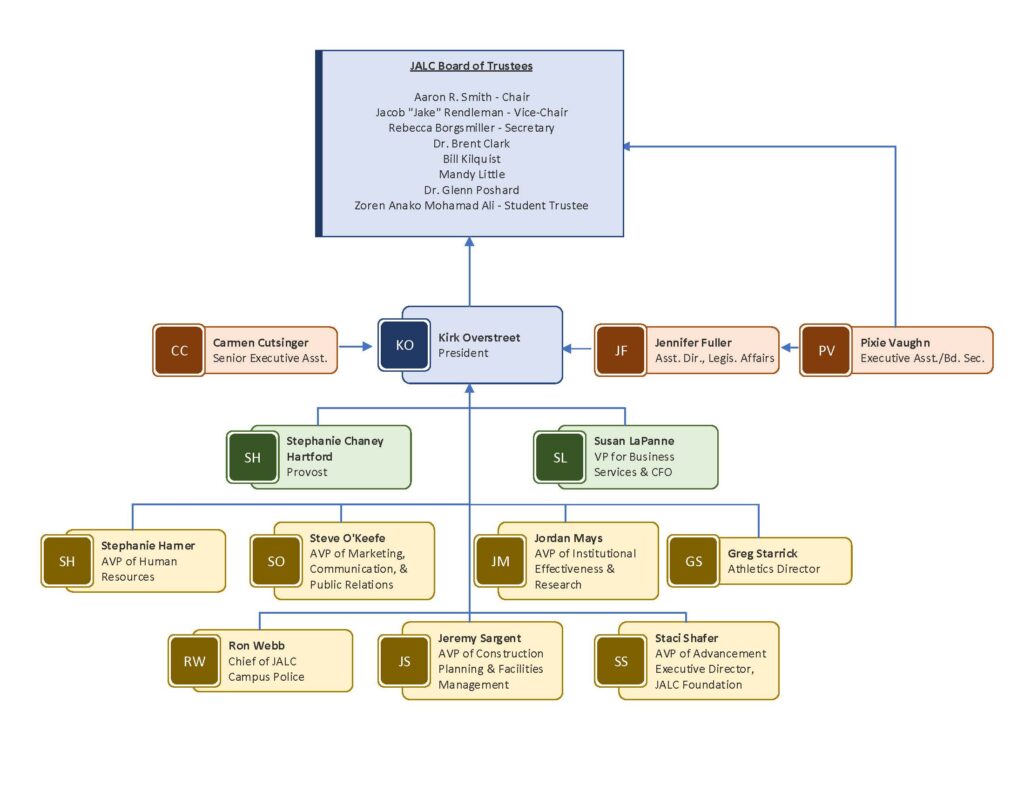

  • AMENDED:               DECEMBER 7, 2015; MARCH 1, 2016; AUGUST 1, 2016; OCTOBER 6, 2016; DECEMBER 12, 2016; APRIL 26, 2017; JULY 31, 2017; MAY 8, 2018; AUGUST 31, 2018; NOVEMBER 1, 2018; APRIL 23, 2019; OCTOBER 1, 2019; JANUARY 23, 2020; DECEMBER 18, 2020; MAY 14, 2021; SEPTEMBER 30, 2021; APRIL 28, 2022; OCTOBER 4, 2024; MAY 29, 2025; Nov. 18, 2025;
  • CROSS REF.:              BOARD POLICY 4120

A. Purpose and Scope
John A. Logan College (“College”) is committed to maintaining a safe, orderly, and effective environment for teaching, learning, research, work, services, and public events. This policy applies to all persons on College‑owned, controlled, or leased property and/or at College‑sponsored activities, including students, employees, contractors, volunteers, visitors, and guests. Conduct expectations are in addition to— and do not replace— obligations under other College policies and applicable law.

B. Core Standard of Conduct (Disruption of Operations)
No person may engage in behavior that materially disrupts, obstructs, or interferes with the operations of the College—academic or otherwise—including instruction, College business processes, events, or services. Examples include, but are not limited to: (1) willful interference with classes, offices, public meetings, or events; (2) refusal to comply with lawful directives of authorized College officials issued to maintain order or safety.

C. Immediate Response and Removal from Campus

  1. Authority. When an individual’s conduct materially disrupts College operations or creates a reasonable threat to safety or order, authorized College officials may direct the individual to cease the behavior, relocate, or immediately leave the area or campus. Failure to comply may result in removal and issuance of a trespass warning under Illinois law.
  2. Event and Facility Enforcement. For events or facility use, enforcement may include verbal warnings and removal/denial of further access to the event or premises consistent with College policies/procedures.
  3. Limitations. Immediate removal is an interim measure to restore safety and operations and does not replace applicable student conduct, employee, or other guest/visitor due‑process procedures described in Section E.

D. Lawful Directives; Identification
Individuals must comply with lawful directives of College officials (including Campus Police) made to preserve safety or operations, and must present identification when reasonably requested in connection with a safety or conduct matter. Failure to comply may constitute disruption of operations and may lead to removal and referral to the appropriate process. [110 ILCS 805/3‑42.1.]

E. Referrals, Due Process, and Sanctions

  1. Students. Alleged violations by students will be referred to the Student Code of Conduct process. Interim measures (including interim suspension or no‑contact directives) may be issued where necessary to preserve safety or academic operations, consistent with Title IX/Clery where applicable.
  2. Employees. Alleged violations by employees will be addressed under applicable College policies, contracts/collective bargaining agreements, and procedures.
  3. Visitors/Guests. Non‑affiliated individuals may be subject to removal, trespass notice, and future access restrictions as warranted under Illinois law.

F. Free Speech; Time, Place, Manner
Nothing in this procedure restricts lawful expressive activity. The College may impose content‑neutral time, place, and manner restrictions narrowly tailored to significant College interests (safety, order, uninterrupted instruction/operations), while leaving open ample alternative channels of communication.

G. Non‑Discrimination; Accommodations
Enforcement of this policy shall be non‑discriminatory and consistent with the Americans with Disabilities Act (ADA) Title II and Section 504 of the Rehabilitation Act, including reasonable modifications and auxiliary aids unless doing so would fundamentally alter College programs/activities or pose undue burden.

H. Safety, Title IX, and Clery Compliance
Conduct involving violence, threats, harassment, or sex discrimination will be addressed under applicable College policies/procedures, including Title IX and the Clery Act, as required.

I. Whistleblower Protection; No Retaliation
Nothing in this policy shall be construed to retaliate against individuals who, in good faith, report violations or participate in investigations under the College’s fraud prevention/whistleblower protections or other protected‑activity laws.

J. Safety and Enforcement:

  • The JALC Department of Public Safety shall monitor activities.
  • Failure to comply will result in removal under trespassing or campus conduct policies.

Additional Notes

  • This procedure does not restrict spontaneous lawful expression in other public areas, provided it remains non-disruptive to institutional duties or operations.

  • Adopted:         March 31, 2026     
  • Amended:            
  • Reviewed:        March 30, 2026     
  • Legal Ref.:       Illinois Public Community College Act — Campus Police Authority: 110 ILCS 805/3‑42.1.; Criminal Trespass: 720 ILCS 5/21‑5 (State‑supported land); 720 ILCS 5/21‑3 (real property); First Amendment (time, place, manner): Ward v. Rock Against Racism, 491 U.S. 781 (1989); Title IX: 20 U.S.C. § 1681; 34 C.F.R. pt. 106; Clery Act: 20 U.S.C. § 1092(f); 34 C.F.R. § 668.46; ADA Title II: 42 U.S.C. § 12132; 28 C.F.R. pt. 35; Section 504: 29 U.S.C. § 794; 34 C.F.R. pt. 104;
  • Cross Ref.:       Board Policies 3610, 3373, 4310, 4315, 4320, 4321, 4330, 7210, 8310; Administrative Procedures 306

Purpose and Scope

The purpose of this procedure is to establish guidelines for the John A. Logan College (JALC) Department of Public Safety (DPS) to ensure compliance with applicable Illinois and federal laws. This procedure outlines the authority, responsibilities, and operational expectations of DPS, which encompasses both sworn police officers and campus security officers, to maintain a safe and secure environment for the college community.

Establishment and Authority

  • Creation of the Department
    • John A. Logan College establishes the Department of Public Safety (DPS) to provide law enforcement, security, and public safety services for the campus and college-controlled property. DPS is comprised of sworn law enforcement officers and non‑sworn campus security officers.
  • Sworn Police Officers
    • Sworn police officers appointed within DPS shall have the powers of police officers in cities and sheriffs in counties, including the authority to enforce state statutes and applicable local ordinances and to make arrests within the community college district, as authorized by the Illinois Public Community College Act (110 ILCS 805/3-42.1) and the Illinois Police Training Act (50 ILCS 705).
  • Campus Security Officers
    • Campus security officers are non‑sworn personnel who provide security, patrol, access control, safety monitoring, and related support services. Campus security officers do not possess arrest powers beyond those granted to private persons under Illinois law.


Oath of Office Administration

Pursuant to the authority granted under the Illinois Public Community College Act (110 ILCS 805/3-42.1) and the Illinois Oath of Office Act (5 ILCS 255/1), all individuals appointed as sworn police officers within the Department of Public Safety at John A. Logan College shall be required to take and subscribe to a written official oath of office prior to assuming their duties. The oath will be received and approved by the President, and filed in Human Resources.
 
Compliance with Illinois and Federal Law

  • Training and Certification:
    • Sworn police officers within DPS shall meet the minimum basic training and certification requirements under the Illinois Police Training Act and the Illinois Law Enforcement Training Standards Board. Officers authorized to carry firearms must complete all required firearms and use‑of‑force training.
    • Campus security officers within DPS shall complete the required basic security training mandated by the Illinois Department of Financial and Professional Regulation or other training approved by the College. Such training shall be completed within the timeframe established by applicable law or College standards.
  • Continuing Education:
    • Law enforcement officers and non-law enforcement officers shall participate in ongoing training and professional development to stay current with changes in Illinois and federal laws, law enforcement techniques, and best practices.
  • Use of Force:
    • The use of force by officers within the Department of Public Safety shall comply with applicable Illinois and federal laws, including the Illinois Use of Force in Law Enforcement Act and relevant federal statutes. Officers shall receive training on the proper use of force and de-escalation techniques.
  • Civil Rights and Non-Discrimination:
    • The Department of Public Safety shall uphold the civil rights of all individuals and ensure non-discriminatory practices in all interactions. Officers shall receive training on civil rights, cultural competency, and implicit bias to promote fair and equitable treatment of all members of the college community.

Operational Procedures

  • Patrol and Security:
    • The Department of Public Safety shall provide patrol, security, and public safety services for the campus. Services may be performed by sworn police officers, campus security officers, or a combination thereof, depending on operational needs and staffing.
  • Incident Reporting and Investigation:
    • All incidents, including crimes, accidents, and emergencies, shall be promptly reported and thoroughly investigated by the Department of Public Safety. Reports shall be documented and maintained in accordance with Illinois and federal laws.
  • Collaboration with External Agencies:
    • The Department of Public Safety shall collaborate with local, state, and federal law enforcement agencies to enhance campus safety and ensure compliance with applicable laws.
  • Community Engagement:
    • The Department of Public Safety is committed to community-oriented policing and shall engage with students, faculty, and staff to build trust and foster a safe and inclusive campus environment.

Accountability and Oversight

  • Internal Review and Audits:
    • The Department of Public Safety shall conduct regular internal reviews and audits to ensure compliance with this policy and applicable laws. Any deviations or violations shall be addressed promptly.
  • External Oversight:
    • The Department of Public Safety shall be subject to oversight by the college administration and relevant external regulatory bodies to ensure accountability and transparency.
  • Complaint and Grievance Procedures:
    • The Department of Public Safety shall establish procedures for individuals to file complaints or grievances regarding officer conduct. Complaints shall be investigated promptly and thoroughly, and appropriate actions shall be taken based on the findings.

  • Adopted:              September 24, 2025
  • Amended:            May 15, 2026
  • Reviewed:            September 3, 2025; April 1, 2026
  • Legal Ref.:           110 ILCS 805/3-42.1; 775 ILCS 5/1-101; 720 ILCS 5/7-5; 50 ILCS 705/8.1; 20 U.S.C. § 1092(f); 20 U.S.C. § 1681; Crime Awareness and Campus Security Act of 1990; 5 ILCS 255/1
  • Cross Ref.:          Administrative Procedures 410, 412, 413, 414a-d, 415
  1. Purpose and Scope
    This Procedure establishes a clear, lawful, and uniform process under Illinois jurisdiction by which the JALC Department of Public Safety (“DPS”) may provide copies of police incident reports and traffic accident reports (each, a “Report”) directly to individuals involved in the underlying incident, without requiring the requester to submit a request under the Illinois Freedom of Information Act, 5 ILCS 140/1 et seq. (“FOIA”), while maintaining privacy protections, applying required redactions, and preserving all FOIA exemptions for any later public request.
  2. Authority; Relationship to FOIA; No Waiver
    • 1. DPS may, consistent with Illinois law and applicable privacy and safety considerations, provide a Report to an involved party outside the FOIA process because FOIA governs public access to records and does not limit Campus Police from providing records to persons with a direct involvement or legally recognized authorization.
    • 2. Notwithstanding any direct release under this Procedure, DPS shall continue to apply all applicable exemptions and protections recognized under FOIA, including those reflected in 5 ILCS 140/7, through redaction or withholding as appropriate.
    • 3. A release under this Procedure (a) is not a FOIA response, (b) shall not be treated as a public disclosure, and (c) shall not waive, narrow, or impair any FOIA exemption, privilege, or lawful basis for redaction or withholding in response to any subsequent FOIA request by any person.
  3. Eligible Recipients (Direct Release Without FOIA)
    Subject to verification and redaction requirements in this Procedure, Campus Police may release a Report directly to the following (each, an “Eligible Recipient”):
    • 1. Any individual expressly named in the Report, including a victim, driver, arrestee, complainant, or other identified involved person.
    • 2. A parent or legal guardian of an involved minor, but only to the extent the parent or legal guardian’s status is verified and the release does not unlawfully disclose information about other juveniles or protected persons.
    • 3. An insurance representative, but only upon receipt of written authorization executed by an involved party who is an Eligible Recipient under Section 3.1.
    • 4. An attorney or other agent, but only upon receipt of written authorization executed by an involved party who is an Eligible Recipient under Section 3.1.
  4. Verification; Conditions Precedent to Release
    DPS shall not release any Report under this Procedure unless and until the requester’s identity and eligibility are verified. Verification shall be completed using at least one of the following methods, as applicable:
    • 1. In-person presentation of a valid government-issued photo identification.
    • 2. Secure electronic verification through an authenticated JALC student/staff portal process or authenticated email process reasonably designed to confirm the requester’s identity.
    • 3. Written authorization from an involved party who is an Eligible Recipient, together with identification sufficient to verify the identity of the requesting representative (e. g. , attorney, agent, or insurance representative).
  5. Reports and Materials Eligible for Release; Minimum Necessary
    Subject to redaction and withholding under this Procedure, DPS may release the following components of a Report file to an Eligible Recipient: (a) the incident or accident report form; (b) officer narratives; and (c) diagrams and basic attachments customarily included with the Report. DPS may limit the release to the minimum necessary portions reasonably required for the Eligible Recipient’s informational purpose and may withhold attachments not reasonably necessary to that purpose where lawful to do so.
  6. Mandatory Redactions and Protected Information
    • 1. DPS shall redact or withhold information as required by law and consistent with FOIA privacy and safety standards, even when releasing to an Eligible Recipient, unless a court order specifically requires disclosure of the protected information.
    • 2. Without limiting Section 6.1, Campus Police shall redact, at a minimum, the following categories to the extent they appear in the materials being released and are not required to be disclosed by court order:
      • 1. Driver’s license numbers.
      • 2. Home addresses where disclosure poses a safety risk (as determined under Section 7.2).
      • 3. Dates of birth (a partial date of birth may be used if reasonably necessary for identification and lawful to provide).
      • 4. Personal phone numbers of third parties.
      • 5. License plate numbers and vehicle identification numbers (VINs) of other individuals not covered by the requester’s eligibility.
      • 6. Insurance policy numbers and claim numbers.
      • 7. Information identifying juveniles, except that a verified parent or legal guardian may receive juvenile-identifying information solely as to their own minor, subject to any additional legal restrictions.
  7. Redaction Standard; Safety-Based Discretion; Not a FOIA Response
    • 1. Redactions under this Procedure shall be consistent with (a) Campus Police redaction practices used in FOIA responses, and (b) Illinois FOIA privacy standards, as applied to the context of a direct release to an Eligible Recipient.
    • 2. The Chief of DPS or the Chief’s designee may apply additional redactions or withhold discrete portions of a Report when the Chief or designee reasonably determines that disclosure would create a safety risk or would unlawfully disclose protected information.
    • 3. Redaction and release under this Procedure shall not convert the release into a FOIA response and shall not create any precedent for the scope of disclosure in response to a FOIA request.
  8. Documentation of Release (Internal Recordkeeping)
    Each direct release under this Procedure shall be documented internally by addendum or log entry consistent with JALC’s Administrative Procedure Manual. The documentation shall include, at a minimum:
    • 1. The name of the requesting party.
    • 2. The requester’s relationship to the incident and the eligibility category relied upon (Section 3).
    • 3. The date of release and method of delivery (Section 9).
    • 4. The staff member authorizing and completing the release.
    • 5. A brief description of redactions applied and/or materials withheld (if any).
  9. Delivery Methods; Security; No Unauthorized Redistribution
    DPS may deliver Reports under this Procedure only by the following methods:
    • 1. In person, by paper copy.
    • 2. Secure email, as a password-protected PDF transmitted to an authenticated email address.
    • 3. Certified mail or other tracked mail service. Reports released under this Procedure shall not be posted publicly and shall not be sent to third parties absent verified written authorization from an involved party who is an Eligible Recipient, or as otherwise required by law.
  10. FOIA Coordination Safeguards; Escalation
    • 1. If a request for a Report is made by a person who is not an Eligible Recipient, DPS shall refer the requester to the JALC FOIA Officer for processing under FOIA.
    • 2. If any requester demands an “unredacted” Report, DPS shall deny that request and shall advise that applicable FOIA exemptions and privacy/safety protections continue to apply and will be enforced through redaction and/or withholding as required.
    • 3. Questions regarding broader disclosure, unusual requests, disputes regarding eligibility, or uncertainty regarding redactions shall be escalated to the FOIA Officer prior to release.
  11. Required Disclaimer on Released Reports
    DPS shall include the following disclaimer on each Report released under this Procedure (e. g. , on the first page or cover page): “This report is provided to an individual involved in the incident for informational purposes. Release under this procedure does not constitute a public disclosure under the Illinois Freedom of Information Act.”

  • Adopted:              May 15, 2026
  • Amended:            
  • Reviewed:            
  • Legal Ref.:          5 ILCS 140/1 et seq. – Illinois Freedom of Information Act 5 ILCS 140/7 – Illinois FOIA Exemptions (Privacy and Law Enforcement) 110 ILCS 805/1-1 et seq. – Illinois Community College Act 705 ILCS 405/1-1 et seq. – Illinois Juvenile Court Act 50 ILCS 205/1 et seq. – Illinois Local Records Act 725 ILCS 5/100-1 et seq. – Illinois Code of Criminal Procedure (Law Enforcement Authority) 20 U.S.C. § 1232g; 34 C.F.R. Part 99 – Family Educational Rights and Privacy Act (FERPA) 20 U.S.C. § 1092(f) – Jeanne Clery Disclosure of Campus Security Policy and Campus Crime Statistics Act 23 Ill. Adm. Code Part 1501 – Illinois Community College Board Administrative Rules
  • Cross Ref.:           Administrative Procedure 340, 405

Purpose

To implement the Board’s policy on building access and security by defining operational hours, access protocols, and the management of physical and electronic access tools in compliance with federal and state mandates.

Scope

This procedure applies to all John A. Logan College employees, students, contractors, and visitors who require access to campus buildings and facilities.

Campus Hours & Location Access

  • MainCampus Hours refer to the designated timeframes during which common public areas and primary entrances of John A. Logan College are accessible to students, employees, contractors, and visitors. These hours are established to promote safe and efficient access to campus facilities while maintaining operational control and security.
  • JALC’s Main Campus hours are 6:00 a.m. to 10:00 p.m. Monday through Friday. Weekend hours are 9:00 a.m. to 5:00 p.m. Saturday and Sunday. On most observed holidays, the campus is closed.
  • Access outside of Main Campus Hours is restricted and requires written approval from the appropriate dean/director or above, and/or the President.
  • Emergency access must be coordinated through Campus Police (618-985-5550).
  • During Main Campus Hours:
    • Public access is permitted to general-use buildings (e.g., Buildings A–F), hallways, restrooms, and designated gathering spaces.
    • Entrances and exterior doors are electronically unlocked and monitored by Campus Safety systems.
    • Campus Police are available for emergency coordination and access support.

Security Measures

  • Unauthorized access or tampering with locks or security systems is grounds for disciplinary action.
  • JALC Department of Public Safety conducts routine patrols and responds to access-related incidents.

  • Adopted:              March 27, 2026
  • Amended:            
  • Reviewed:            
  • Legal Ref.:          Clery Act (20 USC § 1092(f)); Illinois Campus Security Enhancement Act (110 ILCS 12/); ICCB Administrative Rules (23 Ill. Adm. Code § 1501.116)
  • Cross Ref.:           Administrative Procedure 406

Purpose

To establish a standardized procedure for the issuance, use, and return of physical keys and electronic/networked door lock systems at John A. Logan College (JALC), ensuring secure access control, efficient identification, and alignment with campus-wide safety protocols, including lockdown procedures.

Relationship to Building Access and Security Framework

This procedure operationalizes the building access and security framework established by Administrative Procedure 406 – Building Access and Security.

Access credentials, lock system configurations, access levels, and monitoring activities governed by this procedure shall be issued and managed only in accordance with the access authorizations, operational hours, and approval authorities defined in Administrative Procedure 406.

Nothing in this procedure expands or modifies access rights beyond those authorized under Administrative Procedure 406.

Scope

This procedure applies to all JALC employees, contractors, and authorized visitors who require access to secured areas on campus using either physical keys or ID badge credentials.

Definitions

  • Electric/Networked Lock System: A door locking mechanism controlled electronically and integrated with the campus security network.
  • Physical Key: A mechanical device issued for access to specific campus areas.
  • ID Badge: A college-issued identification card embedded with RFID or magnetic stripe technology used for access control.
  • Key Holder: Any person issued a physical key.
  • Access Level: The classification of access granted based on employment role.
  • Master Key: A key that opens multiple or all locks within a designated area.
  • Lockdown: A security protocol initiated in response to a threat, requiring immediate restriction of movement and access.

Procedures

1. Issuance and Activation

  • ID Badges: Issued by Campus IT upon HR authorization.
  • Physical Keys: Issued by Facilities Department upon HR authorization. A signed Key Agreement Form is required. Keys must be returned upon separation from the College.
  • Security‑Sensitive Access and Background Investigations: In accordance with the Campus Security Enhancement Act, 110 ILCS 12/5, the College identifies certain access privileges as security‑sensitive based on the nature of the facilities, systems, information, or individuals involved.
    • Prior to issuing physical keys, ID badge credentials, or electronic/networked access associated with security‑sensitive areas, the College shall require completion of an appropriate criminal background investigation for any individual, including employees, contractors, vendors, or other authorized personnel, as determined by the College.
    • The designation of security‑sensitive access and the determination of the appropriate level of background investigation shall be made by the College in coordination with Facilities, Campus Safety, Human Resources, and other relevant offices.

2. Access Levels and Employment Classifications

Access is granted based on employment classification:

ClassificationAccess LevelExamples
Executive/AdminFull AccessPresident, Provost, Director
FacultyLimited AccessOffices, classrooms
StaffTask-Based AccessMaintenance, IT, custodial
Temporary/ContractorRestricted AccessSpecific project areas only

Access levels are reviewed and approved by Human Resources.

3. Access Control and Monitoring

  • Entry to secured areas (via badge or key) is logged and monitored by the central security system in compliance with FERPA.
  • Unauthorized access attempts trigger alerts to JALC Department of Public Safety.
  • Badge and key access are reviewed quarterly for compliance and role alignment.

4. Loss, Theft, and Return

  • Lost or stolen badges/keys must be reported immediately to the JALC Department of Public Safety and Facilities for deactivation and incident reporting.
  • Keys and badges must be returned upon termination, role change, or project completion.
  • Failure to return keys or badges may result in disciplinary action or fees.
  • Reissuance is subject to review and may incur charges.

5. Lockdown Integration

  • During a lockdown, all electric locks default to a secure state (locked or unlocked) based on pre-configured emergency protocols in accordance with the Illinois School Safety Drill Act.
  • Department of Public Safety retains override authority to remotely lock or unlock doors.
  • Staff must follow the JALC Emergency Response Plan during lockdowns.

6. Maintenance and Testing

  • Facilities and IT jointly conduct monthly tests of lock systems.
  • Any malfunction must be reported immediately via the Facilities Work Order system.

Responsibilities

  • Department of Public Safety: Oversees system integrity, emergency response, and key/badge incident management.
  • IT Department: Badge issuance, maintains network connectivity and software integration.
  • Facilities Department: Key issuance, physical lock maintenance, and incident reporting.
  • Department Heads: Consult with HR for authorization levels.
  • Human Resources: Maintains job descriptions and authorization levels.

  • Adopted:              September 24, 2025
  • Amended:             March 27, 2026
  • Reviewed:             September 3, 2025; March 9, 2026
  • Legal Ref.:           FERPA – 20 U.S.C. § 1232g; Clery Act – 20 U.S.C. § 1092(f); Illinois Campus Security Act – 110 ILCS 12/; Illinois School Safety Drill Act – 105 ILCS 128/; Identity Protection Act – 5 ILCS 179/; ICCB Administrative Rules – 23 Ill. Adm. Code 1501.116 and 1501.117; State Records Act – 5 ILCS 160/; Occupational Safety and Health Act (OSHA) – 29 U.S.C. § 654; Illinois Administrative Code – Title 29, Part 1500
  • Cross Ref.:          Administrative Procedure 407; JALC Emergency Response Plan; JALC Employee Handbook; JALC Student Handbook

Purpose

To establish clear institutional standards for employment practices, reporting obligations, and coordination with external law enforcement agencies in compliance with Illinois PA 104-0440, and other applicable state and federal laws.

Scope

This procedure applies to all JALC employees, administrators, and contractors engaged in hiring, promotion, discipline, reporting, and campus security operations.

Definitions

  • Protected Characteristics: Race, color, religion, sex, gender identity, sexual orientation, national origin, age, disability, and any other category under Illinois or federal law.
  • Compliance Officer: Administrator responsible for oversight and reporting.
  • Adverse Action: Any employment decision that negatively affects an employee’s status.
  • External Agency: Any law enforcement entity not part of JALC Department of Public Safety.

Procedure Statement

John A. Logan College is committed to fair, transparent, and lawful employment practices and to protecting the rights of students, employees, and visitors during interactions with external law enforcement agencies. Compliance with state and federal law is mandatory and non-negotiable.

What JALC Will Do

  • Ensure Equal Opportunity: All hiring, promotion, and disciplinary decisions will be based on merit and qualifications, free from discrimination.
  • Provide Transparency: Job postings will include clear descriptions of duties, qualifications, and compensation ranges.
  • Maintain Confidentiality: Personal and demographic data collected for compliance will be securely stored and used only for reporting purposes.
  • Conduct Training: Supervisors and HR staff will receive annual training on anti-discrimination laws, reporting obligations, and complaint handling.
  • Report as Required: Submit all mandated reports to state agencies within statutory deadlines.
  • Investigate Complaints Promptly: All allegations of discrimination or retaliation will be investigated in accordance with JALC policy and applicable law.
  • Cooperate with Lawful Investigations: JALC Department of Public Safety will assist external agencies when proper legal authority is presented.

What JALC Will Not Do

  • No Retaliation: JALC will not retaliate against any individual for filing a complaint, participating in an investigation, or exercising rights under the law.
  • No Discriminatory Practices: JALC will not make employment decisions based on protected characteristics.
  • No Unauthorized Data Collection: JALC will not collect personal information beyond what is required for compliance or operational necessity.
  • No Delayed Reporting: JALC will not fail to meet statutory reporting deadlines or conceal required information.
  • No Unauthorized Access: JALC Department of Public Safety will not permit searches, seizures, or interviews without proper legal authority.
  • No Expansion of Obligations: JALC will not impose requirements beyond those mandated by law unless required by ICCB or federal regulations.

Employment and Reporting

  • Policy Review and Updates: Office of Legislative Affairs shall review legislative changes annually and updates procedures.
  • Hiring and Promotion: HR shall ensure postings and selection processes comply with equal opportunity standards.
  • Training: Mandatory annual compliance training for supervisors and HR staff.
  • Complaint Handling: Complaints are logged, investigated, and resolved per JALC complaint and grievance procedures.
  • Reporting: College shall prepare and submit reports to state agencies; copies retained for five years.
  • Audit: Annual internal audit of employment practices and reporting compliance.

Coordination with External Law Enforcement Agencies

  • Verification of Legal Authority: JALC Department of Public Safety shall request ID and credentials, verify legal documents.
  • With Legal Documents: JALC shall cooperate fully, provide access as required by law, and document all interactions.
  • Without Legal Documents: College will deny access, explain legal requirements, and protect rights.
  • Emergency Situations: JALC Department of Public Safety will allow intervention if imminent threat exists; notify the President’s Office immediately.
  • Notification and Documentation: Department of Public Safety shall log all interactions with external law enforcement and report to the JALC President’s Office within 24 hours.
  • Student and Employee Rights: College shall ensure constitutional and statutory rights are protected.

Immigration Enforcement Response Procedures

A. Initial Response to Immigration Officials

  • Upon arrival of U.S. Immigration and Customs Enforcement (ICE), Customs and Border Protection (CBP), or other immigration officials at any JALC facility:
    • Politely instruct the official to wait while the designated JALC official (Chief of Police) is contacted.
  • Staff Script for Encounters:
    • “I am required to contact our Chief of Police before proceeding.”
    • “Please have a seat; someone will speak with you shortly.”
  • Legal Counsel:
    • JALC Police Department must coordinate with the College President (or designee), and consult college legal counsel when responding to any warrant or request for information.

B. Website and Community Communication

  • The College website shall include:
    •  contact information for the Chief of Police, who is responsible for immigration enforcement inquiries.
    • Immigration enforcement resources, including links to guidance on constitutional rights and external support organizations.
  • In the event of immigration enforcement activity that may impact campus safety or operations, JALC Administration will coordinate with the Department of Public Safety to determine appropriate notification to affected areas or the broader College community.

D. Consent and Notification Procedures

  • Unless prohibited by a judicial warrant, court order, or subpoena, JALC will:
    • Notify the student or employee of any request for information or access.
    • Provide the individual with a copy of the legal document received.
    • Obtain written consent before releasing protected information, unless otherwise required by law.

E. Post-Encounter Documentation

  • After any encounter with immigration enforcement officials, the JALC Department of Public Safety shall:
    • Complete the External Agency Interaction Log (Appendix A), specifically noting immigration enforcement as the agency type.
    • Attach copies of all legal documents received.
    • Submit the completed log to the JALC Executive Council within 24 hours.
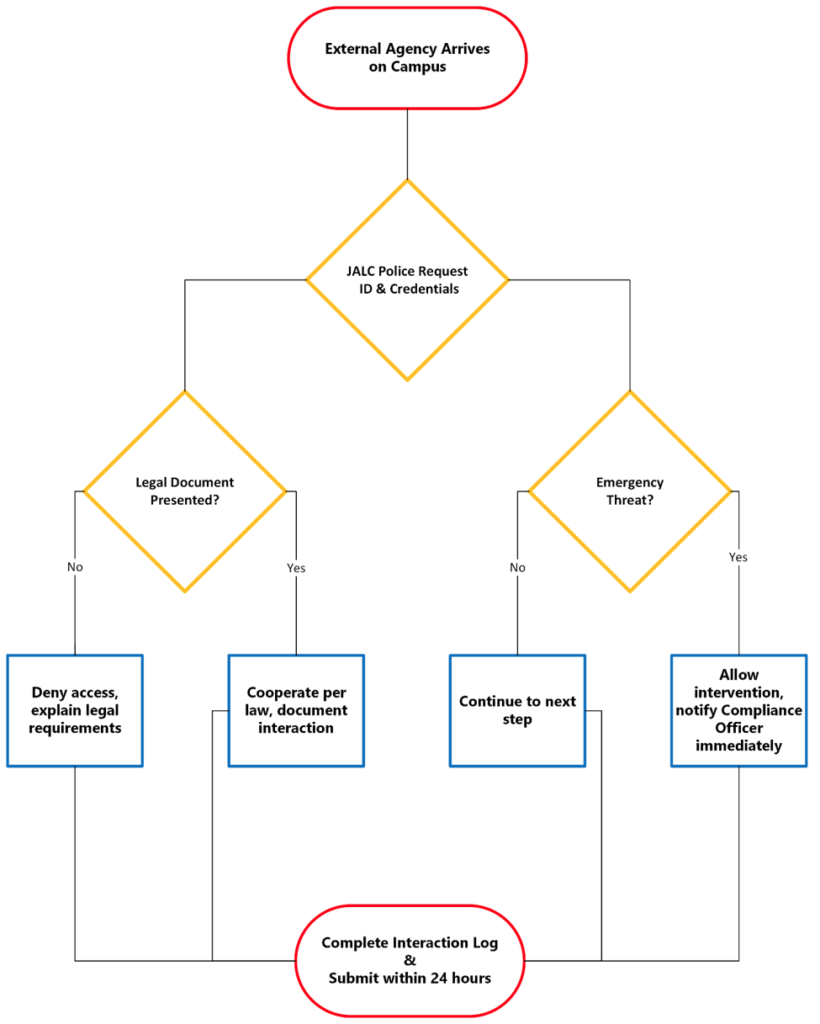
F. Training

  • Annual training for staff, HR, and Department of Public Safety shall include:
    • Procedures for responding to immigration enforcement.
    • Legal requirements and rights of students and employees.

Emergency Protocols

In the event of an imminent threat to life, safety, or property:

  • Immediate Action: JALC Department of Public Safety may permit external law enforcement to act without prior verification if delay endangers lives.
  • Notification: JALC Department of Public Safety must notify the College Executive Council immediately.
  • Documentation: JALC Department of Public Safety shall complete a full report within 24 hours.
  • Student and Employee Safety: College will follow evacuation, shelter-in-place, or lockdown procedures.

Confidentiality Notices

  • Student Records: No release without consent or valid subpoena (FERPA compliance).
  • Employee Records: Disclose pursuant to applicable state and federal law.

  • Adopted: December 11, 2025             
  • Amended:            
  • Reviewed:            December 10, 2025
  • Legal Ref.:          Illinois PA 104-0440; Illinois Human Rights Act – 775 ILCS 5/1-101 et seq.; Illinois Freedom of Information Act (FOIA) – 5 ILCS 140/1 et seq.; Illinois Campus Security Enhancement Act – 110 ILCS 12/1 et seq.; Illinois Community College Act – 110 ILCS 805/1-1 et seq.; Illinois Criminal Code (Search and Seizure) – 725 ILCS 5/100-1 et seq.; Illinois Student Records Act – 105 ILCS 10/1 et seq.; Family Educational Rights and Privacy Act (FERPA) – 20 U.S.C. § 1232g; 34 C.F.R. Part 99; Title IX of the Education Amendments of 1972 – 20 U.S.C. § 1681 et seq.; 34 C.F.R. Part 106; Jeanne Clery Disclosure of Campus Security Policy and Campus Crime Statistics Act – 20 U.S.C. § 1092(f); Americans with Disabilities Act (ADA) – 42 U.S.C. § 12101 et seq.; Civil Rights Act of 1964, Title VII – 42 U.S.C. § 2000e et seq.; Illinois Community College Board (ICCB) Rules – 23 Ill. Adm. Code Part 1501; Illinois Law Enforcement Training and Standards Board Rules – 20 Ill. Adm. Code Part 1720; Illinois Department of Human Rights Rules – 56 Ill. Adm. Code Part 2520; OSHA Workplace Safety Standards – 29 C.F.R. Part 1910; U.S. Department of Education Regulations – 34 C.F.R. Parts 99 & 106
  • Cross Ref.:           BP 4315 / AP 405; BP 3640 / AP 340; BP 3630 / AP 415; BP 3373 / AP 337; AP 360; AP 361; AP 362 ; AP 414D; AP 414C; AP 832; AP 841;

Purpose: To record all interactions between JALC Campus Police and external law enforcement agencies.

Instructions:

  • Complete immediately after interaction.
  • Attach copies of any legal documents.
  • Submit to JALC Executive Council within 24 hours.
Date/Time 
Agency Name 
Officer Name/ Badge Number 
Was a legal document presented?  Yes                                                                  No
What type of document?   
Action taken:   
JALC DPS Officer: 
Notes: 

To reduce risks associated with the removal of a student, guest, or employee due to the suspension or termination of status, the Vice President or Assistant Provost in charge of the suspension or termination will notify the Campus Police Department. The Vice President or Assistant Provost will assess the risk level associated with the suspension or termination, and the Campus Police Department will provide armed officers if their presence is judged to provide a safer environment for the suspension or termination. Campus Police Officers have the authority to search the individual’s belongings for weapons. The Vice President or Assistant Provost in charge of the suspension or termination has the authority to determine if the individual will be allowed to remove their own personal belongings or if they will be delivered by some other means.

If an individual is banned from the campus, written notice from the President or Provost will be served to the individual in person or by First Class mail to their last known address. The written notice shall clearly identify the banned person and shall notify them that their unauthorized presence on campus will be considered criminal trespass. A copy of the written notice, a report of the circumstances leading to the ban, and (if available) a photograph and vehicle information shall be provided to the Campus Police Department.


  • Adopted:              December 18, 2013
  • Amended:             May 24, 2023; August 1, 2024 (Former AP 361)
  • Reviewed:
  • Legal Ref.:
  • Cross Ref.:          Board Policy 3615, 4321, 5225, 8315

In accordance with Board Policy 4320, and in compliance with state and federal law, John A. Logan College establishes these procedures prohibiting sex discrimination:

414A:                  Violence Against Women Act                                                                  

414B:                   The Jeanne Clery Campus Safety Act

414C:                   Illinois Human Rights Act

414D:                  Title IX

414E:                   Stop Campus Hazing Act


  • Adopted:              August 1, 2024
  • Amended:            June 2, 2025
  • Reviewed:
  • Legal Ref.:           Violence Against Women Act (VAWA): 34 U.S.C. § 12291 et seq.; Jeanne Clery Disclosure of Campus Security Policy and Campus Crime Statistics Act (Clery Act), 20 U.S.C. § 1092(f); Preventing Sexual Violence in Higher Education Act (110 ILCS 155); Illinois Human Rights Act (775 ILCS 5/1-101); Title IX of the Education Amendments of 1972 (20 U.S.C. §§ 1681 et seq.); FEDERAL STOP CAMPUS HAZING ACT (34 U.S.C. §§ 12401–12406 (ADDED AS PART OF THE NATIONAL DEFENSE AUTHORIZATION ACT FOR FY 2023)); ILLINOIS STOP CAMPUS HAZING ACT (110 ILCS 22/1 ET SEQ.);
  • Cross Ref.:          Board Policy 4320

I. Purpose

The purpose of this administrative procedure is to ensure John A. Logan College (JALC) complies with the Violence Against Women Act (VAWA) and other relevant laws. The procedure establishes a framework for the prevention, reporting, investigation, and resolution of incidents involving sexual assault, domestic violence, dating violence, and stalking within the college community.

II. Scope

This procedure applies to all employees, students, faculty, applicants for admission or employment, and third parties engaged in any college-related activity. It covers:

  • Incidents occurring on college property or at college-sponsored programs
  • Off-campus incidents that impact the college community
  • Online conduct that creates a hostile learning or working environment

III. Reporting Procedures

  1. Reporting Options
    • 1. Emergency reporting for immediate threats to safety by calling 911 or Campus Police at (618) 985-5550.
    • 2. Formal and anonymous reporting through the Report A Concern form on the JALC website.
    • 3. Confidential reporting to designated Confidential Employees or off-campus crisis centers such as The Survivor Empowerment Center (Hotline: 800-334-2094).
      • For Students:
        • Call the Student Success Center at (618) 985-2828 ext. 8289 and ask to speak with a confidential employee or mental health counselor.
        • Visit the Student Success Center in Office C219 and ask to speak with a confidential employee or mental health counselor.
        • Email the College’s mental health counselor at donaldwinget@jalc.edu.
        • Call the Survivor Empowerment Center at 1-800-334-2094.
      • For Employees and All Other Individuals:
        • Call the Assistant Vice President of Human Resources at (618) 985-2828 ext. 8473.
        • Email the Assistant Vice President of Human Resources at stephanieharner@jalc.edu.
        • Call the Survivor Empowerment Center (Hotline: 800-334-2094).
    • 4. Reporting incidents to local law enforcement (including, but not limited to: Campus Police, Carterville Police, or the Williamson County Sheriff’s Office) in addition to, or instead of, campus reporting.
  2. Institutional Response to Reports
    • The Title IX Coordinator will assess reports and initiate appropriate processes.
    • Supportive measures will be provided to protect victims while ensuring fairness for all parties.
    • If necessary, emergency removal or administrative leave may be enacted based on an individualized safety and risk analysis.

IV. Prevention & Training

JALC is committed to preventing violence through:

  1. Education & Awareness Programs
    • Annual training on consent, bystander intervention, and risk reduction for students and employees.
  2. Training for Staff & Security Personnel
    • Survivor-centered and trauma-informed response training for those involved in reporting and investigations.
  3. Campus Climate Assessments
    • Regular surveys (at least every two years) to evaluate the effectiveness of policies and awareness efforts.

V. Grievance & Disciplinary Procedures

JALC follows a fair and impartial investigation process with:

  • Prompt investigation (within 30 business days, unless extended for good cause).
  • Equal rights for complainants and respondents, including the ability to present evidence and have an advisor.
  • Decision based on a preponderance of the evidence standard (more likely than not).
  • Possible disciplinary actions, including expulsion for students or termination for employees if found responsible.

VI. Retaliation

The Violence Against Women Act (VAWA) prohibits retaliation against individuals who seek or exercise VAWA protections, including those who testify, assist, or participate in VAWA matters. In addition, JALC Board Policy Administrative Procedure provide penalties up to and including termination and/or removal from campus for those who engage in retaliation.

VII. Victim Rights & Supportive Measures

JALC provides victim-centered support including:

  • Medical & mental health services (on-campus counseling and local hospitals with forensic exam services).
  • Academic accommodation (e.g., schedule changes, excused absences).
  • Protection from retaliation for reporting or participating in an investigation.
  • No-contact orders and campus safety measures as needed.

VIII. Clery Act Compliance

  • The Annual Security Report (ASR) includes VAWA crime statistics, prevention efforts, and victim rights.
  • Timely warnings may be issued if an ongoing threat to campus safety exists.

IX. Contact Information


  • Adopted:             August 1, 2024
  • Amended:           September 27, 2024; June 2, 2025
  • Reviewed:          
  • Legal Ref.:          Violence Against Women Act (VAWA): 34 U.S.C. § 12291 et seq.; Clery Act: 20 U.S.C. § 1092(f); Illinois Preventing Sexual Violence in Higher Education Act: 110 ILCS 155
  • Cross Ref.:        Board Policy 4320 (Title IX and Sexual Harassment)

I. Purpose

The purpose of this administrative procedure is to ensure John A. Logan College (JALC) complies with the Jeanne Clery Disclosure of Campus Security Policy and Campus Crime Statistics Act (Clery Act) by:

  • Enhancing campus safety through crime reporting, prevention programs, and timely notifications.
  • Ensuring transparency in campus crime statistics and security procedures.
  • Providing resources and support to victims of crimes, including sexual violence, dating violence, domestic violence, and stalking.

II. Scope

This procedure applies to all members of the JALC community, including students, faculty, staff, visitors, and third parties on campus or engaged in college-affiliated activities. It covers:

  • Crimes occurring on-campus, in on-campus housing, on public property adjacent to campus, and in non-campus buildings or properties controlled by the college.
  • Emergency situations requiring immediate public safety intervention.
  • Violations of the Violence Against Women Act (VAWA), including sexual assault, dating violence, domestic violence, and stalking.

III. Reporting Procedures

  1. Reporting Options
    • 1. Emergency reporting for immediate threats to safety by calling 911 or Campus Police at (618) 985-5550.
    • 2. Formal and anonymous reporting through the Report A Concern form on the JALC website.
    • 3. Confidential reporting to designated Confidential Employees or off-campus crisis centers such as The Survivor Empowerment Center (Hotline: 800-334-2094).
      • For Students:
        • Call the Student Success Center at (618) 985-2828 ext. 8289 and ask to speak with a confidential employee or mental health counselor.
        • Visit the Student Success Center in Office C219 and ask to speak with a confidential employee or mental health counselor.
        • Email the College’s mental health counselor at donaldwinget@jalc.edu.
        • Call the Survivor Empowerment Center at 1-800-334-2094.
      • For Employees and All Other Individuals:
        • Call the Assistant Vice President of Human Resources at (618) 985-2828 ext. 8473.
        • Email the Assistant Vice President of Human Resources at stephanieharner@jalc.edu.
        • Call the Survivor Empowerment Center (Hotline: 800-334-2094).
    • 4. Reporting incidents to local law enforcement (including, but not limited to: Campus Police, Carterville Police, or the Williamson County Sheriff’s Office) in addition to, or instead of, campus reporting.


IV. Timely Warnings & Emergency Notifications

  • A. Timely Warning Notices (Crime Alerts)
    • Issued for Clery Act crimes posing a serious or ongoing threat to the campus community.
    • Warnings are sent via:
      • JALC email & text alerts
      • Campus website & social media
      • Flyers & digital campus signage
  • B. Emergency Notifications
    • Issued for immediate threats (e.g., active shooter, severe weather, gas leaks, infectious disease outbreaks).
    • Emergency alerts will include:
      • Nature of the threat
      • Safety instructions
      • Updates as needed

V. Annual Security Report (ASR) Compliance

JALC will publish an Annual Security Report (ASR) by October 1 each year, containing:

  • Crime statistics for the past three years (on-campus, on public property near campus, and in non-campus facilities).
  • Campus security policies and procedures, including:
    • Reporting crimes
    • Prevention programs
    • Victim rights & resources
    • Disciplinary procedures for sexual misconduct and VAWA-related offenses
  • Drug & alcohol abuse prevention policies

The ASR is:

  • Available online via the JALC website.
  • Distributed to all students & employees via email.
  • Provided to prospective students & employees upon request.

VI. Prevention & Awareness Programs

JALC will implement ongoing prevention programs to educate students and employees on:

  • Campus safety & crime prevention
  • Bystander intervention techniques
  • Consent, healthy relationships, & sexual violence prevention
  • Alcohol & drug awareness

VII. Rights & Resources for Victims of Crime

Victims of sexual assault, dating violence, domestic violence, or stalking will receive:

  • Access to counseling & crisis support (on-campus and off-campus services).
  • Assistance in changing academic, housing, transportation, or work arrangements.
  • Protective measures (e.g., campus no-contact orders).
  • Information on legal rights & law enforcement reporting options.

VIII. Recordkeeping & Compliance Oversight

The Title IX Coordinator & Campus Police will:

  • Maintain Clery crime logs (available for public review).
  • Conduct annual security audits to ensure compliance.
  • Coordinate with local law enforcement on crime statistics.

IX. Contact Information


  • Adopted:             August 1, 2024
  • Amended:           September 27, 2024; June 2, 2025
  • Reviewed:
  • Legal Ref.:           Jeanne Clery Disclosure of Campus Security Policy and Campus Crime Statistics Act (Clery Act), 20 U.S.C. § 1092(f); Violence Against Women Act (VAWA), 34 U.S.C. § 12291 et seq.; Preventing Sexual Violence in Higher Education Act (110 ILCS 155)
  • Cross Ref.:        Board Policy 4320

I. Purpose

This procedure ensures that John A. Logan College (JALC) complies with the Illinois Human Rights Act (IHRA) by:

  • Prohibiting discrimination, harassment, and retaliation based on protected characteristics.
  • Establishing clear reporting, investigation, and resolution procedures for discrimination complaints.
  • Promoting equal access to education and employment opportunities free from bias.
  • Providing training and education on rights and responsibilities under IHRA.

II. Scope

This procedure applies to all JALC employees, students, applicants, contractors, and visitors and covers discrimination in:

  • Admissions and enrollment
  • Employment and hiring practices
  • Academic programs and student activities
  • Campus housing and services
  • Any college-sponsored event or program

Protected categories under the Illinois Human Rights Act (775 ILCS 5/1-101) include:

  • Race, color, national origin, ancestry
  • Sex, sexual orientation, gender identity
  • Religion, marital status, pregnancy
  • Disability, age, military status
  • Arrest record, order of protection status
  • Any other protected class under state law

III. Reporting Procedures

  1. Reporting Options
    • 1. Emergency reporting for immediate threats to safety by calling 911 or Campus Police at (618) 985-5550.
    • 2. Formal and anonymous reporting through the Report A Concern form on the JALC website.
    • 3. Confidential reporting to designated Confidential Employees or off-campus crisis centers such as The Survivor Empowerment Center (Hotline: 800-334-2094).
      • For Students:
        • Call the Student Success Center at (618) 985-2828 ext. 8289 and ask to speak with a confidential employee or mental health counselor.
        • Visit the Student Success Center in Office C219 and ask to speak with a confidential employee or mental health counselor.
        • Email the College’s mental health counselor at donaldwinget@jalc.edu.
        • Call the Survivor Empowerment Center at 1-800-334-2094.
      • For Employees and All Other Individuals:
        • Call the Assistant Vice President of Human Resources at (618) 985-2828 ext. 8473.
        • Email the Assistant Vice President of Human Resources at stephanieharner@jalc.edu.
        • Call the Survivor Empowerment Center (Hotline: 800-334-2094).
    • 4. Reporting to external agencies:
      • Illinois Department of Human Rights (IDHR) | (312) 814-6200 | www.illinois.gov/dhr
      • Equal Employment Opportunity Commission (EEOC) | (800) 669-4000
  • B. College Response to Reports
    • Immediate action will be taken to prevent further discrimination or harassment.
    • The Title IX & Equal Opportunity Coordinator will initiate an impartial investigation.
    • Supportive measures (e.g., schedule changes, campus no-contact orders) will be provided.

IV. Investigation & Resolution Process

  • A. Formal Complaint Process
    • Complaints will be reviewed within 10 business days of submission.
    • The Title IX & Equal Opportunity Office will conduct an investigation within 30 business days.
    • Both parties will have equal opportunity to present evidence and witnesses.
    • A preponderance of the evidence standard will be used to determine if discrimination occurred.
  • B. Disciplinary Actions
  • If a violation is found, JALC may impose penalties based on Board Policy, Administrative Procedure, and/or the JALC Student and Employee Handbooks. Those penalties may include, but are not limited to:
    • Student discipline (e.g., warning, suspension, expulsion).
    • Employee discipline (e.g., reprimand, termination).
    • Corrective actions (e.g., training, policy changes).

V. Prevention & Training

  • Mandatory anti-discrimination training for employees and students.
  • Bystander intervention programs to prevent harassment.
  • Annual campus climate surveys to assess compliance and inclusivity.

VI. Retaliation Protection

  • Retaliation against individuals who report discrimination is strictly prohibited.
  • Victims and witnesses will be protected through confidentiality measures and support services.

VII. Contact Information


  • Adopted:              August 1, 2024
  • Amended:             September 27, 2024; June 2, 2025
  • Reviewed:
  • Legal Ref.:            Illinois Human Rights Act (775 ILCS 5/1-101); Title IX of the Education Amendments of 1972 (20 U.S.C. §§ 1681 et seq.); Preventing Sexual Violence in Higher Education Act (110 ILCS 155)
  • Cross Ref.:          Board Policy 4320

I. Purpose

This procedure ensures that John A. Logan College (JALC) complies with Title IX of the Education Amendments of 1972, which prohibits discrimination based on sex in federally funded education programs. It establishes guidelines for:

  • Preventing and responding to sex discrimination, harassment, and violence.
  • Providing a clear process for reporting, investigation, and resolution of Title IX complaints.
  • Ensuring equitable treatment of all parties involved in complaints.

II. Scope

This procedure applies to all JALC students, faculty, staff, and visitors and covers incidents that occur:

  • On-campus or at JALC-owned or controlled properties.
  • At college-sponsored events or programs (including online activities).
  • Prohibited conduct under Title IX includes:
  • Sex-based discrimination, sexual harassment, and sexual misconduct.
  • Sexual violence, including sexual assault, dating violence, domestic violence, and stalking.

III. Reporting Procedures

  1. Reporting Options
    • 1. Emergency reporting for immediate threats to safety by calling 911 or Campus Police at (618) 985-5550.
    • 2. Formal and anonymous reporting through the Report A Concern form on the JALC website.
    • 3. Confidential reporting to designated Confidential Employees or off-campus crisis centers such as The Survivor Empowerment Center (Hotline: 800-334-2094).
      • For Students:
        • Call the Student Success Center at (618) 985-2828 ext. 8289 and ask to speak with a confidential employee or mental health counselor.
        • Visit the Student Success Center in Office C219 and ask to speak with a confidential employee or mental health counselor.
        • Email the College’s mental health counselor at donaldwinget@jalc.edu.
        • Call the Survivor Empowerment Center at 1-800-334-2094.
      • For Employees and All Other Individuals:
        • Call the Assistant Vice President of Human Resources at (618) 985-2828 ext. 8473.
        • Email the Assistant Vice President of Human Resources at stephanieharner@jalc.edu.
        • Call the Survivor Empowerment Center (Hotline: 800-334-2094).
    • 4. Reporting incidents to local law enforcement (Campus Police, Carterville Police, or the Williamson County Sheriff’s Office) in addition to, or instead of, campus reporting.

IV. Response to Title IX Complaints

  • A. Initial Assessment & Supportive Measures
  • Upon receiving a report, JALC will:
    • Assess immediate safety risks and implement protective actions if needed.
    • Offer supportive measures (e.g., academic adjustments, no-contact orders, housing changes).
    • Provide written notification of rights and resources to complainants and respondents.
  • B. Investigation Process
    • 1. Notice of Allegations
      • Both parties will receive written notice of the allegations, their rights, and available resources.
    • 2. Investigation Procedures
      • Investigators will gather evidence, interview witnesses, and review documentation.
      • Both parties may present evidence and have an advisor (who may be an attorney).
      • Investigations will be completed within 30 business days, unless an extension is necessary.
    • 3. Hearing & Determination
      • A trained decision-maker will review evidence and conduct questioning.
      • A determination will be made using the preponderance of evidence standard.
    • 4. Appeals
      • Either party may appeal based on procedural error, new evidence, or bias within 7 business days.

V. Disciplinary Sanctions & Remedies

If a respondent is found responsible for a Title IX violation, possible sanctions include, but are not limited to:

  • For students: Warning, suspension, expulsion.
  • For employees: Written warning, suspension, termination.

Victims may receive remedies such as counseling, academic accommodation, and protective orders.

VI. Prevention, Training & Awareness Programs

JALC provides:

  • Mandatory Title IX training for students and employees.
  • Prevention programs on consent, bystander intervention, and sexual violence awareness.
  • Campus climate surveys to assess effectiveness.

VII. Prohibition on Retaliation

JALC prohibits retaliation against individuals who report Title IX violations or participate in investigations. Retaliation will result in disciplinary action. In addition, JALC Board Policy and Administrative Procedure provide penalties up to and including termination and/or removal from campus for those who engage in retaliation.

VIII. Contact Information for External Agencies

Victims may also file complaints with:


  • Adopted:             August 1, 2024
  • Amended:           September 27, 2024; June 2, 2025
  • Reviewed:
  • Legal Ref.:          Title IX of the Education Amendments of 1972 (20 U.S.C. § 1681 et seq.); Illinois Preventing Sexual Violence in Higher Education Act (110 ILCS 155)
  • Cross Ref.:        Board Policy 4320

I. Purpose

This procedure ensures that John A. Logan College (JALC) complies with the federal Stop Campus Hazing Act and the Illinois Stop Campus Hazing Act by prohibiting hazing in all forms, establishing clear reporting and investigation procedures, and promoting a safe campus environment.

II. Scope

This procedure applies to all JALC students, employees, contractors, and visitors. It covers incidents of hazing occurring:

  • On campus or at JALC-controlled properties
  • At college-sponsored events or programs (including online activities)
  • In connection with any College-recognized organization or activity

III. Definition of Hazing

Hazing is defined as any act that endangers the mental or physical health or safety of a student, or that destroys or removes public or private property, for the purpose of initiation, admission into, affiliation with, or as a condition for continued membership in a group or organization.

IV. Reporting Procedures

  • Emergency reporting for immediate threats to safety: Call 911 or Campus Police at (618) 985-5550.
  • Formal and anonymous reporting through the Report A Concern form on the JALC website.
  • Confidential reporting to designated Confidential Employees or off-campus crisis centers.
  • Reports may also be made to local law enforcement.

V. College Response to Hazing Reports

  • Immediate action to prevent further harm.
  • Investigation by the Title IX & Equal Opportunity Office or designated officials.
  • Supportive measures for victims, including academic accommodations and protective orders.

VI. Investigation & Resolution Process

  • Complaints reviewed within 10 calendar days.
  • Investigation completed within 30 calendar days unless an extension is necessary.
  • Equal opportunity for all parties to present evidence and witnesses.
  • Determination based on the preponderance of evidence standard.

VII. Disciplinary Actions

  • Penalties may include warning, suspension, expulsion (students), or reprimand, termination (employees).
  • Corrective actions may include training, policy changes, and removal from campus.

VIII. Prevention & Training

  • Mandatory anti-hazing training for students and employees.
  • Bystander intervention programs.
  • Annual campus climate surveys to assess compliance and effectiveness.

IX. Retaliation Protection

  • Retaliation against individuals who report hazing is strictly prohibited.
  • Victims and witnesses will be protected through confidentiality measures and support services.

X. Contact Information


  • Adopted:              11/18/2025
  • Amended:            
  • Reviewed:            
  • Legal Ref.:          Federal Stop Campus Hazing Act (34 U.S.C. §§ 12401–12406 (added as part of the National Defense Authorization Act for FY 2023)); Illinois Stop Campus Hazing Act (110 ILCS 22/1 et seq.);
  • Cross Ref.:           Board Policy 4320; Administrative Procedures 414A, 414B, 414C, 414D

PURPOSE

John A. Logan College is committed to enhancing the quality of campus life by integrating the best technology practices of safety and security. The utilization of security cameras is a critical component of a comprehensive security program. Camera coverage of public areas is intended to provide the Campus with a valuable resource for investigating crimes, accidents, and other incidents which occur on campus.

The following guidelines address the College’s safety and security needs while respecting individual privacy. This policy will guide the process of installing surveillance equipment on College property and will address the viewing, retention, dissemination, and destruction of recordings.

RESPONSIBILITY

The Chief of Police (Chief) is authorized to oversee and coordinate the use of security cameras at John A. Logan College. The Chief is responsible for disseminating the policy and assisting other departments in implementing procedures related to this policy.

The Chief has the responsibility to purchase and authorize the installation of security cameras in accordance with this policy.

The Chief will monitor new developments in relevant laws and security industry practices to ensure the use of security cameras at the College is consistent with the highest standards and compliant with all federal, state, and local laws.

The Chief will accept input from other College employees and groups regarding camera locations and will periodically review camera locations to ensure compliance with this policy. The Campus Police Department, in conjunction with Information Technology, will maintain a list of camera locations, a general description of technology deployed, and camera capabilities.

TheChiefwill review all requests received from outside agencies to release recordings from the security cameras. No release of security camera recordings will occur without authorization by the Chief or the College President/designee.

CAMERA PLACEMENT

Cameras may be placed on a temporary or permanent basis in public areas of John A. Logan College. The security cameras shall not make audio recordings.

Security cameras shall not be placed in private areas of campus, except in cases of criminal investigations and in accordance with Illinois law. Private areas include private offices, bathrooms, shower areas, locker and changing rooms, any other areas where a reasonable person might change clothing.

Security cameras shall not be directed or zoomed into windows or doorways of private rooms, nor any private building not on College property.

This document does not apply to covert cameras used by Campus Police for criminal investigations, as governed by Illinois law. The Chief shall approve the installation of covert cameras.

CAMERA USE AND MONITORING

The existence of this policy does not imply or guarantee security cameras will be monitored in

real-time. However, the College reserves the right to do so. Real-time monitoring of the security cameras will be conducted only by authorized officers of the Campus Police Department in the course of normal duties. Non-police employees shall not monitor or view video except as necessary in the course of an investigation. Review of the recorded video shall require authorization from the Chief, College President, Executive Council, or College Counsel, and be logged electronically by the user. In cases of an ongoing crime or recent incident where immediate review of the recording would assist in the investigation, or in cases where the Chief is not available, Campus Police employees may access the necessary recording. In these situations, the employee shall prepare a memo to the Chief setting out the reason for accessing the recording.

Should the Chief determine it necessary to aid in an investigation or search, small video clips or image stills may be released to the media or the public. Such release will be coordinated with the College FOIA Officer.

Cameras are not to be used to monitor individual students, faculty, or staff, except as necessary for an  investigation, in accordance with Illinois law.

Cameras may be used to monitor a work area, such as in areas where financial transactions occur. Cameras in these areas should not be able to view the contents of computer screens.  

Security cameras will not be utilized to prosecute petty violations, such as parking violations.

Security cameras will not be monitored by any department or staff to evaluate employee performance.

Select Information Technology staff who are tasked with installation, maintenance, or adjustment of cameras are approved for incidental access to the footage if such access is directly in conjunction with those aforementioned duties.

Reasonable notification of the presence of security cameras will be implemented and will include notice at primary building entrances.

Security cameras shall be used exclusively for campus safety and security purposes. Monitoring individuals based on characteristics of race, gender, ethnicity, sexual orientation, disability, or other protected classification is strictly prohibited.

STORAGE, RETENTION, AND RELEASE OF RECORDINGS

Recordings will normally be retained for a length of time depending on the location of the camera and the activity level in the area.

Video recordings shall only be accessible to authorized personnel and will be password protected to ensure a proper audit trail for access to the recordings.

The Chief shall be responsible for authorization of the permanent storage of any recordings, which may be required for court proceedings.

Any dissemination of recordings to entities other than law enforcement must be authorized by one or more administrators—such as the Chief, College President, or Executive Council—and must also include approval from legal counsel. All such authorizations must be logged. 

Review and dissemination logs should be kept with the JALC FOIA Officer.


  • Adopted:              March 26, 2025
  • Amended:
  • Reviewed:            
  • Legal Ref.:           720 ILCS 5/26-4; 740 ILCS 14/15; 5 ILCS 140/7; 20 U.S.C. § 1232g (FERPA); 18 U.S.C. § 1801
  • Cross Ref.:           Board Policy 3630

Purpose
The purpose of this procedure is to implement the Chronic Infectious Disease Policy at John A. Logan College, ensuring the health and safety of the campus community while respecting the rights and privacy of individuals with chronic communicable diseases.
 
Scope
This procedure applies to all students, employees, and visitors at John A. Logan College who may be affected by or come into contact with chronic infectious diseases.
 
Procedure

  • 1. Education and Awareness
    • The College will provide ongoing education to staff, students, and the community about chronic infectious diseases, focusing on transmission methods and prevention strategies.
    • Educational materials and programs will be developed in collaboration with public health authorities.
  • 2. Accommodation and Participation
    • Students with chronic communicable diseases may attend classes and participate in school functions if reasonable accommodations can be made to minimize transmission risks.
    • Employees with chronic communicable diseases may retain their positions if reasonable accommodations can be made without undue hardship to the College.
    • Decisions will be based on current public health guidelines and individual case facts, ensuring no prejudgment of cases.
  • 3. Privacy and Confidentiality
    • The College will respect the privacy of individuals with chronic communicable diseases, disclosing medical conditions only to the extent necessary to protect health and safety.
    • Information will be shared on a need-to-know basis, and those informed will be instructed not to further disclose the information.
  • 4. Health and Safety Measures
    • The College will implement health and safety measures to minimize the risk of disease transmission, including sanitation protocols and personal protective equipment as needed.
    • Regular reviews of public health guidelines will be conducted to update procedures accordingly.
  • 5. Hygiene and Environmental Standards
    • Definitions:
      • Disruptive condition: Any environmental factor (such as noise, odor, or cleanliness) that impedes learning or business operations.
    • Expectations:
      • Maintain reasonable standards of personal hygiene while on campus.
      • Avoid strong fragrances or substances that may disrupt the learning environment or affect the health and comfort of others.
    • Compliance & Remedies:
      • If a person’s hygiene or environmental condition fails to meet basic standards and disrupts the learning environment or affects others, the College may intervene.
      • The administrative intervention process will follow a progressive approach:
        • Verbal warning
        • Formal report
        • Administrative action
      • All interventions and disciplinary actions will comply with Illinois and federal laws, including the ADA, Section 504, HIPAA, and relevant public health guidelines. The College will ensure reasonable accommodations are provided where appropriate, and all actions will respect the privacy and dignity of the individual.

  • Adopted:              September 24, 2025
  • Amended:            November 18, 2025
  • Reviewed:            September 3, 2025; November 17, 2025
  • Legal Ref.:          105 ILCS 5/10-21.11; Americans with Disabilities Act (42 U.S.C. § 12101); Health Insurance Portability and Accountability Act (HIPAA) (Public Law 104-191); Centers for Disease Control and Prevention & Illinois Department of Public Health Guidelines
  • Cross Ref.:           Board Policy 4311

Purpose
To ensure a safe and healthy environment for all employees, students, and visitors at the community college. This procedure outlines responsibilities and actions required to comply with applicable Illinois and federal laws, including the Occupational Safety and Health Act (OSHA), specifically 29 CFR 1910.132(d)(2), and the Illinois Health and Safety Acts. The goal is to minimize health and safety risks and promote a culture of safety within the college community.

Scope
Applies to all employees, students, contractors, and visitors at all college facilities, including classrooms, laboratories, offices, and outdoor areas. Covers identification, control, and elimination of health and safety risks, including PPE hazard assessments and certifications.


Procedure

  1. Responsibility and Compliance
    The Board of Trustees delegates compliance responsibility to the College administration. Administration must ensure adherence to all applicable health and safety laws, including OSHA 1910.132(d)(2).
  2. PPE Hazard Assessment and Certification
    To comply with OSHA 1910.132(d)(2), the College shall:
    • Conduct formal hazard assessments of work areas to determine PPE needs.
    • Complete written certifications that include:
      • The workplace evaluated.
      • The name of the person certifying the evaluation.
      • The date(s) of the hazard assessment.
      • A statement that the document is a certification of hazard assessment.
    • Maintain certification records for a minimum of three years.
  3. Health and Safety Programs
    Maintain ongoing programs to identify and mitigate risks. Communicate program details to all employees, including PPE requirements and hazard assessment outcomes.
  4. Restricted Area Access Control
    The College shall:
    • Secure all restricted areas where hazardous materials, equipment, or operations are present.
    • Post clear signage at all entry points to restricted areas stating that access is prohibited to untrained and/or uncertified personnel.
    • Ensure signage complies with ANSI Z535 standards for safety signs and colors.
    • Maintain a log of authorized personnel and training certifications for each restricted area.
    • Conduct periodic audits to verify signage visibility, access control integrity, and personnel compliance.
  5. Training
    Provide training on PPE use, limitations, maintenance, and disposal. Ensure employees understand their responsibilities under OSHA regulations.
  6. Financial and Business Planning
    Allocate sufficient funds to implement and maintain health and safety programs, including PPE assessments and training.
  7. Risk Control and Reduction
    Conduct regular assessments and updates to safety protocols. Use hazard assessment data to inform PPE selection and workplace modifications.
  8. Incentive and Recognition Programs
    Encourage employee participation in identifying and mitigating risks through recognition initiatives.
  9. Communication and Information Sharing
    Establish channels to share occupational health and safety information, including PPE requirements and hazard assessment results.
  10. Advocacy and Positioning
    Advocate for safety measures that protect the institution and its employees.
  11. Facility Planning and Design
    Ensure new facilities are designed to support safe and healthful environments, including PPE accessibility and hazard mitigation.
  12. Individual Responsibility
    All employees must conduct their work in a safe and healthful manner. Compliance with PPE protocols and participation in hazard assessments is a condition of employment.
  13. Audits and Reviews
    Conduct regular audits to ensure compliance with OSHA 1910.132(d)(2) and other applicable laws.

  • Adopted:              August 25, 2025
  • Amended:            
  • Reviewed:            
  • Legal Ref.:          29 U.S.C. § 651 et seq.; 29 C.F.R. § 1910.132(d)(2); 820 ILCS 225/; 820 ILCS 219/; 410 ILCS 45/; 105 ILCS 5/10-22.6
  • Cross Ref.:           Board Policy 4310

Purpose

To establish requirements to prevent fall-related injuries and ensure regulatory compliance when College personnel or contractors perform temporary and infrequent work on low‑slope roofs. This Administrative Procedure implements applicable federal Occupational Safety and Health Administration (OSHA) standards and the Illinois Occupational Safety and Health Act for public employers.

Scope

This procedure applies to all John A. Logan College employees, student workers, and contractors who perform work on low‑slope roofs on College-controlled property. It governs tasks performed at least 15 feet from the roof edge without conventional fall protection, as allowed under OSHA 29 C.F.R. § 1910.28(b)(13), and sets requirements for training, planning, visual controls, supervision, and documentation.

Definitions

  • Low‑slope roof. A roof having a slope less than or equal to 4 vertical units on 12 horizontal units (≤ 4:12). (See 29 C.F.R. § 1910.21(b).)
  • Temporary. A task performed on a roof where the duration is brief and the exposure is limited to the time needed to complete the task.
  • Infrequent. A task performed only on occasion, such as on a one-time, rare, or sporadic basis, not regular or routine.

Responsibilities

  • Supervisors: Determine whether the task qualifies as temporary and infrequent; confirm that all work remains at least 15 feet from the roof edge unless conventional fall protection is used; implement this procedure; and maintain required documentation.
  • Employees/contractors: Comply with this procedure; stay outside the marked 15‑foot zone unless protected by compliant fall‑protection systems; and complete required training before performing roof work.
  • Environmental Health & Safety (EHS) or designee: Provide guidance, training content, and periodic audits for compliance.

Procedural Requirements for Work ≥ 15 Feet from Edge (Temporary & Infrequent)

  • Work Rule Enforcement: No individual may approach within 15 feet of any unprotected roof edge without fall protection. Supervisors must communicate this rule before work begins.
  • Visual Controls: Establish and maintain a clearly marked 15‑foot boundary (e.g., high‑visibility hazard tape) and post warning signs indicating the restricted access zone.
  • Training: Before performing work under this procedure, affected personnel must be trained on applicable OSHA criteria, hazards of roof work, emergency procedures, and how to maintain safe distances from edges.
  • Documentation: Supervisors must retain records of task assessments confirming the temporary and infrequent nature of the work, training completion, monitoring logs, and any incidents or near‑misses.

Exceptions and When Fall Protection is Required

If the work becomes frequent or non‑temporary, or if any portion of the task must occur within 15 feet of the roof edge, the work shall not proceed under this procedure. In those cases, the College must implement compliant fall‑protection systems such as guardrails, safety nets, travel restraint, or personal fall‑arrest systems that meet 29 C.F.R. §§ 1910.29 and 1910.140, and ensure training consistent with 29 C.F.R. § 1910.30.

Construction or Roofing Projects

If a task is classified as construction (e.g., roof replacement, new construction, or major structural repair), the College and its contractors must comply with OSHA construction standards for fall protection: 29 C.F.R. §§ 1926.501–1926.503. This procedure does not supersede those requirements.

Planning and Pre‑Job Assessment

  • Pre‑Job Review: Confirm the task qualifies as temporary and infrequent, verify all work can be performed ≥ 15 ft from the edge, and identify access/egress routes that avoid proximity to edges.
  • Weather: Evaluate wind, precipitation, and surface conditions; postpone work during conditions that increase slip or trip risks.
  • Access: Use secured ladders or fixed access that meet College policy and OSHA requirements.

Records and Retention

Training, task assessments, and incident/near‑miss logs shall be retained consistent with OSHA recordkeeping requirements (29 C.F.R. Part 1904) and College records schedules. Records must be available for review by College administration and regulatory authorities upon request.

Compliance and Enforcement

Failure to comply with this Administrative Procedure may result in work stoppage and corrective action under College policy and applicable collective bargaining agreements. Serious or repeated violations may be referred to Illinois OSHA as required.

All incidents and near misses occurring under this procedure shall be reported and investigated in accordance with Administrative Procedure 417.B (Incident Reporting and Investigation).


  • Adopted:              March 27, 2026
  • Amended:            
  • Reviewed:            March 27, 2026
  • Legal Ref.:          29 U.S.C. § 651 et seq. (Occupational Safety and Health Act); Walking‑Working Surfaces: 29 C.F.R. § 1910.28(b)(13) (Protection from falling objects and fall protection on low‑slope roofs); Fall Protection Systems Criteria: 29 C.F.R. § 1910.29; Training Requirements: 29 C.F.R. § 1910.30; Personal Fall Protection Systems: 29 C.F.R. § 1910.140; Definitions: 29 C.F.R. § 1910.21(b); Recordkeeping: 29 C.F.R. Part 1904; Construction – Fall Protection (when applicable): 29 C.F.R. §§ 1926.501–1926.503; Illinois Occupational Safety and Health Act (public employers): 820 ILCS 219/1 et seq. (including §§ 15, 20, and 25); Illinois Administrative Code (Illinois OSHA): 56 Ill. Adm. Code 350.
  • Cross Ref.:           Board Policy 4310; Administrative Procedure 417, 417.B

Purpose

This procedure implements the incident reporting and investigation requirements of Administrative Procedure 417 (Workplace Safety) and establishes a consistent process for investigating workplace incidents, injuries, illnesses, and near misses in order to prevent recurrence, improve safety performance, and ensure compliance with applicable state and federal laws, including the Illinois Workers’ Compensation Act.

Scope

This procedure applies to all occupational incidents, illnesses, and near misses (unplanned events that do not result in injury, financial loss, or property damage but have the potential to do so). It covers incidents involving more than first aid, lost work time, significant property damage, or the potential for a serious event.

Definitions

  • Incident: An unplanned event that results in or could have resulted in injury, illness, property damage, or process disruption.
  • Near Miss: An unplanned event that did not result in injury, illness, or damage but had the potential to do so.
  • Lost Workday Case: An injury/illness resulting in more than three scheduled workdays lost, triggering IWCC reporting.
  • Preferred Provider Program (PPP): An IWCC-approved network that counts as one of the employee’s two provider choices.

Roles & Responsibilities

Incident Investigation Team

  • Composition: One member of the Safety Committee (team leader); the immediate supervisor of the employee involved or the supervisor in charge of the area; a designee from the Campus Police Department. If the affected party is not an employee, the instructor or responsible administrator serves as the supervisor role.
  • Training: All Safety Committee members shall be trained in incident/accident investigation. The Safety Committee Chair designates the team leader case-by-case.

Reporting & Timelines

Immediate Notification: Campus Police must be notified immediately upon occurrence. Following the initial response, Campus Police notifies the Vice President for Business Services and the Safety Committee Chair within 24 hours.

Employee Notice (Illinois requirement): Employees must notify JALC of a work-related injury or illness within 45 days of the accident or awareness of the condition. Oral or written notice is acceptable.

Supervisor Submission: Supervisor completes the JALC Incident Report and submits to HR within 24 hours of notification.

Investigation Completion: The investigation should conclude within 72 hours of the incident when practicable.

Investigation Steps

  • Initial Response:
    • Ensure the injured person receives care and prevent further harm. Campus Police secure the scene as needed.
  • Interviews:
    • Interview the injured party (if medically able) and witnesses. Emphasize fact-finding, not fault. Document any disagreements.
  • Evidence & Documentation:
    • Record the nature of injury; body part; source; incident type and mechanism; hazardous conditions; causal factors; and any unsafe acts. Collect photos, sketches, and relevant training or JHA records.
  • Analysis & Corrective Actions:
    • Identify root/basic causes; implement immediate controls; assign corrective actions (equipment/procedure modifications, training, engineering controls). Review incident trends and employee training history.

Medical Care & Provider Choice (Illinois Requirement)

  • Necessary Care: JALC provides all necessary medical services required to cure or relieve effects of the injury/illness, including rehabilitation as appropriate.
  • Provider Choice: Employees may choose up to two physicians/hospitals (two-choice chain). If JALC implements an IWCC-approved PPP, the PPP counts as one choice.
  • IWCC Reporting (Employer/Carrier)
  • Trigger: Cases with more than three lost workdays must be reported to IWCC via EDI. Fatal cases are reported within two workdays; non-fatal within the month. Supplemental reports are filed if permanent disability is later determined.
  • Responsibility: HR coordinates with the College’s workers’ compensation carrier/TPA to submit required EDI transactions and maintain claim records.

Posting & Notices

HR maintains the current IWCC “Notice to Employees” poster at conspicuous locations and on the HR intranet, and provides the IWCC Handbook upon request.

Return-to-Work & Wage Replacement (Summary)

HR and the carrier/TPA administer temporary disability benefits and return-to-work coordination in accordance with the Act. Supervisors shall provide modified duty information when available and as approved by treating providers.

Report Submission & Routing

The investigation team leader submits the completed Incident Investigation Report to the Vice President for Business Services or designee for review. Upon approval, the VP forwards it to the Safety Committee Chair for tracking and corrective action follow-up.

Records & Retention

HR retains claim and medical records in accordance with applicable retention schedules and confidentiality requirements. Safety retains investigation files and corrective action logs.

Anti-Retaliation

JALC prohibits retaliation against any employee for reporting an injury/illness, participating in an investigation, or exercising workers’ compensation rights.


  • Adopted:             December 18, 2013
  • Amended:           August 1, 2024 (Former AP 362); October 4, 2024; September 24, 2025
  • Reviewed:           September 3, 2025
  • Legal Ref.:          OSHA (29 U.S.C. § 651 et seq.); Workers’ Compensation Act: 820 ILCS 305; Illinois Health and Safety Act (820 ILCS 225)
  • Cross Ref.:          Board Policy 4310; Administrative Procedure 417, 417.A

Purpose

The purpose of this procedure is to implement the College’s Substance Use and Abuse Policy by outlining the steps and responsibilities for maintaining a drug-free environment, providing prevention and support resources, and ensuring compliance with relevant laws and regulations.

Scope

This procedure applies to all students, faculty, staff, and officers of John A. Logan College, as well as any individuals engaged in College-sponsored activities or working on contracts or grants with the State of Illinois.

Procedure

  1. Policy Communication
    • The College will distribute the Substance Use and Abuse Policy to all employees and students.
    • A copy of the Notice Regarding Drug-Free Workplace will be posted in prominent locations on campus.
  2. Prevention and Education
    • The College will provide drug and alcohol abuse prevention information through health classes and professional counseling services.
    • The College will establish and maintain a drug-free awareness program to inform employees about the dangers of drug abuse, the College’s policy, available counseling and rehabilitation programs, and the penalties for drug violations.
  3. Support and Referral
    • The College will assist individuals seeking help for substance abuse by providing referrals to certified drug and substance abuse counselors.
    • Information about available programs can be obtained confidentially from the Office of Human Resources.
  4. Compliance and Enforcement
    • Employees engaged in contracts or grants with the State of Illinois must abide by the terms of the Drug-Free Workplace statement and notify the College of any criminal drug statute convictions within five days.
    • The College will notify the contracting or granting agency within ten days of receiving notice of an employee’s conviction.
    • The College will impose sanctions or require participation in a drug abuse assistance or rehabilitation program for any employee convicted of a drug violation.
  5. Drug Testing
    • The College reserves the right to conduct drug testing of employees and/or students under circumstances permitted by law, including but not limited to pre-employment screening, reasonable suspicion, post-accident, or as a condition of participation in certain programs or activities. Refusal to submit to testing or a positive test result may result in disciplinary action, up to and including termination or dismissal.
  6. Disciplinary Actions
    • Violations of the Substance Use and Abuse Policy by employees may result in disciplinary actions up to and including termination.
    • Violations by students may result in disciplinary actions up to and including suspension, and may affect financial aid eligibility.
  1. Medical Marijuana
    • The possession or use of cannabis, including medical marijuana, is prohibited on campus and at College-sponsored events, in compliance with federal and state laws.
  2. Good Faith Efforts
    • The College will make good faith efforts to maintain a drug-free workplace through the implementation of this procedure and compliance with the Drug-Free Workplace Act and the Drug-Free Schools and Communities Act.

  • Adopted:              September 24, 2025
  • Amended:            
  • Reviewed:             September 3, 2025
  • Legal Ref.:          Illinois Drug-Free Workplace Act; Public Act 103-0399; Illinois Youth Education and Drug Overdose Protection Act (Louie’s Law); Drug-Free Schools and Communities Act; Drug-Free Workplace Act of 1988; Americans with Disabilities Act; Family Educational Rights and Privacy Act (FERPA)
  • Cross Ref.:           Board Policy 4313

Purpose

The purpose of this procedure is to establish a clear and comprehensive process for implementing the Anti-Harassment Policy at John A. Logan College. This procedure aims to ensure a safe and respectful environment for all students, employees, and visitors by outlining the steps for reporting, investigating, and addressing incidents of harassment, violence, threats, intimidation, or coercion.

Scope

This procedure applies to all students, employees, and visitors of John A. Logan College. It covers all incidents of harassment, violence, threats, intimidation, or coercion that occur on campus or during College-related activities.

Procedure

  1. Reporting Incidents
    • Any individual who believes there is a serious threat to their safety or the safety of others should immediately contact Campus Police and their immediate supervisor.
    • Reports of harassment, violence, threats, intimidation, or coercion can be made by students, employees, or visitors to the Human Resources Department or the Office of Student Affairs.
  2. Investigation Process
    • Upon receiving a report, the College will promptly initiate an investigation.
    • The investigation will be conducted by designated College officials who are trained to handle such matters.
    • All employees are expected to cooperate fully with the investigation.
  3. Interim Measures
    • During the investigation, the College may implement interim measures to ensure the safety and well-being of the complainant and the campus community.
    • These measures may include temporary suspension, no-contact orders, or other appropriate actions.
  4. Resolution and Disciplinary Action
    • Based on the findings of the investigation, the College will take appropriate disciplinary action against individuals found to have violated the Anti-Harassment Policy.
    • Disciplinary actions may include suspension, expulsion, termination of employment, or exclusion from campus.
    • Where circumstances warrant, the College will involve law enforcement agencies and may seek prosecution of conduct that violates the law.
  5. Support and Resources
    • The College will provide support and resources to individuals affected by harassment, violence, threats, intimidation, or coercion.
    • This may include counseling services, academic accommodations, and other forms of assistance.
  6. Training and Awareness
    • The College will conduct regular training and awareness programs for students, employees, and visitors to promote a safe and respectful campus environment.
    • These programs will cover the Anti-Harassment Policy, reporting procedures, and available resources.

Review and Amendments

This procedure will be reviewed periodically and amended as necessary to ensure its effectiveness and alignment with the College’s commitment to a safe and respectful environment.


  • Adopted:              September 25, 2025
  • Amended:            
  • Reviewed:            September 3, 2025
  • Legal Ref.:          Illinois Human Rights Act (775 ILCS 5/1 et seq.); Title VII of the Civil Rights Act of 1964 (42 U.S.C. §§ 2000e et seq.); Americans with Disabilities Act (42 U.S.C. § 12101)
  • Cross Ref.:           Administrative Procedures 308, 523, 524

Purpose

The purpose of this procedure is to establish a clear and comprehensive process for implementing the Sex Offender Registration Policy at John A. Logan College. This procedure aims to ensure the safety and well-being of the College community by outlining the steps for registration, monitoring, and enforcement.

Scope

This procedure applies to all students and employees of John A. Logan College who are required to register as sex offenders. It covers the registration process, monitoring, and enforcement actions related to non-compliance.

Procedure

  • Registration Process
    • All students and employees who are registered sex offenders must register in person with the John A. Logan College Police Department within three days of the beginning of each semester (for students) or within three days of hiring or assignment (for employees).
    • If conviction occurs after enrollment/employment, sex offenders must register in person with the JALC Police Department within three days of conviction.
    • They must provide current and accurate information, including their name, address, place of employment or enrollment, and any other required details.
    • Employees must also notify the JALC Police Department of any changes in their employment status or personal information within three days, in accordance with Illinois law.
  • Prohibition from Campus
    • John A. Logan College shares its campus with Mary Logan Alternative High School and hosts dual credit high school students. In accordance with Illinois law (720 ILCS 5/11-9.3), registered sex offenders who have committed offenses against minors are prohibited from being present on school grounds or in proximity to minors unless specific legal exceptions apply.
    • As such, any student or employee who is a registered sex offender and whose offense involved a minor shall be barred from physical presence on campus. This restriction includes all buildings, parking lots, and outdoor areas where minors may be present.
    • Affected individuals may request remote access accommodations for coursework or employment duties, subject to administrative approval. Requests will be reviewed on a case-by-case basis to ensure compliance with legal mandates and institutional safety policies.
    • Campus Police will enforce these restrictions and coordinate with Human Resources and Student Services to ensure that barred individuals do not enter campus grounds. Violations of this restriction will result in immediate disciplinary action and may be referred to law enforcement.
  • Monitoring and Updates
    • The JALC Police Department will maintain a confidential registry of all registered sex offenders attending or employed by the College.
    • Students and employees are required to update their registration information promptly if there are any changes during their enrollment or employment.
  • Enforcement and Disciplinary Action
    • Failure to register with the JALC Police Department will result in disciplinary action, which may include suspension or termination of enrollment or employment, in accordance with College policies and applicable laws.
  • Confidentiality and Privacy
    • The College will ensure that the registration information is kept confidential and is only accessible to authorized personnel.
    • The College will comply with all applicable laws and regulations regarding the privacy and confidentiality of registered sex offenders.
  • Support and Resources
    • The College will provide support and resources to registered sex offenders to help them comply with the registration requirements.
    • This may include counseling services, academic accommodations, and other forms of assistance.
  • Training and Awareness
    • The College will conduct regular training and awareness programs for students and staff to promote understanding of the Sex Offender Registration Policy and procedures.
    • These programs will cover the registration process, monitoring, enforcement actions, and available resources.

Review and Amendments

This procedure will be reviewed periodically and amended as necessary to ensure its effectiveness and alignment with the College’s commitment to safety and compliance with legal requirements.


  • Adopted:              December 18, 2013
  • Amended:            August 1, 2024 (Former AP 362); October 4, 2024, September 24, 2025
  • Reviewed: September 23, 2025
  • Legal Ref.:           Illinois Sex Offender Registration Act (730 ILCS 150/3); Sex Offender Registration and
  • Notification Act (18 U.S.C. § 2250)
  • Cross Ref.:           Board Policy 4322

Purpose:

To establish a comprehensive procedure for implementing the College’s Emergency Response Plan, ensuring the safety and security of students, staff, and property during emergencies.

Scope:

This procedure applies to all College personnel, students, and visitors during an emergency situation as defined in the Emergency Response Plan. Emergency response exercises are governed by Administrative Procedure 421.A.

Procedure:

  1. Emergency Response Plan Compliance:
    • The College shall maintain an Emergency Response Plan that is compliant with the National Incident Management System (NIMS) and the Campus Security Enhancement Act of 2008.
    • The Emergency Response Plan shall be reviewed regularly by the President’s Executive Council.
  2. Authority and Declaration:
    • The College President or their designee has the authority to declare a campus state of emergency and to declare an end to the state of emergency.
    • The Incident Commander, as identified in the Emergency Response Plan, will consult with the President regarding the emergency and the need for a campus state of emergency declaration.
  3. Initial Response:
    • In the event of an emergency, the Campus Department of Public Safety (DPS) shall immediately implement procedures to safeguard persons and property and maintain educational facilities.
    • Depending on the nature and magnitude of the event, an incident commander outside the Campus DPS may lead the response actions.
  4. Suspension of Purchasing Policy:
    • During the first 24 hours of the incident and after declaring a campus state of emergency, Board Policy 7154 — Purchasing is suspended to allow for a quick response and minimize injury, loss of life, and damage to property.
    • Suspension of this policy applies only to those assigned responsibility in the College’s Emergency Response Plan.
  5. Campus Access Control:
    • During a state of emergency, only persons authorized by the President and/or incident commander will be allowed on campus.
    • Individuals who cannot present proper identification and/or are not authorized to be present are subject to arrest.
  6. Approval and Review:
    • The Emergency Response Plan, including the designated emergency personnel, shall be reviewed regularly by the President’s Executive Council.

  • Adopted:             March 27, 2026
  • Amended:           
  • Reviewed:          
  • Legal Ref.:          Illinois Emergency Management Act (20 ILCS 3305); Illinois Campus Security Enhancement Act (110 ILCS 12); Robert T. Stafford Relief and Emergency Assistance Act (42 U.S.C. §§ 5121-5207); Federal Emergency Management Regulations (44 CFR 206.35)
  • Cross Ref.:           Board Policy 4330; Administrative Procedure 421.A

Purpose

To establish a comprehensive procedure for planning, conducting, evaluating, and improving emergency response exercises at John A. Logan College in order to test and strengthen the College’s Emergency Response Plan and emergency authorities established in Administrative Procedure 421 – Emergency Response and Declaration.

This procedure is intended to ensure compliance with the Campus Security Enhancement Act of 2008 (110 ILCS 12/20), the National Incident Management System (NIMS), and other applicable Illinois and federal laws.

Scope

This procedure applies to all emergency response exercises conducted by John A. Logan College, including tabletop, functional, and full-scale exercises. It applies to College personnel, students, and external partners who participate in such exercises.

This procedure does not govern live emergency response or the declaration of a campus state of emergency, which are addressed in Administrative Procedure 421.

Relationship to Administrative Procedure 421

Emergency response exercises conducted under this procedure are designed to test, evaluate, and improve the College’s Emergency Response Plan and the emergency authorities, roles, and operational responses established in Administrative Procedure 421 – Emergency Response and Declaration. Nothing in this procedure alters, expands, or limits emergency authorities granted under Administrative Procedure 421.

Procedure

Planning Committee for Emergency Response Exercises

A Planning Committee shall be established for each emergency response exercise. The Planning Committee shall guide the development and execution of the exercise and shall include, at a minimum:

  • Incident Commander (chairperson)
  • Command staff positions, as appropriate
  • General staff positions, as appropriate
  • A municipal, county, or regional emergency management official
  • Training exercise observer(s) with appropriate NIMS certification(s)

The Planning Committee shall:

  • Develop a written training scenario for the exercise
  • Ensure the scenario incorporates the Incident Command System (ICS) and standardized resource management procedures consistent with NIMS
  • Submit the training scenario for review and approval as outlined below

Emergency Operations Committee Review

  • The Emergency Operations Committee shall review the proposed training scenario and, if acceptable, forward it to the College President for approval.
  • Upon approval by the President, the scenario shall be presented to the Board Building, Grounds, and Safety Committee for final approval.
  • Any material changes to the approved exercise scenario shall require re-approval by the Board Building, Grounds, and Safety Committee.

Conduct of Emergency Response Exercises

Emergency response exercises shall be conducted in accordance with the approved training scenario and applicable NIMS standards. Exercises may involve internal departments and external agencies as appropriate to the scenario.

After-Action Meetings and Reports

An initial after-action meeting shall be conducted immediately following the exercise and shall include all primary supervisors involved in the exercise.

Within seventy-two (72) hours of the exercise, the Planning Committee and the Emergency Operations Committee shall conduct a comprehensive after-action meeting to complete an After-Action Report, including a corrective action plan.

The After-Action Report shall be presented to:

  • Emergency Operations Committee
  • College President
  • Board Building, Grounds, and Safety Committee
  • Any participating external agency, as appropriate

The After-Action Report is confidential and not subject to disclosure under the Illinois Freedom of Information Act (5 ILCS 140), unless otherwise determined by College legal counsel.

Approval and Review

This procedure shall be reviewed periodically to ensure compliance with applicable law and the effectiveness of emergency response exercise planning and execution.


  • Adopted:      March 2, 2010
  • Amended:     August 1, 2024; September 24, 2025, March 31, 2026
  • Reviewed:    September 3, 2025; March 30, 2026
  • Legal Ref.:   Campus Security Enhancement Act of 2008 (110 ILCS 12/20); Freedom of Information Act (5 ILCS 140); NIMS Regulations; Illinois Emergency Management Agency Act (20 ILCS 3305); Robert T. Stafford Disaster Relief and Emergency Assistance Act (42 U.S.C. §§ 5121-5207); Federal Emergency Management Agency (FEMA) Regulations (44 CFR 206.35)
  • Cross Ref.:   BP 4330; Administrative Procedure 421

Purpose:
This procedure establishes the operational framework by which John A. Logan College implements and complies with all applicable federal and state laws to support students experiencing homelessness or housing insecurity. The procedure ensures that affected students receive equitable access to education, financial aid, housing, and support services in a manner that upholds their dignity, privacy, and academic success.

Scope:
This procedure applies to all JALC students who meet the definition of “homeless” or “unhoused” under federal or state law. It governs the responsibilities of the designated HOUSE Liaison, Student Services, Financial Aid, Counseling, and other relevant departments in identifying, supporting, and tracking students in need. It also outlines coordination with external agencies, dispute resolution protocols, and compliance with privacy regulations including FERPA.

Procedure:

1. Identification and Outreach

  • Students may self-identify or be referred by faculty/staff.
  • The HOUSE Liaison will maintain a confidential list and initiate outreach.

2. Service Coordination

  • Collaborate with local shelters, food banks, and social services.
  • Provide on-campus resources such as meal vouchers, emergency funds, and counseling.

3. Financial Aid Support

  • Assist students in applying for independent status.
  • Expedite processing of emergency grants and housing stipends.

4. Academic Support

  • Offer tutoring, mentoring, and flexible scheduling.
  • Monitor progress and intervene when necessary.

5. Dispute Resolution

  • Follow state-mandated procedures for resolving disputes related to eligibility or services, modeled after K-12 homeless student policies.

6. Recordkeeping and Privacy

  • Maintain records in compliance with FERPA and state privacy laws.

  • Adopted:              8/26/2025
  • Amended:            
  • Reviewed:            
  • Legal Ref.:          42 U.S.C. § 11431 et seq. (McKinney-Vento Homeless Assistance Act), 20 U.S.C. § 1001 et seq. (Higher Education Act of 1965), and 110 ILCS 151/ (Higher Education Housing and Opportunities Act)
  • Cross Ref.:           Board Policy 4325

PURPOSE

To establish a standardized process for recruiting, approving, and onboarding all categories of staff at

John A. Logan College, in accordance with Board Policy and applicable laws.

SCOPE

  • This procedure applies to all employees. Where applicable, the terms of a Collective Bargaining Agreement (CBA) shall supersede this procedure.

RESPONSIBLE PARTIES & DEFINITIONS

  • President: Authorizes searches, makes hiring recommendations to the Board of Trustees, .
  • Board of Trustees: Grants final approval for all hires.
  • Office of Human Resources (HR): Coordinates recruitment, application processing, background checks, and onboarding.
  • Search Committees: Evaluate candidates and make recommendations to the President.
  • Assignment: Duties and responsibilities designated to a staff member.

IMPLEMENTATION PROCEDURE

1. Recruitment and Position Authorization

  • All positions must be authorized by the President.
  • Job descriptions must include duties, qualifications, salary range and/or pay rate, and essential functions.

2. Application Submission

  • Applicants must follow the instructions provided in the job posting and submit all required materials (application, resume/CV, transcripts, etc.) through the HRIS applicant tracking system.

3. Background Check

  • All applicants must undergo a criminal background check coordinated by HR.
  • Other forms of background checks may be required, as appropriate.
  • For positions designated by the College as security‑sensitive, additional or enhanced background investigations may be required prior to hire or prior to assignment of duties, consistent with applicable law, including the Campus Security Enhancement Act (110 ILCS 12/5). The designation of a position as security‑sensitive and the nature of any required background investigation shall be determined by the College in coordination with Human Resources and applicable Administrative Procedures governing campus access and security.

4. Search Committees

  • Faculty: The Provost appoints the Chair, who forms a five-member committee—Assistant Provost (or designee), three full-time faculty (two from the department, may include Chair), and one additional member from faculty or professional staff. If, for any reason, one or more of these members cannot participate fully in the search process, the Committee Chair will appoint a replacement.
  • Professional/Executive: Appointed by the President or VP/Provost; 2–5 members.
  • HR orients all committees on interview procedures.

5. Advertising

  • HR posts positions for a minimum of 10 days.
  • Deadlines may be extended with HR approval.

6. Applicant Screening and Interviewing

  • HR screens applications for minimum qualifications.
  • Committees select candidates for video/phone and in-person interviews using Material Review Criteria.
  • Faculty teaching topics are identified collaboratively by academic leadership, as applicable.

7. Recommendations to Hire

  • Committees submit recommendations based on qualifications, interviews, and references.
  • Reference checks are conducted by the hiring supervisor, committee chair, or designee.
  • HR commissions final background checks.

8. Board Approval

  • All hires must be ratified by the Board of Trustees.
  • Employees may begin conditionally with Presidential approval but require formal Board approval.

9. Onboarding

  • HR provides orientation and training for all new hires.
  • Start dates will be the 1st and 16th of each month, or the next practicable business day.
  • All new hires must attend appropriate orientation and complete necessary training and certification as a part of the onboarding process, per HR.

10. Probationary Period

  • All new and internal hires undergo a 120-day probationary period with evaluations at 30, 90, and 120 days.

11. Recordkeeping

  • HR maintains records of all applications, background checks, approvals, and assignments.

ADDITIONAL GUIDELINES

Interim Appointments

  • When an immediate staffing need arises, the President is authorized to hire or reassign personnel on an interim basis for a period not to exceed one year.
  • Interim appointments shall be made at the prevailing rate of pay and must be reported to the Board of Trustees for ratification at the next regular meeting.
  • Interim positions will be posted through the standard hiring process before becoming permanent.

Substitute and Short-Term Assignments
The President may employ substitutes to replace professional staff on a temporary basis at the prevailing rate of pay. Additionally, the President may authorize short-term instructional or training assignments requested by local businesses or industry. Short-term is defined as less than one academic semester. Compensation and workload for such assignments will be established prior to contract approval.

Faculty Hiring Exceptions

  • No hiring of faculty under contract with another district after August 1 unless non-detrimental.
  • No release from contracts after August 1 without satisfactory circumstances.

Executive Administrator Requirements

  • Doctorate or terminal degree and 5 years of administrative experience required.
  • Compensation determined by the President and Board.

Conflict of Interest

  • Members of the same family or household are eligible for employment at John A. Logan College; however, no employee or Board member shall participate in the selection, hiring, supervision, or performance review of a family or household member. For purposes of this policy, “family” includes spouse, child, child’s spouse, parent, parent’s spouse, sibling, sibling’s spouse, domestic partner, and individuals residing in the same household. It also includes an employee or Board member’s spouse’s child, parent, brother, or sister.
  • Disclosure of personal/professional relationships with candidates is mandatory at all levels of the hiring process.

  • Adopted:             April 1, 1980
  • Amended:           January 10, 1985; July 15, 1996; November 21, 2008; July 3, 2012, February 1, 2014; December 5, 2014; October 1, 2024; December 10, 2025; April 3, 2026
  • Reviewed:           December 3, 2025; March 31, 2026
  • Legal Ref.:          Fair Labor Standards Act (FLSA), 29 U.S.C. § 201 et seq.; Title VII of the Civil Rights Act of 1964, 42 U.S.C. § 2000e et seq.; Equal Pay Act of 1963, 29 U.S.C. § 206(d); Age Discrimination in Employment Act (ADEA), 29 U.S.C. § 621 et seq.; Americans with Disabilities Act (ADA), 42 U.S.C. § 12101 et seq.; Immigration Reform and Control Act (IRCA), 8 U.S.C. § 1324a; Pregnancy Discrimination Act of 1978, 42 U.S.C. § 2000e(k); Family and Medical Leave Act (FMLA), 29 U.S.C. § 2601 et seq.; Title IX of the Education Amendments of 1972, 20 U.S.C. § 1681 et seq.; Executive Order 11246; Illinois Human Rights Act, 775 ILCS 5/1-101 et seq.; Illinois Equal Pay Act of 2003, 820 ILCS 112/1 et seq.; Illinois Public Community College Act, 110 ILCS 805/1-1 et seq.; Illinois Campus Security Enhancement Act, 110 ILCS 12/5; Illinois Administrative Code, Title 23, Part 1501 (23 Ill. Adm. Code § 1501); Illinois Administrative Code, Title 44, Part 750 (44 Ill. Adm. Code § 750); Illinois Administrative Code, Title 56, Part 250 (56 Ill. Adm. Code § 250); Illinois Wage Payment and Collection Act, 820 ILCS 115/1 et seq.; Illinois Minimum Wage Law, 820 ILCS 105/1 et seq.; Illinois Personnel Records Review Act, 820 ILCS 40/0.01 et seq.; Illinois Freedom to Train Act (proposed, 2025), HB3057; Illinois Equal Pay Act Pay Transparency (HB 3129, 2023); Illinois Service Member Employment and Reemployment Rights Act (ISERRA), 330 ILCS 61/1-1 et seq.; Illinois Family Military Leave Act, 820 ILCS 151/1 et seq.; Illinois Family Bereavement Leave Act, 820 ILCS 154/1 et seq.; Illinois Nursing Mothers in the Workplace Act, 820 ILCS 260/1 et seq.; Illinois Victims’ Economic Security and Safety Act (VESSA), 820 ILCS 180/1 et seq.; ICCB System Rules Manual (2024)
  • Cross Ref.:          Board Policy 5110, 5111; Administrative Procedure 406

Purpose

John A. Logan College is committed to maintaining high standards of teaching and learning. This procedure ensures that all faculty and instructional staff assigned to teach college-level, credit-bearing courses are appropriately qualified in accordance with Illinois Community College Board (ICCB), Higher Learning Commission (HLC), other relevant accreditation guidelines, and applicable legislation.

Scope

This procedure applies to all full-time, adjunct, dual credit, and instructional staff teaching credit-bearing courses (defined by ICCB as 1.1 and 1.2) at John A. Logan College.

Procedure

  • 1. Minimum Faculty and Instructional Staff Qualifications
    • 1.1 Transfer (Baccalaureate/General Eduation) Courses (PCS 1.1)
    • Faculty and instructional staff engaged in providing instruction in transfer coursework shall possess, at minimum, a:
      • Master’s degree in the discipline or subfield being taught; or
      • Master’s degree in another discipline/subfield with a minimum of 18 graduate credit hours in the discipline or subfield being taught.
    • Credential Documentation:
      • JALC faculty application
      • Official transcripts from accredited institutions.
      • International credentials must be evaluated for U.S. equivalency.
    • 1.2 Career and Technical Education (CTE) Courses (PCS 1.2)
    • Faculty and instructional staff engaged in providing technical and career coursework at the associate degree level shall possess at a minimum:
      • An associate’s degree and at least 2000 hours of relevant work experience and
      • The appropriate industry credential relevant to the specific field.
    • Credential Documentation:
      • JALC faculty application
      • Official transcripts from accredited education institutions
      • International transcripts must be evaluated for U.S. equivalency
      • Industry credentials and/or licensure
      • Résumé outlining working experience
    • CTE Alternative Credential Experience:
    • Faculty and instructional staff engaged in providing technical and career coursework who do not explicitly meet minimum associate’s degree requirement can be justified on an individual basis by documenting other qualifications per alternative credential experience. John A Logan College determines that alternative credential experience is achieved if at least three (3) of the following requirements specific to the course(s) taught are documented, noting that all requirements should be met in a way specifically related to the course being taught:
      • More than 2000 hours of relevant work experience
      • Academic certificate (e.g. college dental assisting certificate, Emergency Medical Technician, Certified Nursing Assistant)
      • Industry credential (e.g. welding certification – AWS, IT certification – CompTia, Cisco CCNA, HVAC EPA 608 certification)
      • Valid professional licensure (e.g. Emergency Medical Technician-EMT, Certified Nursing Assistant-CNA, Journeyman/Master Electrician license)
      • Apprenticeship or formal industry training (e.g. Registered apprenticeships, union training programs, Illinois Law Enforcement Training and Standards Board training transcript, Illinois Department of Corrections Training Academy transcript)
      • Military Technical Training and Experience
      • Continuing professional education hours or professional development hours
      • Industry honors and awards related to the course taught documented excellence in teaching from students
      • Teaching and training experience in industry (e.g. corporate trainer, safety instructor, continuing education instructor)
    • 1.3 Dual Credit Courses
    • Faculty and instructional staff engaged in providing instruction of dual credit courses shall meet the relevant faculty and instructional staff credential standards of the College stated in Sections 1.1 and 1.2.
    • Per the Dual Credit Quality Act (110 ILCS 27), high school instructors who do not meet the faculty and instructional staff credential standards may still teach dual credit courses if they have an approved professional development plan (PDP) to bring their credentials into compliance. The Manager of Dual Credit and Partnerships and Academic Affairs must review the PDP within 30 days. Dual credit faculty who are approved with a professional development plan will be monitored for completion in 3 years. Credential progress will be monitored by the Manager of Dual Credit and Partnerships and Academic Affairs. Documentation of credential progress will be maintained in Human Resources.
    • Credential Documentation:
      • JALC faculty application
      • Official transcripts from accredited education institutions
      • International transcripts must be evaluated for U.S. equivalency
      • Industry credentials and/or licensure
      • Résumé outlining working experience
  • 2. Credential Review Process
    • 2.1 Application Submission
      • For people applying to John A. Logan College, applicants must submit unofficial documentation at the time of application demonstrating that they meet the minimum qualifications outlined in Sections 4.1 and 4.2 of this procedure. Required documentation may include unofficial transcripts, a current résumé, and copies of applicable national- or state-level recognition, professional licensure, or industry credentials. Official transcripts and, where applicable, official verification of licenses or credentials are required upon hire.
      • Dual credit courses offered at the high school and taught at the high school teachers are proposed by the high schools. To initiate the process of creating a new dual credit offering or making an instructor change to an existing dual credit offering, high schools must submit a dual credit request form and the appropriate credential documentation to Academic Affairs and the Manager of Dual Credit and Partnerships for an unofficial review.
    • 2.2 Evaluation
      • For people applying to John A. Logan College, credential documentation is reviewed by Academic Affairs and the Office of Human Resources for compliance.
      • With regard to dual credit faculty, the high school instructors, team leaders and high school administrators will be informed of the results of the review of credentials by the Manager of Dual Credit and Partnerships.
      • For international transcripts submitted with the JALC faculty application, Academic Affairs reviews the transcripts as they are received and determines their U.S. equivalency.
    • 2.3 Approval
      • Approved faculty and instructional staff credentials are filed in the employee’s record in Human Resources.
      • Dual Credit faculty Professional Development Plans will be filed in the College’s Human Resource Information System.
    • 2.4 Record Keeping
      • All credential documentation is maintained in Human Resources.
      • Faculty and instructional staff credentials are reviewed and verified during the faculty evaluation process to ensure compliance with institutional and accreditation standards.
  • 3. Compliance
    • All faculty credentialing must comply with ICCB Administrative Rules, HLC guidelines, and any applicable state or national accreditation standards. Faculty teaching in programs with specific accreditation or state board mandates must meet those requirements in addition to college standards.

  • Adopted:      May 23, 2023
  • Amended:     December 10, 2025; April 3, 2026
  • Reviewed:    December 3, 2025; March 27, 2026
  • Legal Ref:    ICCB Administrative Rule 1050.30; 23 Ill Admin. Code § 1501.303(f); ICCB Recognition Standard 8a; Higher Learning Commission (HLC) Guidelines; NACEP Accreditation Guidelines; NSQOL Accreditation Standards; Illinois Dual Credit Quality Act (110 ILCS 27/)
  • Cross Ref.:    Board Policy 5110, 5111, 5220

THE POSITION

  1. All full-time faculty job listings will include the position description, the required qualifications, the preferred qualifications, and the essential functions and position duties as identified in the Association’s collective bargaining agreement. The President must authorize the posting of the position.
  2. Required position qualifications must be met by May 31 for a fall semester start date or October 31 for a spring semester start date.
  3. The Material Review Criteria, Interview Question form, Search Committee Recommendation form, and Advertising Request form will be completed by the Assistant Provost of Academic Affairs or their designee and submitted to the Provost for approval. 
  4. The teaching topic indicated on the Material Review Criteria and Interview Questions form will be identified by the Dean or Department Chair in collaboration with the subject lead instructor(s). If there is no subject lead instructor(s), the Department Chair or Dean will collaborate with the Assistant Provost of Academic Affairs or their designee to identify the teaching topic. 

SEARCH COMMITTEES

  1. The Provost will appoint the Chair of the Search Committee for full-time faculty positions.
  2. The Chair will establish the Search Committee for full-time faculty positions. The Search Committee will consist of five members: the Assistant Provost of Academic Affairs or their designee, three full-time faculty, of which two must be from the department and may include the Department Chair, and one additional member from either full-time faculty or professional staff. If, for any reason, one or more of these members cannot participate fully in the search process, the Committee Chair will appoint a replacement.
  3. The Office of Human Resources will orient the Committee on the process to be followed during the interviews. 

ADVERTISING

  1. The Office of Human Resources will advertise full-time faculty positions as indicated on the Advertising Request form.
  2. The Assistant Provost of Academic Affairs, or their designee, will submit the following documents to the Office of Human Resources prior to a full-time faculty position posting:
    • The Material Review Criteria and Interview Questions, which include the Teaching Topic;The Search Committee Recommendation; andThe Advertising Request.
    • The Office of Human Resources will consider only those applicants who have submitted the required application materials by the posted deadline. The deadline may be extended with the approval of the Provost to achieve a sufficient pool of applicants.

APPLICANT SELECTION

  • 1. The Office of Human Resources shall record all applications and address the pool of applicants according to Equal Employment Opportunity regulations and John A. Logan College policy.
  • 2. Applications will be screened by the Office of Human Resources or in an approved environment as determined by the Office of Human Resources.Official or unofficial transcripts must be submitted to the Office of Human Resources with a cover letter and CV/resume as required in order to be included as a candidate for the position.
  • 3. Official transcripts must be on file within the Office of Human Resources prior to the official first date of employment.
  • 4. To ensure diversity in the candidate pool, 10% of the qualified candidate pool should meet a diversity goal. If 10% of the employees are not satisfied after the recruitment efforts have been attempted, the position can go forward with documentation regarding diversity efforts.
  • 5. The Search Committee shall review the qualified candidates and determine which applicants will be interviewed. 
  • 6. The Office of Human Resources will coordinate the scheduling of the applicant interviews and establish an interview schedule.

RECOMMENDATIONS TO HIRE

  • 1. Departments should consider the following when submitting hiring recommendations to the President: qualifications, interviews, references, and the scope of the position.
  • 2. The Office of Human Resources will provide the Committee Chair with references for recommendations on hiring. The Committee Chair or their designee will conduct reference checks.
  • 3. Initial placement on the salary schedule is established using the Full-Time Faculty Initial Placement on Salary Schedule rubric provided in accordance with the collective bargaining agreement with the Full-Time Faculty Association and in consultation with the Provost. 
  • 4. When the recommended applicant is provided and accepts an employment offer, the Office of Human Resources shall conduct a background check before submission to the Board of Trustees.
  • 5. Recommendations must be signed and received in the President’s Office for final approval before the board agenda deadline to be included on that month’s agenda.
  • 6. The President shall present his/her recommendation to the Board of Trustees for ratification or approval at the next regular board meeting.

NOTE:    This document is an Administrative Procedure established by the administration of John A. Logan College. The Board of Trustees is not bound by such Administrative Procedures, and nothing in this document shall be construed as a waiver by the Board of its managerial authority to hire all employees of the College. This Administrative Procedure shall not, in any way, limit the Board of Trustees’ right to reject any recommendations or to hire staff not recommended by the administration.


  • Adopted:        April 1, 1980
  • Amended:      January 10, 1985; July 15, 1996; May 22, 1998; August 1, 2006; July 1, 2007; August 1, 2008; November 21, 2008; December 5, 2014; March 22, 2022, July 01, 2023, June 11, 2024
  • Reviewed:
  • Legal Ref.:
  • Cross Ref.:      Board Policies 5110; 5310

All employees, ex-employees (who have terminated employment within the preceding year), or the employee’s authorized representative may, by making a written request, review their personnel files in accordance with the law a maximum of two times per year at reasonable intervals, unless provided differently in a collective bargaining agreement.  If the request is submitted in writing and in accordance with the law, the records will be made available within seven days.  The College will mail copies of such records to the employee if the employee can demonstrate that he/she is unable to review the records at the worksite during normal working hours.  All copies of the information provided by the College to an employee will be charged to the employee at the prevailing copy cost as established in the College Business Office.

All written requests for review of personnel records must be made to the Office of Human Resources, and subsequent record reviews by the employee will normally take place in that office area.  The College has the right to protect the records from loss, damage, or alteration to ensure the integrity of the files.

Employees are hereby informed that they may disagree with any information contained in the personnel file, and removal or correction of that information may be mutually agreed upon by the College and employee.  If agreement cannot be reached by both parties, the employee may have a written statement attached to the disputed portion of the record explaining the employee’s position.  If either the College or employee knowingly places in the personnel record information that is false, John A. Logan College or the employee, whichever is appropriate, shall have remedy through legal action to have that information expunged.

Certain restrictions apply to both employees and John A. Logan College in regard to third-party access to personnel files.  Generally, the College shall not divulge disciplinary material to a third party without informing the employee by first-class mail.  The employee will be notified at the last known address on or before the day the information is divulged.  This release of information and written notice will not apply if the employee has waived written notice as part of a signed arbitration, or if such information is requested by a government agency as a result of a claim or complaint by an employee, or as a result of a criminal investigation by such agency.

Unless authorized in writing by the employee, the College will not gather or keep a record of employees’  associations, political activities, publications, communications, or non-employment activities that may occur off the College’s premises.

According to the law, the Office of Human Resources will allow employees or other designated representatives to inspect records of the following types:

  •    1.    letters of reference for that employee;
  •    2.    test scores, except cumulative total test scores;
  •    3.    materials used by the College for management planning;
  •    4.    information of a personal nature about a person other than the employee when such disclosure would invade the privacy of the other person;
  •    5.    records relevant to any other pending claim between the College and employee that may be discovered in a judicial proceeding;
  •    6.    investigatory or security records are being kept to investigate criminal conduct or other activity that could harm the College’s properties or operations.

The law penalizes non-compliance with the Personnel Record Review Act, and employees may take action in the local circuit court to compel compliance.

This administrative procedure is designed to provide brief knowledge of the law and establish a procedure for implementing the law at John A. Logan College.  This policy is not intended as a re-statement or summary of the law.


  • Adopted:          November 30, 1984
  • Amended:         February 23, 1996; July 1, 2024 (moved from Article III)
  • Reviewed:
  • Legal Ref.: 820 ILCS 40
  • Cross Ref.:        

I. Purpose

This Administrative Procedure establishes a clear, consistent, and equitable process for the promotion of professional staff at John A. Logan College (JALC). The procedure ensures compliance with all applicable federal and state laws, the Illinois Community College Board (ICCB) Administrative Rules, and internal Board Policies.


This procedure is intended to support professional growth, recognize meritorious performance, and ensure transparency in advancement decisions.

II. Scope

This procedure applies to non-faculty professional staff employed by JALC, regardless of funding source, employment classification, or department assignment.

Note: In cases where a Collective Bargaining Agreement (CBA) governs promotion for any employee group, the applicable CBA shall supersede this procedure.

III. Guiding Principles

Promotion decisions for professional staff at JALC shall be:

  1. Equitable and Consistent – Decisions shall be based on objective criteria applied uniformly across the College.
  2. Transparent – Expectations, timelines, and criteria will be communicated in advance.
  3. Aligned with Institutional Needs – Promotions must reflect current or projected organizational structure and mission priorities.
  4. Compliant – All steps will comply with federal and state law, ICCB Administrative Rules, JALC Board Policies, and relevant accreditation standards.

IV. Definitions

  • Professional Staff: Employees in professional positions who are not part of any bargaining unit.
  • Promotion: Advancement to a position with increased responsibility, higher-level duties, or elevated classification, accompanied by appropriate compensation adjustments.
  • Position Reclassification: Adjustment of job title or classification based on significant, permanent changes in duties; may occur independently of promotion.

V. Eligibility for Promotion

To be eligible for consideration, a professional staff member must:

  1. Have a record of satisfactory or above-satisfactory performance evaluation.
  2. Demonstrate competencies and qualifications that meet or exceed those required for the higher-level position.
  3. Have no active disciplinary actions within the past 12 months, unless waived by the President or designee in rare circumstances.

VI. Promotion Process

A. Initiation of Request

A promotion may be initiated in one of the following ways:

  1. Supervisor-Initiated: Based on organizational need, outstanding performance, or restructuring.
  2. Human Resources-Initiated: When job duties have evolved significantly and warrant reevaluation.

All requests must be submitted to the Office of Human Resources for review.

B. Documentation Requirements

The following materials must be included in a promotion request:

  • Updated job description (drafted by supervisor in consultation with HR)
  • Justification memorandum outlining:
    • Rationale for promotion
    • Alignment with institutional goals
    • Budgetary impact
    • Summary of employee qualifications
  • Most recent performance evaluation
  • Supporting evidence (certifications, achievements, workload changes, etc.)

C. Human Resources Review

HR shall:

  1. Conduct a classification analysis to determine whether the proposed position aligns with established job families, pay grades, and organizational structure.
  2. Ensure the request complies with:
    1. Federal and state employment laws
    1. ICCB Administrative Rules regarding position creation/adjustment
    1. JALC Board Policies on hiring, evaluation, and compensation
  3. Prepare a written recommendation and forward it to the appropriate Executive Council (EC) member.

D. Administrative Review & Approval

  1. Executive Council Review:
    The supervising EC member evaluates the request and submits a recommendation to the President.
  2. Presidential Review:
    The President determines whether to endorse the promotion and, if applicable, recommends any required action to the Board of Trustees.
  3. Board Approval (if required):
    Promotions involving:
    1. Personnel reclassification resulting in significant compensation changes
    1. Creation or elevation of positions within the Executive Council level must receive Board of Trustees approval, consistent with ICCB rules and JALC Board Policy.

E. Notification & Implementation

Upon approval:

  1. HR issues an official notice of promotion to the employee.
  2. Updated job descriptions and organizational charts are published accordingly.
  3. Compensation adjustments become effective on the date authorized by the Board or President.
  4. HR ensures proper documentation is recorded in the personnel file.

VII. Compliance with Federal and State Laws

This procedure shall be interpreted and applied in accordance with:

  • Title VII of the Civil Rights Act
  • Equal Pay Act
  • Americans with Disabilities Act (ADA)
  • Fair Labor Standards Act (FLSA)
  • Illinois Human Rights Act
  • Illinois Public Community College Act
  • ICCB Administrative Rules (including sections governing qualifications, reporting, and employment practices)

VIII. Collective Bargaining Supremacy Clause

If any provision of this procedure conflicts with an applicable Collective Bargaining Agreement, the terms of the CBA shall supersede this procedure for employees covered by that agreement.


  • Adopted:             March 31, 2026
  • Amended:           
  • Reviewed:           March 27, 2026
  • Legal Ref.:         Title VII of the Civil Rights Act of 1964 – 42 U.S.C. § 2000e et seq.; Equal Pay Act – 29 U.S.C. § 206(d).; Americans with Disabilities Act – 42 U.S.C. § 12101 et seq.; Fair Labor Standards Act (FLSA) – 29 U.S.C. § 201 et seq.; Illinois Human Rights Act – 775 ILCS 5/; Illinois Public Community College Act – 110 ILCS 805/; Illinois Personnel Record Review Act – 820 ILCS 40/; Illinois Minimum Wage Law – 820 ILCS 105/; ICCB General Personnel Requirements – 23 Ill. Adm. Code § 1501.101 et seq.; Position Classifications & Reporting – 23 Ill. Adm. Code §§ 1501.202, 1501.301, 1501.302.; Programmatic and Organizational Requirements – 23 Ill. Adm. Code § 1501.
  • Cross Ref.:          Board Policy 5110, 5111, 5223, 5224, 5230, 5290; Administrative Procedure 501, 501A, 502A, 522A.1, 523

Under the SURS return-to-work restrictions (40 ILCS 5/15-139), an annuitant may not return to work in any capacity, paid or unpaid, with a SURS-covered employer until retired for at least 60 calendar days. The Annuitant must have a clear separation from SURS-covered employment and no written or oral agreement to return to a SURS-covered employer at the time of retirement. If the Annuitant does not satisfy this requirement, the annuity will be canceled. 

It is the Annuitant’s responsibility to notify SURS upon returning to employment for a SURS-covered employer; any position at JALC is considered SURS-covered, including volunteer and grant positions.

In order to apply to any position at JALC, paid or unpaid, the Annuitant must include their Certification of Retirement Annuity in the application materials. No application, paid or unpaid, will be considered if the Certification of Retirement Annuity is not attached.

If the Annuitant returns to SURS-covered employment after the 60-day period, the Annuitant will be subject to an earnings limitation. The exact amount of the earnings limitation will be stated on the Certification of Retirement Annuity upon finalization of the retirement claim. If the Annuitant exceeds the earnings limitation, the retirement annuity will be reduced or suspended.*

DEFINITION OF AFFECTED ANNUITANT

An employed annuitant would become an affected annuitant on the first day of an academic year following the academic year in which the Annuitant initially meets the following conditions:

  • Receives compensation during an academic year beginning after August 1, 2013, that is greater than 40 percent of the highest annual rate of earnings earned prior to retirement, and
  • Receives an annuity of at least $833.33 per month ($10,000 per year) in the academic year containing June 1, 2015, and any academic year thereafter.

If the employee fails to disclose their annuitant status prior to 15 days of employment and the College is required to make a contribution to SURS because of affected status, the employee will be responsible for reimbursing the College for said contribution.

* https://surs.org/life-events/return-to-work-employee-restrictions/


  • Adopted:      October 16, 2024
  • Amended:   
  • Reviewed:   
  • Legal Ref.:  
  • Cross Ref.:    Board Policy 5113, Retiree Return to Work Policy

PURPOSE

To establish a standardized process for recruiting, approving, and managing volunteers at John A. Logan College in accordance with Board Policy.

SCOPE

This procedure applies to all individuals who wish to provide voluntary service to College departments, programs, and activities. It governs the application, approval, and onboarding process for volunteers.

RESPONSIBLE PARTIES & DEFINITIONS

  • AVP of Human Resources: Oversees the volunteer staff employment program.
  • Executive Administrators: Approve reimbursement requests for authorized expenses.
  • Board of Trustees: Grants final approval for each volunteer.
  • Volunteer: A “volunteer” is an individual who provides services without any express or implied promise of remuneration. Volunteers are not considered employees unless they are formally hired by JALC and compensated for their services.
  • Assignment: The specific set of duties, responsibilities, and service activities designated to a volunteer by the supervising department or program, which the volunteer agrees to perform under the oversight of College personnel.

IMPLEMENTATION PROCEDURE

  1. Recruitment and Interest
    • College departments are responsible for identifying needs for volunteer support and promoting opportunities through internal and external channels.
  2. Application Submission
    • Prior to volunteering, interested individuals must complete a Volunteer Application Form and submit it to the Human Resources Office for approval.
    • The application must include:
      • Personal information
      • Desired area of service
      • Position of interest
      • Availability
      • Emergency contact details
  3. Background Check
    • All applicants must undergo a criminal background check prior to beginning any volunteer assignment.
    • HR will coordinate the background check and notify the applicant of the results.
  4. Review and Recommendation
    • HR will review the application and background check results.
    • Qualified applicants will be recommended to the Board of Trustees for approval by the President.
  5. Start Date
    • Volunteers may begin their assignment on a conditional basis with approval from the President. Formal approval must come from the Board of Trustees.
  6. Onboarding
    • HR will provide orientation materials outlining College policies, expectations, and safety protocols.
    • All volunteer staff must attend orientation and complete necessary training and certification before beginning.
  7. Expense Reimbursement
    • Volunteers are eligible for expense reimbursement only, and shall not be compensated for their assignment or time.
    • Volunteers may be reimbursed for authorized meal, mileage, and overnight accommodation expenses with prior approval from an executive administrator.
    • Reimbursements must comply with College travel and expense policies and procedures.
  8. Recordkeeping
    • HR will maintain a record of all volunteer applications, background checks, approvals, and service assignments.

  • Adopted:             December 10, 2025
  • Amended:          
  • Reviewed:           December 3, 2025
  • Legal Ref.:          Illinois Volunteer Protection Act (745 ILCS 10/2-101); Federal Volunteer Protection Act of 1997 (42 U.S.C. § 14501); Fair Labor Standards Act
  • Cross Ref.:          Board Policy 5111

PURPOSE

Stipends (or fixed pay) are used to compensate individuals who are engaged in College-related activities normally outside the realm of Board Policies #5220, 5220A, 5221A, and 5221B. Stipend positions are intended as an additional method of accomplishing specific aims and objectives consistent with the established missions and goals of John A. Logan College. Stipends may be granted for professional activities of College-wide or district-wide significance, including activities such as instruction, athletics, student activities, or other projects designated by the president. Stipends will be considered on the basis of documented need and the availability of human and material resources. Stipends will not be added to the base salary.

GENERAL GUIDELINES

The following guidelines and procedures will apply when stipends are requested:

   1.    All stipend positions should be filled with qualified applicants. Hiring records for employees should be kept in accordance with the Illinois Records Act. The Office of Human Resources will advertise various stipends as directed by the president. Titles and level classifications of stipend positions shall be maintained by the Office of Human Resources.

   2.    Stipends may also be used for activities performed during summer terms. Stipends may be filled by presidential appointment, internal posting, or external advertising.

   3.    With the exception of presidential appointments, which can be at any stipend level, anyone interested in stipend positions must apply in accordance with College hiring procedures. The Stipend Application is a multi-use form to be used by supervisors when proposing a new stipend or by an internal applicant when applying for a stipend activity or project. Positions externally advertised should be circulated through the Opportunity Employment Bulletin, and an application completed in the Office of Human Resources. The Stipend Application should be attached to the Employee Recommendation Form. These forms may be obtained from the Office of Human Resources.

   4.    When a short-term stipend for a special project(s) is completed, written documentation must be provided by the project supervisor and sent to the division vice-president or president indicating that the project is completed. Results and evaluation of the project should be included. An Employee Recommendation Form terminating the employee should be submitted through the appropriate channel with a copy of the evaluation information for the employee’s personnel file.

   5.    The payroll information should be collected and forwarded to the Business Office according to College procedures.

   6.    Stipend employees who resign from their position are encouraged to give a two-week notice when a position is vacated.

   7.    Faculty advisors shall be paid at a rate of $24.00 per advisee for fall, spring, and/or summer semesters.

STIPEND SALARY SCHEDULE 

Stipend LevelAnnual Stipend Range
I150 – 500
II400 – 900
III1,000 – 1,800
IV1,500 – 3,000
V2,500 – 4,100
VI3,500 – 5,500
VII5,000 – 9,000
VIIIPresidential Stipend

If more than one person serves in a given stipend position, the stipend will be divided equally.


  • Adopted:         February 14, 1992
  • Amended:        February 28, 1995; October 24, 1995; April 11, 1997; March 22, 2001; April 1, 2004; October 23, 2007; August 20, 2008; June 9, 2011; July 17, 2018
  • Reviewed:
  • Legal Ref.:
  • Cross Ref.:

In the utilization of interns at John A. Logan College, the following procedures will be followed:

   1.    All requests for internships are to be referred to the appropriate assistant provost’s office.

           A.  Only requests for non-teaching professional internships will be considered. No teaching internships will be allowed.

           B.  Interns will not be allowed to perform routine or ongoing classroom duties or assume routine or ongoing responsibility for classroom activities.

   2.    All prospective interns will be interviewed and accepted or rejected by the appropriate dean prior to any internship obligation.

   3.    Persons accepted for internships and the appropriate assistant provost will develop a clearly written internship agreement that will include the following information:

           A.  goals and objectives of the internship experience;

           B.  duties and responsibilities of the intern;

           C.  responsibilities of the direct supervisor of the intern (maybe someone other than the dean); and

           D.  criteria and methods of evaluating the intern’s performance.

   4.    Contractual agreements regarding internship experiences shall be forwarded to the appropriate vice-president/provost for approval.

   5.    Copies of all approved contractual agreements regarding internship experiences shall be forwarded to the President.

   6.    Contractual agreements between John A. Logan College and the interns may be voided if the intern does not fulfill the obligations of the contract to the satisfaction of the College.


  • Adopted:          September 20, 1993
  • Amended:
  • Reviewed:
  • Legal Ref.:        
  • Cross Ref.:

John A. Logan College is committed to fostering a culture of continuous learning and professional growth for all employees. This commitment reflects the institution’s belief that the development of its workforce is essential to achieving its mission and enhancing institutional effectiveness.

All employees not covered by a Collective Bargaining Agreement (CBA)—regardless of classification or employment status—are encouraged and supported in pursuing opportunities for professional development that enhance their skills, knowledge, and contributions to the College community.

Compensation for Educational Attainment

  • Employees who earn degrees from regionally accredited institutions may be eligible for increases in base salary as follows:
    • $750 for each fifteen (15) credit hours earned toward a master’s or doctoral degree, up to a cumulative maximum of $2,250 for a master’s and $3,750 for a doctorate.
      • Upon completing the degree(s), the full cumulative maximum shall be considered to have been earned.
    • Employees who earn an associate degree or higher may be eligible for a $750 increase in base pay.
  • These increases apply to degrees earned on or after February 28, 2012.
  • For grant-funded positions, any salary adjustment is subject to approval by the appropriate grant authority.
  • For part-time positions, compensation will be prorated based on the percentage of employment.
  • Sunset Provision: To be eligible for compensation under this section, employees’ last hire date must be prior to January 1, 2026.

  • Adopted:             May 15, 2026
  • Amended:           
  • Reviewed:            May 1, 2026
  • Legal Ref.:          Illinois Human Rights Act (775 ILCS 5/); Illinois Wage Payment and Collection Act (820 ILCS 115/); Affordable Care Act; Employee Retirement Income Security Act
  • Cross Ref.:          Board Policy 5250

Purpose:
To establish a standardized, legally compliant process for the evaluation of all John A. Logan College employees, ensuring evaluations are conducted annually based on the most recent hire date for the employee’s current position, and scheduled in accordance with existing College procedures.

Scope:
This procedure applies to all employees of John A. Logan College.

Procedure

1. Evaluation Schedule

  • Annual Requirement:
    Each employee shall be evaluated annually, with the evaluation period based on the anniversary of the most recent hire date for the employee’s current position.
  • Scheduling:
    Evaluations must be scheduled and completed within 30 days before or after the anniversary date, unless otherwise specified by a collective bargaining agreement or contract.
  • Probationary Employees:
    Employees in a probationary period shall be evaluated according to the schedule outlined in Administrative Procedures.

2. Evaluation Process

  • Supervisor Responsibility:
    The immediate supervisor is responsible for initiating and conducting the evaluation, using College-approved evaluation forms and criteria relevant to the employee’s classification.
  • Employee Input:
    Employees shall be given the opportunity to provide input and self-assessment as part of the evaluation process.
  • Performance Criteria:
    Evaluations will be based on job descriptions, performance standards, and goals established at the beginning of the evaluation period.
  • Documentation:
    All completed evaluations must be submitted to the Office of Human Resources for inclusion in the employee’s official personnel file, in accordance with the Illinois Personnel Record Review Act (820 ILCS 40/).

3. Legal and Regulatory Compliance

  • Non-Discrimination:
    All evaluations must be conducted in a manner consistent with the Illinois Human Rights Act (775 ILCS 5/), Title VII of the Civil Rights Act of 1964 (42 U.S.C. § 2000e et seq.), and the Americans with Disabilities Act (42 U.S.C. § 12101 et seq.).
  • Confidentiality:
    Evaluation records are confidential and may only be accessed or disclosed in accordance with the Personnel Record Review Act (820 ILCS 40/) and the Family Educational Rights and Privacy Act (FERPA, 20 U.S.C. § 1232g).
  • Collective Bargaining:
    Where applicable, evaluation procedures and timelines must comply with relevant collective bargaining agreements.

4. Improvement Plans and Follow‑Up

  • Performance Improvement Plans (PIP): Employees receiving a “Needs Improvement” rating will be placed on a Performance Improvement Plan. The immediate supervisor must consult with the Assistant Vice‑President of Human Resources to establish targeted performance objectives, support, and timelines.
  • Progress Monitoring & Re‑Evaluation Cadence:
    • If improvement is progressing, the employee will be formally re-evaluated by the first scheduled review date outlined in the performance improvement plan.
    • If improvement is not sufficient, the employee will be formally re-evaluated by the subsequent review date outlined in the performance improvement plan.
  • Alignment with Evaluation Cycle: These follow‑up evaluations occur within the annual anniversary‑based evaluation cycle specified in Section 1; the March 31 date previously referenced in legacy materials is retired to avoid conflicting timelines.
  • Documentation: Supervisors must document progress and decisions; all records are filed with Human Resources in accordance with the Illinois Personnel Record Review Act.

5. Appeals

  • Right to Respond:
    Employees may submit a written response to their evaluation, which will be attached to the evaluation in the personnel file.
  • Appeal Process:
    Disputes regarding evaluations may be addressed through the College’s established grievance or complaint procedures.

  • Adopted:             12/10/2025
  • Amended:           
  • Reviewed:            12/3/2025
  • Legal Ref.:         Illinois Human Rights Act, 775 ILCS 5/; Illinois Personnel Record Review Act, 820 ILCS 40/; Title VII, Civil Rights Act of 1964, 42 U.S.C. § 2000e et seq.; Americans with Disabilities Act, 42 U.S.C. § 12101 et seq.; Family Educational Rights and Privacy Act (FERPA), 20 U.S.C. § 1232g; Illinois Public Community College Act, 110 ILCS 805/
  • Cross Ref.:          Administrative Procedures (501, 502A, 831); Collective Bargaining Agreements

Purpose: To implement the College’s policy on professional growth, vacation, health insurance, and life insurance for professional and executive support staff.

Scope: This procedure applies to all full-time professional and executive support staff employees of the College, excluding Grant Personnel (see AP 711).

Procedure:

  1. Professional Growth & Development: The College is committed to fostering a culture of continuous learning and professional growth for all employees. This commitment reflects the institution’s belief that the development of its workforce is essential to achieving its mission and enhancing institutional effectiveness. These benefits are based on alignment with Board Policy 5250.
  2. Vacation: Vacation leave for applicable positions is accrued monthly and must be approved by supervisors. Employees may carry over a maximum of 448 vacation hours at the end of a fiscal year. Accumulated vacation leave will be paid out upon termination of employment.
  3. Health Insurance: The College provides group health insurance with premiums shared between employees and the College. Eligibility requirements are determined by the insurance provider.
  4. Life Insurance: The College provides life insurance coverage equivalent to the base salary, rounded up to the nearest ten thousand dollars, with a minimum coverage of fifty thousand dollars.

Additional Benefits

Benefits not otherwise covered in individual employment contracts or collective bargaining agreements may include, but are not limited to:

  • Professional Development (both internal and external)
  • Conference and workshop attendance
  • Professional certifications
  • Mentorship and leadership development programs
  • Access to internal training and continuing education resources

These benefits are subject to availability of funds and administrative approval.

*Illinois Pension Code specifically regulates pay increases related to the years preceding retirement. This procedure will adhere to current guidelines in Illinois Pension Code. It is the responsibility of the employee to pay any penalties incurred by the College in regard to the Illinois Pension Code.


  • Adopted:             December 10, 2025
  • Amended:          
  • Reviewed:           December 3, 2025
  • Legal Ref.:          Illinois Human Rights Act (775 ILCS 5/); Illinois Wage Payment and Collection Act (820 ILCS 115/); Affordable Care Act; Employee Retirement Income Security Act; Illinois Pension Code (40 ILCS 5); Public Acts 094-0004 and 094-1057
  • Cross Ref.:          Board Policy 5250, Administrative Procedure 530, 711

This administrative procedure specifies how Board Policy 5141, Retirement Benefits, is implemented as it relates to the reimbursement of retirees’ health insurance.

Reimbursement will be based on the difference between the actual rates for the chosen coverage within the retirees’ College Insurance Plan (CIP), administered by the Illinois Central Management Services, and the rates for the John A. Logan College health insurance plan of PPO + Dental + Vision for current employees. No reimbursement will occur unless the retirees’ premium is higher than the employees’ share of the premium for comparable coverage under the John A. Logan College health insurance plan. No Medicare premiums will be included as retiree premiums. This reimbursement will be identified as the “current active employee levels method.”

Examples:

  1. Retiree Only CIP Premium (Non-Medicare) $270, Active Employee Share of JALC premium $230, Reimbursement $40
  2. Retiree Only CIP Premium (Medicare Primary) $60, Active Employee Share of JALC      Premium $230, Reimbursement $0
  3. Retiree Plus Dependent CIP Premium (Non-Medicare) $1,300, Active Employee Share of JALC Premium $480, Reimbursement $820
  4. Retiree Plus Dependent CIP Premium (Medicare-Retiree, Non-Medicare Dependent) $1,200, Active Employee Share of JALC Premium $480, Reimbursement $720
  5. Retiree Plus Dependent CIP Premium (Non-Medicare Retiree, Medicare-Dependent) $700, Active Employee share of JALC Premium $480, Reimbursement $220
  6. Retiree Plus Dependent CIP Premium (Medicare Primary-Both) $278, Active Employee Share of JALC Premium $480, No Reimbursement $0

If a retiree has additional dependents via a spouse or child(ren), reimbursement amounts will be calculated on the difference between the CIP premium and an active employee’s share of the JALC premium for the respective coverage.  Employees must have retired by September 30, 2023, to include reimbursement for dependent child(ren) in their health insurance reimbursement.

The amounts above are for illustration purposes only. Actual CIP deduction amounts and JALC rates will be evaluated throughout the fiscal year, and reimbursement calculations will be adjusted based on actual enrollment and the actual rates for each plan.

The “current active employee levels method” of reimbursement described above will apply except in these specific instances:

  1. When a specific reimbursement percentage is designated in an individual employment contract, the reimbursement would be based on specific contract language.
  2. For those individuals retired on or before August 1, 2008, with a status of Medicare Primary for all enrollees as illustrated in example b and example f above, the College will reimburse up to the actual cost of their CIP premium for the chosen coverage when the amount is below the current dollar amount the College pays for an active employee. For those individuals illustrated in examples: a, c, d, and e above and anyone retired after August 1, 2008, the “current active employee levels method” will still apply.   Retirees will not be reimbursed more than their actual CIP premiums.
  3. In accordance with direction from the Board of Trustees on January 28, 2014, reimbursement to those retired on or before August 1, 2008, who had reimbursement previously reduced due to a change in enrollment status shall have the reimbursement recalculated in accordance with #3. This adjustment is effective February 1, 2014, and shall be applied going forward.
  4. Retirees will be responsible for immediately notifying the payroll office of any changes in enrollment status, including, but not limited to, dependent status, plan changes, and changes in Medicare eligibility. The College will request from each retiree proof of enrollment and premium amounts at least two times per year. The request will be made after each open enrollment period with effective dates of January 1st and July 1st of each year or as needed if the College believes there has been a potential status change that may affect the reimbursement calculation. If the requested proof is not provided by the deadline as stated, future reimbursements will be suspended until such proof is received.  Once requested proof is received, any reimbursements not paid as of the due date will be made retroactive. If a change in status results in an overpayment, the retiree will be responsible for repaying the College.

  • Adopted:         January 28, 2014 (to be effective February 1, 2014)              
  • Amended:        June 12, 2017; September 26, 2019; November 13, 2024
  • Reviewed:
  • Legal Ref.:               
  • Cross Ref.:       Board Policy 5141

The procedure for assigning an employee to a modified duty assignment is as follows:

  1. Fitness for Duty Report:  Employees recuperating from a work-related injury or illness and unable to perform essential job functions shall have the treating healthcare provider complete a Fitness for Duty Report.  The employee’s healthcare provider shall review the position description applicable to the employee’s job prior to completing the Fitness for Duty Report.  It is the responsibility of the employee to inform all healthcare providers of the “employer’s” modified duty policy.
  2. Identification of Modified Duty Work:  The employee shall submit the Fitness for Duty Report to their division supervisor, who shall then consult with the appropriate personnel to identify modified duty work that is compatible with the employee’s restriction(s) and the duration of the modified duty assignment, as determined by the health care provider.
  3. Expiration of Assignment:  When the modified duty assignment expires, as stated on the Fitness for Duty Report, the employee cannot continue to work.  Modified duty assignments may not exceed ninety (90) days unless extended at the request of the employee’s supervisor and with supporting medical documentation supplied by the employee.

  • Adopted:             February 28, 2012
  • Amended:
  • Reviewed: 
  • Legal Ref.:          
  • Cross Ref.:          Board Policy 5154

In accordance with PLAWA, all employees are to be afforded a maximum of forty (40) hours of PLAWA leave (hereinafter PL) per 12-month period to be earned at a rate of one (1) hour of PL for every forty (40) hours worked in a 12-month period, up to a maximum of forty (40) hours of PL in a 12-month period. 

JALC currently provides Sick Leave for full-time employees at the rate of 13.3 hours per month of employment. It is the intention of this procedure that the (40) hours of PL be taken from the already allocated “personal business” sickleave the employees currently accrue. If an employee does not specify a reason prior to or at the time of their leave, it shall be presumed to be PL up to the maximum (40) hours. Part-time employees who do not earn sick leave shall accrue PL at the rate of one (1) hour of PL for every forty (40) hours worked in a 12-month period, up to a maximum of forty (40) hours of PL in a 12-month period.   Employees shall be paid their regular hourly rate of pay for PL.

The 12-month period for purposes of calculating PL shall be the calendar year. Employees shall be permitted to use accrued PL beginning on March 30, 2024, or ninety (90) days after the commencement of their employment, whichever is later. Full-time and part-time employees may, at the end of a 12-month period, carry over accrued, unused PL into the next 12-month period. An employee, however, may not use more than 40 hours of accrued PL in a 12-month period and may not carry over more than 40 hours; anything in excess of 40 hours shall be converted to general sick leave and shall follow the accumulated sick leave policy.

JALC does not credit PL under this policy to any other employee vacation bank or paid time off (PTO) bank. As a result, in accordance with PLAWA, JALC does NOT compensate employees for accrued, unused PL upon termination or separation from employment.

PL Use

JALC requires employees to provide seven (7) calendar days’ notice of the employee’s intent to take PL. If, however, the employee’s need to take PL is not foreseeable, the employee must provide notice as soon as is practicable after the employee is aware of the necessity of taking PL. JALC may deny an employee’s request to use PL if granting leave would significantly impact College operations. The following is an illustrative (not exhaustive) list of reasons why requests to use PL may be denied: 1) Staffing would fall below minimum levels necessary to provide effective public service; 2) Emergency circumstances exist requiring employee attendance; 3) Employee absence would hamper JALC’s ability to meet critical workflow obligations or deadlines.

An employee is not required to search for or find a replacement worker to cover the hours during which the employee will be on PL. Employees may take PL in increments as small as one (1) hour unless the employee’s scheduled workday is less than one (1) hour, in which case, the employee’s scheduled workday shall be used to determine the amount of PL taken. An employee may take PL for any reason of the employee’s choosing. An employee is not required to provide JALC with a reason for taking PL. JALC will not require the employee to provide documentation or certification of the reason that PL was taken. An employee may choose whether to use PL under this policy prior to using any other leave provided by JALC or State law. If an employee does not specify a reason prior to or at the time of their leave, it shall be presumed to be PL. Employees shall be paid their regular hourly rate of pay for PL.

If an employee is separated from employment with JALC and is rehired within twelve (12) months of separation from JALC, previously accrued PL that had not been used by the employee shall be reinstated, and the employee shall be entitled to use it at the commencement of re-employment.

** This procedure does not apply to anyone covered under a collective bargaining agreement.


  • Adopted:           January 1, 2024
  • Amended:          
  • Reviewed:
  • Legal Ref.:         820 ILCS 192/5
  • Cross Ref.:         Board Policy 5270

Purpose

To establish clear, consistent guidelines for full-time and part-time professional staff and faculty at JALC who wish to engage in work outside their regular duties—including consulting, external employment, research, and teaching assignments—while ensuring compliance with institutional policies and applicable laws. All approved outside work must not conflict with or be conducted during JALC work hours.

Scope

This procedure applies to all full-time and part-time employees (professional staff and faculty) seeking to perform work for any person or entity other than the College, or to take on instructional duties in addition to their primary roles.

1. Request for Approval

  • Written Request: Each semester, employees must submit a written request to their supervisor for approval to engage in consulting, research, external employment, or adjunct/part-time teaching.
  • Form Submission: The supervisor will submit approved requests to Human Resources for appropriate filing and personnel updates.
  • Details Required: The request must include:
    • Estimated time commitment for the activity.
    • Description of the nature of the work (consulting, teaching, research, etc.).
  • Teaching Assignments at JALC: Before class assignments are made, written approval must be obtained in advance from the immediate supervisor.

2. Eligibility and Limits

  • Professional Staff Teaching at JALC: Full-time professional staff may teach up to six (6) credit hours per semester (including summer). Part-time staff may teach only if their combined instructional and administrative duties do not exceed 75% of a full-time equivalent (FTE) workload.
  • Supervisory Review: Supervisors must confirm that outside assignments will not impair the employee’s ability to fulfill their primary job responsibilities.
  • Work Schedule Adjustments: Any missed hours from work performed outside of an employee’s normal duties due to consulting, research, external employment, or adjunct/part-time teaching must be made up through an approved modified schedule or use of leave time. Class preparation and grading must occur outside regular or modified work hours.

3. Annual Reporting & Compliance

  • Annual Statement: Employees must submit an annual statement to their supervisor and HR detailing the actual time spent on approved outside activities.
  • Compliance: Employees must ensure that outside activities do not conflict with their College responsibilities and do not use College resources without proper authorization.

  • Adopted:             March 31, 2026
  • Amended:           
  • Reviewed:           March 31, 2026
  • Legal Ref.:         Illinois Public Community College Act, 110 ILCS 805/; Fair Labor Standards Act (FLSA), 29 U.S.C. § 201 et seq.; Illinois Wage Payment and Collection Act, 820 ILCS 115/; Title VII of the Civil Rights Act of 1964, 42 U.S.C. § 2000e et seq.; Americans with Disabilities Act (ADA), 42 U.S.C. § 12101 et seq.
  • Cross Ref.:     

1. Purpose

The purpose of this procedure is to implement the College’s leave policies, ensuring that employees are granted appropriate leave for disability, illness, maternity, personal reasons, military service, jury duty, and insurance coverage during leave in a fair and consistent manner.

2. Scope

This procedure applies to all employees of John A. Logan College, including faculty, full-time, and part-time staff, professional and executive support staff, and employees covered by collective bargaining agreements in areas the CBA does not cover.

3. Leave Types and Procedures

3.0 General Provisions – Unpaid Leave

           Unpaid leave may be granted only where required or permitted by applicable federal or state law, including but not limited to the Family and Medical Leave Act (FMLA) and other legally mandated leave provisions.

  • All unpaid leave requests must receive prior written approval from the employee’s immediate supervisor, the appropriate Provost or Vice President, and the President.
  • Except where leave is legally mandated, unpaid leave is not automatic and may be approved or denied based on institutional needs, operational impact, and legal requirements.
  • During any period of approved unpaid leave, the College may hire a temporary employee or otherwise assign or redistribute job duties to ensure continuity of College operations.
  • Nothing in this procedure alters or supersedes the terms of an applicable collective bargaining agreement.

3.1 Disability Leave
Employees may apply for disability benefits through SURS after 60 days of illness or injury. Benefits start after a 60-day waiting period. Employment may be terminated after 180 consecutive days of disability with written notice.

3.2 Sick and Personal Leave
Employees receive 160 hours annually (112 sick, 48 personal) for illness, injury, medical exams, or family emergencies. Sick leave accrues monthly; personal leave is granted July 1 and prorated for new hires. Personal time may be used for bereavement.

3.3 Parental Leave
Full-time employees may take unpaid leave under FMLA and/or IPLA guidelines (FMLA paperwork required if applicable). Position is held for return.

3.4 Leave of Absence

Employees with four (4) or more years of service may request a leave of absence without pay, where permitted by law, subject to approval by the immediate supervisor, Provost or Vice President, and the President.

  • Unpaid leave of absence shall occur only after all applicable paid leave benefits have been exhausted, unless otherwise required by law.
  • Employees on unpaid leave of absence may retain service credit in accordance with SURS rules but shall not accrue benefits during the unpaid leave period.
  • Insurance coverage may continue during unpaid leave of absence if permitted by law and if required premiums are paid by the employee. Failure to pay required premiums may result in cancellation of coverage.
  • During an approved unpaid leave of absence, the College may hire a temporary employee or reassign duties to meet operational needs.
  • Leave of absence shall be granted with assurance of reinstatement to the same position or other employment in the recommending department unless reinstatement is impractical.
  • For employees covered by a collective bargaining agreement, the duration of any leave of absence shall be governed by the applicable agreement.
  •  

3.5 Military Leave
Employees in reserve or militia receive leave for training or active duty, pursuant to USSERA and/or ILSERRA. Regular pay continues for annual training; differential pay applies for other service. Benefits and seniority accrue during leave. Position is held for return.

3.6 Jury Duty Leave
Full-time employees receive full pay during jury duty or subpoenaed testimony but must remit any compensation (except travel) to the College.

3.7 Insurance Coverage During Leave
Employees may maintain health, life, and dental coverage during authorized leave. The Board may pay its share of premiums; employees coordinate dues with bargaining units.

3.8 Family and Medical Leave (FMLA)

Provides up to 12 weeks of job-protected leave for qualifying reasons. Paid leave must be used first; any remaining FMLA leave shall be unpaid and is subject to the approval and documentation requirements outlined in this procedure, consistent with applicable law.

 Documentation and HR approval required. FMLA may run concurrently with other leave types.

3.9 Voting Leave

Employees are entitled to up to 2 hours of paid leave to vote if their work schedule prevents adequate voting time. Advance notice required.

3.10 Blood and Organ Donation Leave
Employees may take paid leave to donate blood or organs, as provided under Illinois law. Documentation may be required.

3.11 School Visitation Leave
Under the Illinois School Visitation Rights Act, employees may take up to 8 hours per school year (no more than 4 hours per day) to attend school conferences or activities. Notice and documentation required.

4. Reinstatement

Leave of absence shall be granted with the assurance of reinstatement to the same position or other employment in the department recommending the leave, unless impractical.


  • Adopted:             December 10, 2025
  • Amended:           April 28, 2026   
  • Reviewed:           December 3, 2025
  • Legal Ref.:          Family and Medical Leave Act (FMLA): 29 U.S.C. § 2601 et seq.; Illinois Equal Pay Act: 820 ILCS 112/; Fair Labor Standards Act: 29 U.S.C. § 201 et seq.; Title VII of the Civil Rights Act: 42 U.S.C. § 2000e et seq.; Uniformed Services Employment and Reemployment Rights Act (USERRA): 38 U.S.C. §§ 4301–4335; Illinois Military Leave of Absence Act: 5 ILCS 325/; Illinois Paid Leave for All Workers Act (PLAWA): 820 ILCS 192/
  • Cross Ref.:          Board Policy 5270

Purpose

To define employment categories for professional staff and establish procedures for compensation, overtime, and contract extensions, in accordance with Board Policy 5220 and applicable laws and regulations.

Scope

This procedure applies to all professional staff at the College not covered by a collective bargaining agreement.

1. Employment Categories

Professional staff positions are assigned to categories based on responsibilities, duties, and required qualifications. All job titles correspond with a classification on the salary schedule.

Categories include:

  • Executive Administrators (Executive Council): Provost (Chief Academic Officer/Chief Student Services Officer), Vice-President for Business Services & Chief Financial Officer
  • Senior Administrators: Assistant Provost, Assistant Vice-Presidents
  • Administrators: Senior Dean/Director, Dean/Director, Associate Dean/Director, Assistant Dean/Director, Head Coaches
  • Managers: Manager, Associate Manager, Assistant Manager
  • Professionals: Advisors, Analysts, Assistant Coaches, Coordinators, Facilitators, Technicians, Tutors
  • Executive Support Staff: Senior Executive Assistant, Executive Assistant II, Executive Clerk, Executive Assistant I.

2. Compensation and Benefits

Salary and benefits are determined in accordance with the JALC Board Policy and Administrative Procedure manuals. The College’s compensation philosophy is based on internal equity, external competitiveness, and fiscal responsibility.

  • Annual Increases
  • Annual increases are set by the Board of Trustees, based on comparative market data and recommendations by Cabinet members, with final approval by the President. When the College awards a general salary increase in a given year, application of that increase to professional staff shall follow these rules:
    • Within Range: Professional staff whose current base pay is below the range maximum will receive the general increase added to base pay, not to exceed the maximum of the applicable range.
  • At Maximum: Professional staff whose current base pay reaches the range maximum and therefore cannot receive the full percent increase to base pay shall receive a one‑time stipend equal to the dollar value of the unreceived portion of the general increase.
  • Over Maximum: Professional staff whose current base pay is over the range maximum will not receive a base‑pay increase but will receive a one‑time stipend equal to the full dollar value of the general increase percentage granted to eligible staff within their range.
  • New employees hired between March 1 and June 30 will not be eligible for an annual increase in that calendar year.
  • These rules are applied consistent with Board‑approved salary schedules and the College’s compensation philosophy of internal equity, market competitiveness, and fiscal responsibility.
  • Overtime Compensation
  • Overtime work for executive support staff is compensated at one and one-half times the normal rate of pay. All overtime must be approved in advance by the immediate supervisor.

3. Employment Contract Extensions

The President may recommend employment contract extensions based on alignment with the College’s long-term needs. Extensions shall not exceed one year until five years of employment, after which contracts may be extended to two years, and after ten years, to three years.

Specific rules and regulations regarding staff behavior are necessary for the efficient operation of the College and the benefit and safety of all visitors, students, and staff. All College staff are expected to contribute to a productive and cooperative effort to conduct the College’s business and serve the students and the general public. Further, College staff are responsible to the College and the community to conduct themselves at the highest level of ethical standards and adherence to Board Policy 4211, Employees Ethics Act.

The reputation of John A. Logan College is reflected by one’s attitude toward students, faculty, staff, and visitors with whom they come in daily contact. Personal conduct should be in keeping with the highest standards and ideals with which John A. Logan operates. Regardless of the position, it is essential to remember that good manners and a willing, cooperative attitude are an indispensable part of the job.

Conduct that interferes with operations, discredits the College, or violates performance or ethical standards will not be tolerated. Such conduct will be addressed through performance management processes, specifically Administrative Procedure 524, Progressive Discipline.

CODE OF CONDUCT AND STANDARDS OF BEHAVIOR FOR EMPLOYEES

John A. Logan College staff will show mutual respect for others, basic courtesy, reciprocity (treating others as we wish to be treated), and behaviors that create a positive environment in which to learn and work. College Administration will set the tone for civil behavior through their professional conduct and leadership of the institution. All members of the college community will create a positive environment characterized by considerate and principled conduct.

All employees are expected to conduct themselves and behave with professionalism, courtesy, integrity, and the highest level of ethics. Such conduct includes, but is not limited to:

  • Cooperating with other employees and treating all students, visitors, other employees, and members of cooperating agencies or businesses in a courteous and considerate manner;
  • Reporting to management unethical or illegal conduct, or conduct suspected to be unethical or illegal, by employees or students;
  • Maintaining high standards of honesty and integrity, free from personal considerations, bias, or favoritism.

Employees are expected to perform their assigned duties in accordance with established timelines, standards of quality, and College Policies. This includes, but is not limited to:

  • Meeting established quality standards in a timely fashion;
  • Protecting and conserving College property and resources;
  • Employing all appropriate safeguards and practices to ensure the safety of students, employees, and visitors;
  • Reporting ready for work at the assigned starting time and the proper work location, and notifying the supervisor in advance of any absence from work or the inability to report to work on time.

Employees are required to comply with Federal, State, County, and Municipal laws and regulations as well as the policies and procedures of John A. Logan College.

To assist employees in their efforts to meet the expectations of the College, supervisors shall:

  • Be familiar with College policies and procedures that affect assigned personnel;
  • Consult with Human Resources for assistance prior to initiating corrective or disciplinary action.
  • Substantiate each apparent violation of policy or procedure or instance of unsatisfactory performance before acting;
  • Inform the employee if any policy or procedure has been violated;
  • Ensure that any action taken is prompt and in accordance with applicable College policy or procedure.

The following conduct is prohibited, and any employee engaging in such conduct, attempting to engage in such conduct, or aiding another employee is subject to the progressive discipline procedures. The examples below are illustrative of the behavior that will not be permitted but are not intended to be all-inclusive:

  • Reporting to work under the influence of alcohol and/or illegal drugs or narcotics; using, selling, dispensing, or possessing alcohol and/or illegal drugs or narcotics on College premises, while conducting College business, or at any time which would interfere with the effective conduct of the employee’s work for the College; using illegal drugs; or testing positive for illegal drugs;
  • Fighting or assaulting a fellow employee, visitor, or student; using language, actions, and/or gestures that are threatening, intimidating, abusive, obscene, or profane; engaging in any form of intimidation, bullying, harassment, sexual harassment, discrimination, or contributing to an offensive, hostile environment; disorderly or disruptive conduct;
  • Refusing to follow College policies, regulations, and procedures or management’s instructions concerning a job-related matter, except in cases where the safety of the employee may be endangered or in cases where the action is illegal or unethical;
  • Possessing firearms or other weapons on College property, except as required by the job;
  • Stealing, destroying, defacing, misusing, or using College or another person’s property without authorization;

All employees are expected to maintain a certain standard in their communications with each other and the public. Employees are expected to communicate with a high degree of integrity and transparency. Employees are prohibited from lying, misrepresenting, or intentionally omitting information with the intent to mislead and/or to benefit themselves, other employees, employee groups, or non-college individuals or organizations. This standard applies to communication as an employee, in any form, including social media, to any member of the College, community, or the public.

  • Failing to notify the College of a felony conviction or the loss of a license or certificate required for the position, or failing to cooperate in a College investigation or audit;
  • Abusing sick leave or demonstrating a pattern of sick leave use without required medical documentation or having unauthorized absences from work;
  • Using an employee’s official position for personal gain; using confidential information for personal advantage or to further any private interest; accepting or soliciting, directly or indirectly, any gift or item of other than the modest monetary value from any person or entity seeking action from, doing business with, or whose interests may be substantially affected by the performance or nonperformance of the employee’s duties;
  • Engaging in outside employment or activities that conflict with official College duties and responsibilities, or that tend to impair the capacity for performance of duties and responsibilities in an acceptable manner, or that create a real or apparent conflict of interest (see Board Policy 5153, External Consulting and Employment);
  • Failing to wear assigned safety equipment or failing to abide by safety rules and policies;
  • Disclosing information of a confidential nature to unauthorized persons.

  • Adopted:          January 10, 2022
  • Amended:
  • Reviewed:
  • Legal Ref.:
  • Cross Ref.:      Board Policies 4211-Ethics; 4320-Title IX Policy Prohibiting Sex Discrimination;    Administrative Procedures 524, Progressive Discipline; 525-Intimate Personal Relationships

This procedure aims to provide definitive steps for the progressive discipline of all John A. Logan College staff.   Progressive discipline will be used when necessary and will follow all contracts and state guidelines.  The College reserves the right to skip any progressive step depending on the severity of the situation.

The steps for progressive discipline include the following:

  1. Verbal warning, including an emailed confirmation of the warning.
  2. Written warning, which will be added to the employee’s personnel file.
  3. *Suspension, including paid or unpaid, depending on the circumstance.
  4. Dismissal

*Per Board Policy 5225, the Board, through its authorized representative, reserves the right to suspend employees for indefinite periods of time, with or without pay, immediately upon notice.  The authorized representative is the President of the College.  Such instances of suspension shall be reported to the Board at its next regular meeting.  The Board must ratify the action at that time to sustain the suspension.  This type of action will be taken when it is considered to be in the interest of the College.  No benefits or salary shall be accrued during the suspension.


  • Adopted:      January 10, 2022
  • Amended:    
  • Reviewed:    
  • Legal Ref.:  
  • Cross Ref.:    Board Policy 5225, Dismissal or Suspension

JALC is committed to providing a safe learning environment free from sexual misconduct and maintaining appropriate professional boundaries between staff, faculty, and students/attendees. All members of the JALC community are expected to adhere to this procedure.

PURPOSE

This procedure ensures John A. Logan College (JALC) maintains a safe learning environment, upholds professional boundaries, and prevents sexual misconduct between staff, faculty, and students/attendees in accordance with the requirements of 105 ILCS 5/22-85.5 under Illinois jurisdiction.

SCOPE

This procedure applies to all members of the college community, including but not limited to faculty, staff, administrators, Board of Trustees, volunteers, and students.

DEFINITIONS

  1. “Sexual misconduct” means any unwelcome conduct of a sexual nature, including but not limited to sexual harassment, sexual assault, sexual exploitation, and sexual violence.
  2. “Professional boundaries” refer to appropriate physical, emotional, and behavioral limits maintained by staff and faculty in interactions with students and attendees.

PROHIBITED CONDUCT

The following behaviors are strictly prohibited:

  1. Any form of sexual misconduct as defined above.
  2. Violation of professional boundaries as defined above.
  3. Retaliation against individuals who report violations of this procedure.

REPORTING PROCEDURES

Any individual who witnesses or becomes aware of a violation of this procedure must report it promptly to the designated Title IX Coordinator or through the Title IX Reporting tool.

Confidential reporting is available for individuals who do not wish for JALC to be officially informed of the incident. This means the individual will only talk with a confidential advisor. No formal investigation will result unless the individual decides to formally report the incident.

JALC will investigate all reports promptly, thoroughly, and impartially.

ENFORCEMENT AND CONSEQUENCES

Violations of this procedure may result in disciplinary action, up to and including termination of employment or expulsion from the college.

The college will promptly investigate all reported violations of this procedure in accordance with established procedures.

TRAINING AND EDUCATION

All members of the college community, including but not limited to faculty, staff, administrators, Board of Trustees, and volunteers, must complete mandatory training on this procedure when hired and annually thereafter. Students will receive information about this procedure during orientation and through ongoing awareness programs.

PROCEDURE REVIEW

This procedure will be reviewed annually and updated as necessary to ensure compliance with applicable laws and regulations.

COMPLIANCE

JALC will comply with all reporting and disclosure requirements under 105 ILCS 5/22-85.5 and other applicable state and federal laws.


  • Adopted:              January 2, 2025
  • Amended:
  • Reviewed:
  • Legal Ref.:           105 ILCS 5/22-85.5
  • Cross Ref.:           Board Policies 4211- Ethics; 4320-Title IX Policy Prohibiting Sex Discrimination Administrative Procedures 523-Code of Conduct; 524-Progressive Discipline

The college is committed to maintaining an environment free from conflicts of interest, exploitation, and favoritism that may arise from intimate personal relationships within the college community. Members of the college community are expected to maintain the highest standards of professional conduct in all interactions and relationships. Intimate personal relationships between individuals where one party has direct academic, administrative, supervisory, evaluative, or other authority over the other are prohibited.

PURPOSE

The purpose of this procedure is to:

  1. Uphold the integrity of professional roles within the college community;
  2. Ensure a supportive and equitable learning and working environment;
  3. Prevent conflicts of interest, exploitation, favoritism, or the perception thereof arising from intimate personal relationships.

SCOPE

This procedure applies to all members of the college community, including but not limited to faculty, staff, administrators, Board of Trustees, volunteers, and students.

JURISDICTION

This procedure is governed by and shall be construed in accordance with the laws of the State of Illinois.

DEFINITIONS

  1. “College community” means all individuals associated with the college, including faculty, staff, administrators, students, volunteers, and contractors.
  2. “Intimate personal relationship” means a romantic, sexual, or similarly close personal relationship between members of the college community.
  3. “Conflict of interest” means a situation in which an individual’s personal interests or relationships interfere or appear to interfere with their professional responsibilities or the best interests of the college.

DISCLOSURE REQUIREMENTS

  1. Any member of the college community who is in or enters into an intimate personal relationship that may create a conflict of interest must promptly disclose the relationship to the Human Resources department.
  2. Failure to disclose such relationships may result in disciplinary action.

MANAGEMENT OF CONFLICTS

Upon disclosure, the college will take appropriate action to eliminate or mitigate any actual or potential conflicts of interest, which may include:

  1. Reassignment of duties or responsibilities;
  2. Recusal from decision-making processes affecting the other party;
  3. Transfer to a different department or reporting structure; or
  4. Other measures deemed necessary to maintain the integrity of professional roles and relationships.

PROHIBITED CONDUCT

The following conduct is strictly prohibited:

  1. Engaging in intimate personal relationships where one party has direct authority over the other;
  2. Using one’s position of authority to coerce or exploit another individual into an intimate personal relationship;
  3. Showing favoritism or bias based on an intimate personal relationship; and
  4. Retaliating against any individual who reports a violation of this procedure.

ENFORCEMENT AND CONSEQUENCES

Violations of this procedure may result in disciplinary action, up to and including termination of employment or expulsion from the college.

The college will promptly investigate all reported violations of this procedure in accordance with established procedures.

CONFIDENTIALITY AND NON-RETALIATION

All disclosures and investigations under this procedure will be handled with the utmost confidentiality to the extent possible.

Retaliation against any individual who reports a violation or participates in an investigation is strictly prohibited.

TRAINING AND EDUCATION

All members of the college community, including but not limited to faculty, staff, administrators, Board of Trustees, and volunteers must complete mandatory training on this procedure when hired and annually thereafter.

PROCEDURE REVIEW

This procedure will be reviewed annually and updated as necessary to ensure compliance with applicable laws and regulations.


  • Adopted:         January 2, 2025
  • Amended:     
  • Reviewed:
  • Legal Ref.:      105 ILCS 5/22-85.5
  • Cross Ref.:      Board Policy 4211, Ethics; Administrative Procedures 523 – Code of Conduct; 524 – Progressive Discipline; 525 – Safe Learning Environment and Preventing Sexual Misconduct

PURPOSE

This Anti-Nepotism Procedure (“Procedure”) establishes guidelines to prevent favoritism and conflicts of interest at John A. Logan College (“JALC”) in Illinois.

SCOPE

  1. This Procedure applies to all employees, prospective employees, volunteers, and members of the        Board of Trustees of the College in conjunction with Board Policy 5110.
  2. It governs employment practices to ensure fairness and impartiality at John A. Logan Community             College

DEFINITIONS

  • 1.    “Nepotism” means favoritism granted to relatives regardless of merit.
  • 2.    “Relative” includes spouse, domestic partner, parent, child, sibling, grandparent, grandchild, aunt,    uncle, first cousin, corresponding in-law and “step” relations, or any person residing in the same       household.
  • 3.    “Student” means any individual enrolled in courses at JALC.

PROHIBITED CONDUCT

  1. No employee shall use their position to influence employment or academic decisions affecting a relative.
  2. No employee shall directly supervise, evaluate, or make recommendations regarding employment, promotion, salary, or tenure for a relative.
  3. No student shall receive preferential treatment, for example in admissions, financial aid, student employment, or academic matters due to relation to a JALC employee.

DISCLOSURE

  1. Employees must disclose to Human Resources any relative employed by or enrolled at JALC.
  2. Applicants for employment must disclose any relatives at JALC on their application.
  3. Failure to disclose may result in disciplinary action up to termination.

REVIEW & MITIGATION

Human Resources will review all disclosures to identify potential conflicts.

If a conflict is found, appropriate measures such as reassignment of duties or reporting structures will be taken.

Exceptions may be granted by the President in rare circumstances where no other options exist.

ENFORCEMENT AND CONSEQUENCES

Violations of this Procedure may result in disciplinary action up to and including termination of employment or reversal of the benefit received through said preferential treatment.

The college will promptly investigate all reported violations of this procedure in accordance with established procedures.

APPEALS

Employees may appeal decisions related to this Procedure in writing to the President within 10 days of notification.

The President’s decision on appeals shall be final.

PROCEDURE REVIEW

This procedure will be reviewed annually and updated as necessary to ensure compliance with applicable laws and regulations.


  • Adopted:       January 2, 2025
  • Amended:     
  • Reviewed:
  • Legal Ref.:     105 ILCS 5/22-85.5
  • Cross Ref.:    Board Policy 5110, General Hiring; Administrative Procedures 523 – Code of Conduct; 524 – Progressive Discipline; 526 – Sexual Misconduct

PURPOSE
John A. Logan Community College District 530 (JALC) shall award two categories of waivers, institutional and discretionary, covering full tuition cost regardless of in-district/out-of-district status.

GUIDELINES

These waivers are driven by policy (7370), Illinois Statute, and ICCB Rules.

  1. Persons pursuant to Section 4 of Public Act 99-143, “Senior Citizens and Persons with Disabilities Property Tax Relief Act.”
  2. Full-time John A. Logan College employees, including retired full-time employees with ten (10) years or more of continuous service, their spouse, and dependent children. In the event of the death of a current full-time employee with ten (10) years or more of continuous service, spouse and dependent children at the time of death are extended this benefit.
  3. Part-time employees covered under collectively bargained contracts in accordance with the provisions of the contracts.
  4.   Board of Trustees members, their spouses, and dependent children if they have completed one full term of service (6 years) and are no longer serving as a member of the Board of Trustees (post-service). This benefit shall be in effect as long as the use of said waiver is not in conjunction with active service on the Board of Trustees.
  5.   Student representatives to the Board of Trustees, during their term of service, will receive a tuition-only waiver for a maximum of fifteen (15) hours per semester.
  6. General institutional tuition waivers will not exceed fifteen (15) hours per semester for a lifetime maximum of 60 hours per eligible individual.
  7. Part-time professional or executive support employees working in a regular (non-temporary) position a minimum of 20 hours per week who have worked for the College for a minimum of nine (9) months and their spouse and dependent children. Stipend positions are evaluated on a case-by-case basis to determine if the criteria are met. 
  8.    The President may also waive tuition in special cases when it is in the best interest of the College or to serve a special need within the College district. 

Discretionary Waivers

JALC makes discretionary tuition waivers available for the following reasons:

  1. Recruitment efforts driven by metrics established by the college.
  2. Establish new initiatives, such as new academic programs.
  3. Student hardships where financial aid is not available and/or exhausted.
  4. Mistakes by the institution.
  5. Service to the Community.

Discretionary tuition waivers may be granted at the recommendation of the President or their designee. This waiver applies only to tuition. Any fees to be waived must have the approval of the Vice President of Academic Affairs and the Chief Financial Officer and be supported by fundraising or other fund balances.

DEFINITIONS

  • • An employee’s immediate family is defined based on definitions within the Free Application for Federal Student Aid (FAFSA). JALC reserves the right to deny a tuition waiver for immediate family members.
  • • Employees discharged for cause shall not be entitled to a tuition waiver, effective upon separation.
  • • In addition to the tuition waiver, all fees will be waived for courses that have been approved as pertinent to an employee’s professional development; all such waivers are subject to approval by the employee’s direct supervisor.
  • • Employees classified as student workers while employed do not qualify for this waiver.

  • Adopted:             December 10, 2025
  • Amended:          
  • Reviewed:           December 3, 2025     
  • Legal Ref.:    
  • Cross Ref.:         Board Policy 7370

I. Purpose This procedure establishes ethical standards and guidelines for employees, officers, and representatives of John A. Logan College, in accordance with the Illinois State Officials and Employees Ethics Act (Public Act 93-615, as amended).

II. Definitions For the purpose of this procedure, the following definitions shall apply:

  • Employee: Any individual employed by the college, whether full-time, part-time, or contractual.
  • Officer: Any elected or appointed member of the college’s governing board or administration.
  • Prohibited Political Activity: Activities such as soliciting campaign contributions, distributing political materials, and using college resources for political purposes.
  • Gift: Any tangible or intangible item of value received in connection with one’s employment or position.

III. Prohibited Political Activities

  • Employees and officers shall not engage in prohibited political activities during compensated time or use college resources for such activities.
  • No employee shall be required to participate in political activities as a condition of employment.
  • Employees may engage in political activities outside of compensated work hours and without the use of college resources.

IV. Gift Ban

  • Employees and officers shall not solicit or accept gifts from prohibited sources, except as allowed under legal exemptions (e.g., personal gifts from relatives, educational materials, or gifts under $100 annually).
  • Any unsolicited gift received must be returned to the sender or donated to charity.

V. Ethics Advisor and Ethics Commission

  • The College President shall appoint an Ethics Advisor to provide guidance on compliance with this procedure.
  • An Ethics Commission, if established, shall review complaints, conduct investigations, and recommend disciplinary action.

VI. Complaint Process

  • Complaints regarding ethical violations shall be submitted in writing to the Ethics Advisor.
  • The Ethics Commission shall determine the validity of complaints and take appropriate action, including recommending penalties or disciplinary measures.
  • Employees found in violation of this procedure may be subject to disciplinary action, up to and including termination.

VII. Penalties

  • Violations of this procedure may result in fines, disciplinary actions, or criminal prosecution in accordance with applicable laws.
  • Knowingly filing false complaints may also result in penalties.

VIII. Implementation and Compliance

  • This procedure shall be reviewed periodically to ensure compliance with state laws and institutional regulations.
  • All employees and officers must complete ethics training upon hiring and annually thereafter, unless otherwise specified by statute.

  • Adopted:             December 10, 2025
  • Amended:     
  • Reviewed:            December 3, 2025
  • Legal Ref.:          Illinois Ethics Act (5 ILCS 430/)(5 ILCS 420/)
  • Cross Ref.:         Board Policy 4211

Purpose

To define the process by which vacation leave is accrued, tracked, and utilized by Professional and Executive Support Staff at John A. Logan College, in accordance with Board Policy 5260.

Eligibility

This procedure applies to all Professional and Executive Support Staff employed on a full-time basis. Part-time employees are eligible to earn a proportionate amount of vacation time based on their employment percentage.

Accrual Method

Vacation leave is accrued monthly. If employment is for less than a full month, a pro-rated amount is awarded. Vacation leave must be accrued before it can be used.

  • Vacation time is calculated based on the employee’s anniversary of their original full-time hire date, or rehire date, as applicable. Accrual begins on day one of employment, with year 1 ending on the employee’s 1st anniversary, etc.
  • Leave must be taken in minimum increments of 15 minutes.
  • A full day of absence results in an eight (8) hour deduction from the vacation balance during regular college operations. During Summer Schedule (AP 365), a full day’s hours may be modified to fit an employee’s specific schedule.

Vacation Accrual Schedule

Years of EmploymentDays per YearHours per YearMonthly Accrual (Hours)
1 – 31915212.67
4 – 82116814.00
92217614.67
10 – 122318415.33
132419216.00
142520016.67
15+2620817.33

Transition – CatchUp Provision (Effective February 1, 2026)

Effective February 1, 2026, vacation accruals will be aligned to each employee’s last hire date/anniversary date. From February 1, 2026 through the day before an employee’s next anniversary date, the employee will continue to accrue vacation at the rate in effect as of January 31, 2026. On the employee’s next anniversary date occurring on or after February 1, 2026, the applicable accrual rate under the Vacation Accrual Schedule will be updated based on years of service measured from the original hire date/anniversary date, unless the employee had a break in service from JALC. No retroactive adjustments will be made for the period prior to the anniversary date, and existing vacation balances are unchanged by this transition. Employees whose anniversary date falls on February 1, 2026 will move to the updated rate effective that date. Proration for partial months continues as provided under Accrual Method, and this provision applies to both fulltime and eligible parttime employees.

Carryover and Forfeiture

  • Employees may carry over a maximum of 448 hours (56 days) at the end of each fiscal year.
  • Any hours beyond this limit will be forfeited on July 1 without compensation.

Usage Guidelines

  • Vacation may be taken any time during the year, subject to supervisor approval and operational needs.
  • Employees with financial transaction duties must take a minimum of four (4) contiguous working days of vacation or personal leave each fiscal year.
  • Holidays and Suspended Operation days occurring during vacation leave will not be charged against vacation time.

Separation from Employment

  • Upon termination, employees (or their heirs in case of death) will be paid for accumulated vacation leave.
  • This payment will be reported to the State Universities Retirement System (SURS) as applicable and subject to SURS guidelines.

Tracking and Reporting

  • Vacation leave is tracked via the College’s HR system.
  • Supervisors are responsible for scheduling and approving vacation leave within their areas.

  • Adopted:             January 6, 2026
  • Amended:           
  • Reviewed:            December 3, 2025
  • Legal Ref.:         Illinois Paid Leave for All Workers Act (820 ILCS 192/1 et seq.); Illinois Administrative Code (80 Ill. Adm. Code § 303.250); Fair Labor Standards Act (29 U.S.C. § 201 et seq.; 29 CFR § 4.173); SURS Guidelines; ICCB Administrative Rules (23 Ill. Adm. Code § 1501 et seq.)
  • Cross Ref.:          Board Policy 5260, Admin Procedure 360

Purpose

To support JALC’s mission and community engagement, the College provides up to eight (8) hours of paid Volunteer Time Off (VTO) per fiscal year for eligible employees to participate in Human Resources-hosted or HR-approved volunteer activities with qualified community organizations. This program is designed to enrich lives through learning and community engagement, fostering a sense of belonging and purpose among employees. By working side by side with fellow colleagues, we build meaningful relationships, deepen our connection to the College, and create a positive impact beyond our campus.

Scope & Eligibility

  • Who’s covered: This benefit is available only to non-temporary, benefits-eligible employees. Eligible employees receive the benefit on July 1 of each fiscal year. Employees hired after July 1 will receive their first allotment on the next July 1 following their hire date. Bargaining-unit employees may participate where consistent with applicable collective bargaining agreements; any conflicts will be resolved in favor of the applicable CBA. Student workers are not eligible.
  • Carryover: Unused VTO does not carry over from one fiscal year to the next and is not paid out upon separation from employment.

Annual Allowance & Scheduling

  • Hours available: Up to 8 paid hours per fiscal year in increments of 1 hour or more, performed during regularly scheduled work hours.
  • Scheduling: Must be requested and pre-approved three days prior to the event by the employee’s supervisor via the timekeeping system (charge code: VTO), and HR via the VTO Application Form. Supervisors and/or HR may deny or reschedule VTO to maintain operations.
  • Blackout periods: Departments may set reasonable blackout dates tied to business need (e.g., student enrollment peaks). College blackout dates include the first week of each semester, including kickoff days.
  • Travel time: Reasonable, direct travel to/from the volunteer site during approved VTO is part of VTO time.
  • Expenses: Expenses incurred in connection with volunteer activities will not be reimbursed by the college. Expenses include, but are not limited to, mileage, meals, and per diem. 

Approved Volunteer Activities & Program Design

Employees may use VTO to volunteer with organizations included on the approved community partner list maintained by Human Resources. Approved volunteer activities must be secular in nature (services open to all and not involving proselytizing) and nonpolitical (no campaign activity, fundraising for candidates or political parties, or lobbying while using paid time). These requirements help ensure compliance with the State Officials and Employees Ethics Act and the College’s ethics policies.

Examples of Generally Eligible Activities

  • Food bank sorting/distribution
  • Park/stream cleanups
  • Habitat-type builds
  • Hands-on volunteering, donation drives, or skills-based contributions

Types of Initiatives (from Community Service Plan)

  • Campus-wide service days (e.g., one paid day each year for volunteering)
  • Ongoing partnerships (food pantry, or environmental project)
  • Skills-based volunteering (employees use professional skills to help nonprofits)
  • Seasonal campaigns (holiday giving, back-to-school drives)
  • Flexible opportunities (in-person, virtual, individual, group-based)

Pay, Timekeeping, and FLSA Compliance

  • Paid time: VTO hours are paid at the employee’s straight-time rate.
  • Nonexempt employees: VTO is paid leave and does not count as “hours worked” when calculating overtime under the FLSA; supervisors should schedule to avoid triggering overtime.
  • Exempt employees: Record VTO in full or partial-day increments consistent with College timekeeping practices; no change to salary basis.

Approval Workflow

  • Employee secures initial approval for VTO from immediate supervisor, and completes VTO Application Form for vetting at least one week in advance of the activity.
  • Form goes to HR for approval of activity; if approved, routes to supervisor for schedule approval.
  • If approved by HR and Supervisor, Employee logs hours using the VTO code in HRIS.
  • HR maintains participation records for reporting and program evaluation.

Conduct, Ethics, and Representation

Employees remain subject to JALC conduct and ethics standards while on VTO, including anti-harassment, EEO, conflicts, media statements, and use of College resources. No gifts or benefits may be solicited or accepted in violation of the gift ban provisions of the Ethics Act; political activity on paid time is prohibited. Employees should wear appropriate attire and may use JALC branding where approved by HR/Marketing to ensure consistent representation.

Safety, Risk, and Working with Minors

  • HR will vet hosts for suitability (mission fit, location safety) and determine—in consultation with Risk Management—whether a certificate of insurance (COI) or participant waiver is required for an offsite activity.
    • Any background checks or safeguarding requirements are the responsibility of the organization/employee – not JALC.
  • When work with minors is involved, background check and safeguarding requirements apply.
  • Any injury, accident, or safety incident during VTO must be reported promptly per College procedures; HR/Risk will assess coverage and next steps.

Interaction with Other Leave

VTO is separate from other paid leave (e.g., vacation, personal leave) and from statutory leaves such as voting leave, school visitation leave, family bereavement leave, or VESSA; employees should use the correct leave type for those purposes.


  • Adopted:             September 23, 2026
  • Amended:           
  • Reviewed:           
  • Legal Ref.:         Fair Labor Standards Act (FLSA): 29 U.S.C. §§ 201–219, Key Regulation: 29 C.F.R. Part 778 (Overtime and Regular Rate Calculations); Americans with Disabilities Act (ADA), Title II: 42 U.S.C. §§ 12131–12165; DOJ Regulations: 28 C.F.R. Part 35; Family and Medical Leave Act (FMLA): 29 U.S.C. §§ 2601–2654; Regulations at 29 C.F.R. Part 825; National and Community Service Act of 1990: 42 U.S.C. §§ 12501 et seq.; OPM Volunteer Activities Guidance: 5 U.S.C. §§ 6130; 5 C.F.R. Part 610 (Flexible and Compressed Work Schedules); Paid Leave for All Workers Act (PLAWA): 820 ILCS 192/; State Officials and Employees Ethics Act: 5 ILCS 430/; Illinois Human Rights Act: 775 ILCS 5/; Illinois Workers’ Compensation Act: 820 ILCS 305/; Illinois Community College Act: 110 ILCS 805/; Serve Illinois Commission Statute: 20 ILCS 2330/;
  • Cross Ref.:         

Purchasing Procedures Handbook Access

The Purchasing Policies and Procedures Handbook is a comprehensive outline of the College’s purchasing policies and procedures. This document is located on the Purchasing Office website and serves as an extension of this administrative procedure.

General Purchasing Authority and Standards

Purchasing at John A. Logan College is administered under the authority of the President and the Vice President for Business Services & Chief Financial Officer. All purchases shall be conducted using sound business practices, supported by appropriate documentation, and maintained in a manner sufficient to satisfy audit, inventory, and internal control requirements.

All expenditures must be consistent with the approved institutional budget and shall comply with applicable federal and Illinois statutes, administrative rules, and Board policies governing public purchasing. When feasible and appropriate, the College will seek competitive pricing and procurement methods that promote fiscal responsibility, transparency, and best value.

The College supports environmentally responsible purchasing practices and will procure products with recycled content whenever cost, specifications, performance standards, and availability are comparable to alternative products.

Competitive Procurement and Contracting

Purchases and contracts shall be awarded in a manner that ensures fairness, accountability, and stewardship of public funds. When competitive procurement is required, awards shall be made to the lowest responsible and responsive vendor, taking into consideration price, conformity with specifications, quality, serviceability, and delivery terms.

Certain purchases or contracts may be exempt from formal competitive bidding requirements as permitted by law, including but not limited to professional services, intergovernmental agreements, sole‑source procurements, utilities, emergencies, and other statutorily authorized exceptions.

Documentation supporting the procurement method used shall be retained in accordance with record‑keeping requirements.

Vendors or contractors who participate in the development of specifications, scopes of work, or solicitation documents are prohibited from competing for the resulting procurement.

Board Oversight and Reporting

Purchases or contracts that are not included in the approved budget and that require Board authorization under applicable policy or law shall be submitted to the Board of Trustees for approval prior to solicitation or execution. The administration shall provide periodic reports to the Board regarding purchasing activity, consistent with Board policy and internal reporting practices.

Cooperative and Joint Purchasing

The College may participate in cooperative or joint purchasing programs, including those administered by the State of Illinois or other governmental entities, when such participation is determined to be in the best interest of the College and consistent with applicable purchasing requirements.

Purchasing Cards

Issuance and use of purchasing cards are subject to internal controls and administrative approval. Purchasing cards must be approved by the appropriate dean/director or other administrator and used in accordance with established College policies and procedures.

Purchasing Authority and Approval Limits

Purchasing authority and limits can be found in Administrative Procedure 715, and comply with all applicable state and federal rules.


  • Adopted:          April 1, 1980
  • Amended:         April 11, 1992; June 27, 2017; October 1, 2020; September 2, 2026
  • Reviewed:         March 16, 2026; August 6, 2026
  • Legal Ref.:       110 ILCS 805/; 110 ILCS 805/3‑27.2; 110 ILCS 805/3‑48; 30 ILCS 500/; 2 CFR Part 200;
  • Cross Ref.:        Board Policy 7120, 7151, 7154, 7240; Administrative Procedure 702, 715

College purchasing is the responsibility of the President and the Vice-President for Business Services & CFO.  Purchases must be handled in accordance with a commonly accepted business procedure and substantiated with the necessary records to satisfy audit and inventory requirements.  All expenditures must be compatible with the current budget and fully comply with all Illinois Statutes affecting purchasing.  Products with recycled content shall be procured wherever and whenever cost, specifications, standards, and availability are comparable to products without recycled content.

   1.    Whenever possible, competitive prices are to be secured on items costing $25,000or less.  With the exception of clothing, books, and postage purchases,written evidence documenting compliance with this statement will be maintained in the purchasing files of the business office for all purchases exceeding $2,500 where available. The Director of Purchasing and Auxiliary Services may approve additional exceptions on a case-by-case basis.

   2.    Purchase of supplies, materials, or work involving an expenditure in excess of $25,000must be awarded to the lowest responsible bidder considering conformity with specifications, terms of delivery, quality, and serviceability, after due advertisement, except the following:

           (a)    contracts for the services of individuals possessing a high degree of professional skill (however, the Board may use a competitive selection process for such service whenever it is deemed appropriate);

           (b)    contracts for the printing or engraving of bonds, tax warrants, and other evidence of indebtedness;

           (c)    contracts for materials and work which have been awarded to the lowest responsible bidder after due advertisement, but due to unforeseen revisions, not the fault of the contractor for materials and work, must be revised, causing expenditures, not to exceed ten (10) percent of the contract price;

           (d)    contracts for the maintenance or servicing of, or provision of repair parts for, equipment which are made with the manufacturer or authorized service agent of that equipment where the provision of parts, maintenance, or servicing can best be performed by the manufacturer or authorized service agent;

           (e)    purchases and contracts for the use, purchase, delivery, movement, or installation of data processing equipment, software, or services and telecommunications and interconnect equipment, software, and services;

           (f)     contracts for duplicating machines and supplies;

           (g)    contracts for the purchase of natural gas when the cost is less than that offered by a public utility;

           (h)    purchase of equipment previously owned by some entity other than the district itself;

           (i)     contracts for repair, maintenance, remodeling, renovation, or construction, or a single project involving an expenditure not to exceed $50,000and not involving a change or increase in the size, type, or extent of an existing facility;

           (j)     contracts for goods or services procured from another governmental agency;

           (k)    contracts for goods or services which are economically procurable from only one source, such as for the purchase of magazines, books, periodicals, pamphlets, and reports;

           (l)     contracts for utility services such as water, light, heat, telephone, or telegraph;

           (m)  emergency expenditures approved by three-fourths (3/4) of the members of the Board.

  3.    Specifications on contracts for supplies or work involving expenditures of more than $25,000, which are not included in the budget, must be brought to the Board for approval before bids are sought.  For contracts involving less than $25,000, the President shall use his judgment as to the most appropriate way to complete the transaction.

   4.    Contractors who develop or draft specifications, requirements, statements of work (scope of services), or Requests for Proposals are excluded from competing from such procurements.

   5.    Sealed bids must be opened and announced at a public bid opening.  Bidders must be given at least three (3) days notice of time and place of bid opening, and at least one (1) public notice in a newspaper published in the district must be given ten (10) days before the bid date.

   6.    The administration may utilize joint purchasing with the State of Illinois when such joint purchasing will benefit the College.  As with contracts for supplies or work involving expenditures of more than $25,000, which are not included in the budget, prior approval of the Board of Trustees will be obtained.

   7.    The administration will report to the Board of Trustees all purchases and contracts between $10,000and $25,000.

   8.    Issuance of purchasing cards must be approved by the respective dean or vice-president.            

    9.    All expenditures must be within the scope of the approved budget and in compliance with this Board Policy 7154.  Purchasing not requiring Board approval in advance is subject to the following approval limitations:

President$25,000
Executive Administrators$5,000
Senior Administrators$2,500
Administrators$1,500
Head Coaches$1,000
Managers and Professional Staff$500

  • Adopted:          May 7, 1968 (Original Policy)
  • Amended:         October 6, 1981; March 13, 1989; February 11, 1992; July 28, 1998; January 25, 2005; October 21, 2008; September 22. 2009; May 22, 2012; February 24, 2015; September 26, 2017; June 28, 2022 (Moved to Procedure June 8, 2026)
  • Reviewed:         July 24, 2017; May 17, 2022
  • Legal Ref.:       110 ILCS 805/3-27.2; Public Act 95-0990
  • Cross Ref.:        Board Policies 7154; Administrative Procedures 701, 522

The Treasurer of the Board of Trustees is authorized to make payment on invoices received from vendors as necessary, with review and certification of these disbursements to be made by the Board at its next regular meeting.

These disbursements shall be made only upon express authorization by the Board:

   1.    Site and Construction Fund payments, except for movable equipment purchases included in the annual budget adopted by the Board, or payments made as part of projects previously approved.

   2.    Expenditures which, in the judgment of the president, should be made only upon authorization by the Board.

Disbursements must be made in compliance with the State Prompt Payment Act.


  • Adopted:           February 2, 1971 (Original Policy)
  • Amended:         April 1, 1980; October 21, 2008 (Moved to Procedure June 8, 2026)
  • Reviewed:        
  • Legal Ref.:        30 ILCS 540
  • Cross Ref.:        Board Policies 7154; Administrative Procedure 701

Portable devices referred to in this procedure are considered to generally be tablets and phones.

Purchases Made with College or Grant Funds

When portable devices are purchased, funding will be supplied by the requesting department and not by Information Technology (IT).  Technical support for phones is available as described below.  Purchase of phones is a personal expense as the College does not purchase phones, cellular plans, accessories or other items related to phone usage.

When an employees’ desktop or laptop reaches the point of replacement, s/he may choose a desktop or laptop as a replacement computer, but not both.  Those employees will be eligible to receive a portable device in addition to a desktop or laptop after departmental approval.  Purchase of a portable device is subject to available departmental funding.

IT will make technical specifications of Apple IOS and Android portable devices available to departments to be used for purchase requisitioning.  Each purchase requisition will be marked for delivery to IT.  Acquisition of portable devices that qualify as capital outlay items under College guidelines as defined by Administrative Procedure 701 will be inventoried by Central Receiving even if acquired by means other than a College purchase order.  Portable devices will be delivered to IT for configuration prior to deployment.

IT will provide the following limited support for Apple IOS and Android based devices:

  • Network connectivity setup, security configuration and troubleshooting
  • Email setup and troubleshooting

Warranty considerations prohibit IT from repairing hardware or other software related issues.  It is required that users of Apple IOS devices purchase AppleCare which consists of a second year of warranty coverage and free phone support.  IT also encourages the purchase of extended warranties on Android devices when available.

Other than network connectivity and email issues, the user will be responsible for contacting the manufacturer for repair service.

Since configuration of JALC email circumvents the need for a domain password on tablets and phones, users checking their email with an email application will need to protect their device with a passcode (often a four-digit number) to ensure it will lock when not in use.  However, if the user elects not to accept the passcode requirement, s/he may still check email on the device by using Outlook Web Access, but no email application will be installed on or configured for the portable device.

Portable devices will be configured for inactivity locking after a specified period of time.  In instances where the device will allow for remote removal of data if lost or stolen, the device will be configured with that option.  Devices that allow encryption will be configured to take advantage of that feature.

Applications management and licensing for mobile devices will be routed through IT when College or grant funds are used for purchase.  Employees who choose to purchase applications

themselves may do so with personal (non-college budget) funds.  When college-wide demand necessitates, software site licenses may be purchased in coordination with IT staff.

Portable devices are intended to be used as Wi-Fi devices.  The College will not purchase cellular plans for portable devices.

Purchases Made by Employees

IT will provide the following limited support for Apple IOS and Android based devices:

  • Network connectivity setup and troubleshooting
  • Email setup and troubleshooting

Since warranty considerations prohibit IT from repairing hardware or other software related issues, the purchase of extended warranties is encouraged.

Other than Network connectivity and email issues, the user will be responsible for contacting the manufacturer for repair service.

Since configuration of JALC email circumvents the need for a domain password on tablets and phones, users checking their email with an email application will need to protect their device with a passcode (often a four-digit number) to ensure that it will lock when not in use.  However, if the user elects not to accept the passcode requirement, they may still check their email on the device by using Outlook Web Access.


  • Adopted:           May 16, 2011
  • Amended:         April 10, 2012
  • Reviewed:
  • Legal Ref.:
  • Cross Ref.:        Board Policy 7154, Administrative Procedures 701, 720

Each federal granting agency requires grant awardees to abide by a specific set of accounting standards.  These standards are found in detailed Office of Management and Budget (OMB) circulars which are specific to the individual funding agency.

PURPOSE

John A. Logan College is committed to ensuring accounting standards, policies and procedures are in place and followed to ensure accurate and uniformed reporting and accountability of all federal funds.  OMB’s prescribes three set of standards for academic recipients of Federal grants.  These standards govern:  (1) Financial management systems; (2) Procurement Policies and Procedures; and (3) Property Management. 

All John A. Logan College’s Financial Management Systems will meet the requirements of all grant requirements and OMB Circulars applicable to each specific Federal (funding) agency. 

OMB Circulars provide information to allow for the preparation of documents and information required of Federal grant recipients.  Information submitted will be used for administrative and financial reviews of the recipient organization.

John A. Logan College requires all employees adhere to standards, policies and procedures described OMBs specific to each federal funding agency.  Each employee expending Federal funds will ensure each expenditure goes to benefit the College, as outlined in executed contractual agreements.  All expenditures will be consistent with applicable restrictions and will comply with Federal regulations and College policies. 

Furthermore, John A. Logan College has general spending guidelines to assist College administrators, staff and faculty with administration and fiscal oversight responsibility of any grant funds. These policies and procedures can be accessed through the College’s website.


  • Adopted:          February 24, 2015 (Original Policy)
  • Amended:        (Moved to Procedure June 8, 2026)
  • Reviewed:        
  • Legal Ref.:       Office of Management and Budget Circulars
  • Cross Ref.:       Administrative Procedure 750

Purpose: The purpose of this procedure is to establish a comprehensive framework for the management of federal grants at John A. Logan College, ensuring compliance with federal and state laws, and promoting accountability and transparency in the use of grant funds.

Scope: This procedure applies to all departments, faculty, staff, and students involved in the application, acceptance, management, and reporting of federal grants at John A. Logan College.

Procedure:

  • Application and Acceptance of Grants:
    • The President of the College is the only person authorized to commit the College to any grant or project or to accept a grant award on behalf of the Board.
    • The Office of the Provost coordinates the College’s efforts in external grant funding. No proposal may be submitted without this office’s approval.
  • Financial Management:
    • All financial management systems must meet the requirements of OMB Circulars applicable to each specific federal funding agency.
    • The Business Office is responsible for assisting with budget construction, maintaining official fiscal records, and financial reporting.
    • Unless exempted by the Vice President for Business Services and CFO or the President, grant initiators should seek the maximum allowable administrative cost allowance or indirect costs when applying for external funding.
  • Lobbying Activities:
    • The College prohibits the use of federal funds for lobbying activities in connection with securing federal grants, loans, cooperative agreements, or contracts.
    • If any funds other than federally appropriated funds are used for lobbying, a Disclosure Form to Report Lobbying must be completed and submitted .
  • Institutional Review Board (IRB):
    • All research involving human subjects or animals must be reviewed and approved by the IRB before any research is performed.
    • The IRB must consist of five or more members with varying backgrounds.
  • Grant Personnel:
    • Grant personnel are employees paid by grant funds in excess of 50% of total compensation.
    • Grant personnel shall be compensated in accordance with the terms of the applicable grant.
      • Upon completion of ten (10) years of continuous full-time employment, grant personnel may begin accruing vacation time according to board policy for non-grant personnel.  For the purposes of this policy, continuous employment does not require summer employment.
      • Upon retirement, grant personnel employed twenty (20) full-time years, ten (10) of which must be continuous, are eligible for the same retirement benefits as non-grant personnel with the exception of the benefit of health insurance referred to in Board Policy #5141.   The College will strive to fund such benefits through grant funds, but if not allowed, will fund such through non-grant dollars.
      • If retiring grant personnel were historically employed through non-grant funds at a level of greater than 50% for an adequate time to qualify for retirement benefits as a non-grant employee, he/she will retain eligibility for such benefits.
      • Grant personnel must work under the supervision of designated College officials and have no implied or guaranteed employment beyond the grant period.

  • Adopted:             November 18, 2025
  • Amended:            May 15, 2026
  • Reviewed:            November 17, 2025
  • Legal Ref.:           5 CFR Part 1310; 2 U.S.C. § 1601; Public Law 110-315; 45 CFR Part 46; 30 ILCS 708/1 et seq.; 30 ILCS 500/
  • Cross Ref.:           Administrative Procedure 750

The President of the College is the only person authorized to commit the College to any grant or project or to accept a grant award on behalf of the Board.

The Office of the Provost coordinates the College’s efforts in the area of external grant funding.  No proposal may be submitted without this office’s approval.  Furthermore, no individual may mail or deliver to a grantor agency without specific instructions to do so by the Provost or the President of the College.  This rule is for the protection of John A. Logan College and must be observed.  The Business Office is responsible for assisting with budget construction, for maintaining official fiscal records, and for financial reporting.  The Office of the Provost must approve the budget that is submitted, along with the final submission.  The fiscal office designated by the College is responsible for ensuring that federal, state, and College financial requirements are followed in expending and accounting for external funds received.  This includes ensuring expenditures conform to the approved budget.  The proposal initiator, appropriate Assistant Provost, Project Director, and the Provost are jointly responsible for ensuring a proposal conforms to all applicable federal and state financial requirements and to applicable College policies.

Unless exempted by the Vice-President for Business Services and CFO or the President, grant initiators should seek to receive the maximum allowable administrative cost allowance or indirect costs when applying for external funding.

Upon receipt of a Notification of Grant Award, the recipient should immediately provide the original signature copy of the award document and all accompanying materials to the Provost or designee.  The President accepts the grant, in writing, on behalf of the College.  The funds are not awarded to any individual, but to the institution.


  • Adopted:          April 1, 1980 (Original Policy)
  • Amended:         June 24, 2008; November 24, 2015; January 11, 2017 (Moved to Procedure June 8, 2026)
  • Reviewed:         October 12, 2015; January 11, 2017
  • Legal Ref.:      
  • Cross Ref.:        Board Policy 7170

This procedure alone will apply to all personnel (professional, faculty, and operational) employed in grant projects unless specified otherwise.

Grant personnel are employees who are paid by grant funds in excess of 50% of total compensation.  For the purpose of this definition, employees whose compensation is transferred to grant funds at the discretion of the College and for the purpose of saving non-grant dollars, are not grant personnel.  Furthermore, employees once classified as grant personnel, now having 50% or greater of salary paid by non-grant funds for more than three (3) consecutive years, are not grant personnel and not subject to this procedure.

  1. Grant personnel must work under the supervision of the President, a vice-president/provost, an assistant provost, an associate dean, or director.
  2. Grant personnel will have no implied or guaranteed employment beyond the period provided by the grant funding.
  3. Grant personnel will be compensated according to the placement classification of the position in effect at the time the proposal was submitted or as determined by the relevant bargaining unit contract, provided sufficient grant funds are available.
  4. Grant personnel must take earned vacation time within the period of the grant. Upon elimination of the grant, decision by the College to no longer participate in the grant project, employee resignation or employee retirement, accrued vacation time must be used prior to the last date of employment.
  5. Grant personnel sick leave may be accumulated on the same basis as non-grant personnel unless prohibited by the grant.
  6. Upon completion of ten (10) years of continuous full-time employment, grant personnel may begin accruing vacation time according to board policy for non-grant personnel.  For the purposes of this policy, continuous employment does not require summer employment.
  7. Upon retirement, grant personnel employed twenty (20) full-time years, ten (10) of which must be continuous, are eligible for the same retirement benefits as non-grant personnel with the exception of the benefit of health insurance referred to in Board Policy #5141.   The College will strive to fund such benefits through grant funds, but if not allowed, will fund such through non-grant dollars.
  8. If retiring grant personnel were historically employed through non-grant funds at a level of greater than 50% for an adequate time to qualify for retirement benefits as a non-grant employee, he/she will retain eligibility for such benefits.

  • Adopted:          April 1, 1980 (Original Policy)
  • Amended:         July 1, 1980; March 11, 1985; June 24, 2008 (Moved to Procedure June 8, 2026)
  • Reviewed:        
  • Legal Ref.:      
  • Cross Ref.:        Board Policy 7170; Administrative Procedure 750

Purpose

The purpose of this procedure is to implement the College’s policy on promoting the economic development of disadvantaged business enterprises by ensuring compliance with the Business Enterprise for Minorities, Females and Persons with Disabilities Act and setting forth the steps necessary to achieve the College’s aspirational goals.

Scope

This procedure applies to all procurement and contracting activities undertaken by the College, including but not limited to the acquisition of goods, services, and construction projects.

Procedure

  1. Policy Implementation
    • The College President shall appoint the Director of Purchasing and Auxiliary Services or another designee as a liaison to the Business Enterprise Council.
    • The liaison will be responsible for implementing, monitoring, and enforcing the goals of the Act.
  2. Setting Goals
    • The College will establish aspirational goals to award 30% of contracts to businesses owned by minorities, females, and persons with disabilities.
    • These goals will be reviewed and adjusted annually based on the College’s procurement needs and market availability of qualified businesses.
  3. Affirmative Steps
    • The College will take affirmative steps to ensure the participation of disadvantaged business enterprises, including:
      • Advertising procurement opportunities in media that reach minority, female, and disability-owned businesses.
      • Participating in training sessions, workshops, conferences, and seminars focused on procurement through qualified disadvantaged businesses.
      • Removing barriers to participation by allowing for a simplified bidding process, within the limits of State statute, and providing technical assistance .
  4. Monitoring and Reporting
    • The liaison will track and report the College’s progress towards meeting its aspirational goals.
    • Regular reports will be submitted to the College administration and the Business Enterprise Council.
    • The liaison will file an annual compliance plan with the Council which will include, but is not limited to:
      • The College’s Disadvantaged Business Enterprise Policy and Procedure.
      • An outline and summary for the current fiscal year of the College’s goals for contracting with businesses owned by minorities, females, and persons with disabilities.
      • The manner in which the College intends to reach these goals.
      • A timetable to reach these goals.
      • Procedures to support the Policy as specified by the Act including, but not limited to:
        • Procedures to distribute the list of all businesses legitimately classified as Business Enterprise Program certified to potential contractors and vendors.
        • Procedures to set separate contract goals on specific prime contracts and purchase orders with subcontracting possibilities based upon the type of work or services and subcontractor availability.
        • Procedures to ensure that contractors and vendors make good faith efforts to meet contract goals.
        • Procedures for contract goal exemption, modification, and waiver.
        • The delineation of separate contract goals for businesses owned by minorities, females, and persons with disabilities.
    • The liaison will file an annual report with the Council which will include, but is not limited to:
      • The utilization of businesses owned by minorities, females, and persons with disabilities during the preceding fiscal year.
      • A self-evaluation of the College’s efforts to meet its goals under the Act.
    • The liaison will provide notice to the Council for proposed contracts for professional and artistic services.
    • The College shall use bid forms identifying the bidder’s percentage of disadvantaged business utilization plans and percentage of Business Enterprise Program utilization plan.

  • Adopted:           May 22, 2017      
  • Amended:          September 2, 2026
  • Reviewed:          August 6, 2026   
  • Legal Ref.:        30 ILCS 575/0.01 et seq.; Civil Rights Act of 1964 (42 U.S.C. § 2000d); Americans with Disabilities Act (42 U.S.C. § 12101 et seq.)
  • Cross Ref.:        Board Policy 7126

The Board shall cause an audit to be made at the end of each fiscal year by an accounting firm with at least one (1) accountant licensed to practice public accounting in Illinois.  The auditing firm shall be selected for a three (3) year audit cycle, which may be extended one (1) additional year if mutually agreeable.  An auditing firm may perform this service for no more than two (2) cycles, after which the auditing firm will be ineligible for consideration for the next auditing cycle.

The auditor shall perform the examination in accordance with generally accepted auditing standards and regulations prescribed by the ICCB and submit the report in accordance with generally accepted accounting principles.

The examination and report will include a verification of student enrollment and any other figures upon which claims are filed with the ICCB.  The report will also contain a statement of the scope and findings of the audit and a professional opinion signed by the auditor.  If a professional opinion is denied, the auditor will set forth the reasons for the denial.  The Board will not limit the scope of the examination so as to cause a qualification of the professional opinion.

The Board Finance Committee shall serve as the audit committee for purposes of reviewing and discussing the final audit with the lead auditor and the board treasurer prior to submission to the whole board.

Copies of the audit report shall be filed with the ICCB in accordance with its regulations and shall be filed with the official records of the Board.


  • Adopted:             August 6, 1974 (original policy)
  • Amended:           September 23, 2008 (moved to procedure June 8, 2026)
  • Reviewed:           
  • Legal Ref.:         110 ILCS 805/3-22.1
  • Cross Ref.:          Board Policy 7130

Purpose:
To establish clear and compliant protocols for signature authority on financial instruments and administrative documents, including – but not limited to – checks, contracts, and safety deposit boxes, in accordance with applicable Illinois and federal laws, as well as administrative rules.

Scope:
This procedure applies to all John A. Logan College personnel authorized to execute financial documents or access safety deposit boxes on behalf of the institution.


1. Signature Authority Designation

The President shall maintain a current list of individuals authorized to sign financial and administrative documents.

Authorized Signatories by Category:

CategoryDescriptionAuthorized Roles
Business Instruments:
Check Signing Authority
Signatures authorized and/or required to sign official checks for JALC Accounts*President/CEO Provost VP-Business/CFO
AVP-Business/Controller
Business Instruments:
Wire Transfers
Transfer of JALC funds to authorized external entities via wire.

President/CEO Provost VP-Business/CFO AVP-Business/Controller Assoc. Controller
Business Instruments:
Other Internal Authorizations
Transfer between internal JALC bank accounts, electronic payments via ACH or EFT to authorized outside entities, release of files to third-party payment processorsPresident/CEO Provost VP-Business/CFO AVP-Business/Controller Assoc. Controller Accounting Manager
General Business ContractsConsulting and service contracts, leases, facility rental, MOUs, etc.President/CEO Provost VP-Business/CFO Or authorized written designee for specified contracts up to amounts noted in the Procedure #715.
Student RefundsRelease of student account credit balances or other student refunds to third-party payment processorPresident/CEO Provost VP-Business/CFO AVP-Business/Controller Bursar
Asst. Bursar  
Purchasing DocumentsPOs Applications for credit approval Acceptance of quotes  President/CEO VP-Business/CFO AVP-Business/Controller Director of Purchasing
Cash on HandChange funds and cash boxesVP-Business/CFO AVP-Business/Controller Bursar
Grant Payment Requests and Periodic ReportingIncludes grant payment requests, budgets, and expense reports.President/CEO VP-Business/CFO AVP-Business/Controller Associate Controller
Human ResourcesIncludes hiring forms, pay authorizations, schedule authorizations, state hiring reportsPresident/CEO VP/Provost VP-Business/CFO AVP-Human Resources
PayrollIncludes supplemental payroll expenses, payroll tax returns, Wage AdjustmentsPresident/CEO VP/Provost VP-Business/CFO AVP-Business/Controller
Federal and State Tax Filings (other than Payroll related items)W-9, tax-exempt applications (including sales tax), etc.President/CEO VP-Business/CFO AVP-Business/Controller  

2. Safety Deposit Boxes

  • The Treasurer of the Board is authorized to rent and access a safety deposit box within the College’s banking district.
  • The Secretary and Chair of the Board may also access the box.
  • The Assistant Vice President of Integrated Technology may, with direct approval of the Board of Trustees, rent separate offsite storage of IT backups and designate IT or campus police staff for access.
  • Additional off-campus storage locations must be approved by the Vice President for Business Services & CFO/Board Treasurer.

3. Compliance and Oversight

  • All signature authority assignments must comply with Illinois law, ICCB administrative rules, and federal procurement standards.
  • The President shall review and update the signature authority list at least annually or upon changes in personnel.
  • Internal controls must be maintained to ensure segregation of duties and prevent unauthorized transactions.

  • Adopted:             April 28, 2026
  • Amended:           September 2, 2026
  • Reviewed:           February 5, 2026; August 6, 2026
  • Legal Ref.:          Safety Deposit Box Opening Act (755 ILCS 15/0.01 et seq.); Illinois Public Community College Act (110 ILCS 805/); Code of Federal Regulations Procurement Standards (2 CFR §§200.318 – 200.326); 31 CFR 515.517 – Access to Safe Deposit Boxes
  • Cross Ref.:          Board Policy 7151; Administrative Procedure 721.5

CONTRACTS:
The President and the Vice-President/Provost are authorized to sign contracts on behalf of the Board of Trustees of John A. Logan College with external agencies as long as the total financial commitment does not exceed the thresholds specified in Board Policy 7154 – Purchasing.

When purchasing energy, the President and Vice-President for Business Services & CFO are authorized to sign contracts for commitments exceeding those identified in Board Policy 7154 – Purchasing, if necessary in order to lock in pricing.  In these cases, the contracts are still to be presented to the Board at the next Board meeting.  The contract will require the signatures of both the President and a Vice-President to be valid and binding on the Board.  If both signatures are not present, the Board must approve the contract by majority vote in order to be binding on the Board.

CONFLICT OF INTEREST:
No member of the Board of Trustees may be interested, directly or indirectly, in his or her own name or in the name of any other person, association, trust or corporation, in any contract, work, or business of the district or in the sale of any article, whenever the expense, price, or consideration of the contract, work, business, or sale is paid either from the treasury or by any assessment levied by any statute or ordinance.  No community college Board Member shall be interested, directly or indirectly, in the purchase of any property which (1) belongs to the district, or (2) is sold for taxes or assessments, or (3) is sold by virtue of legal process at the suit of the District.  A Board Member may, pursuant to Sec 805/3-48 of the Community College Act, provide materials, merchandise, property, services, or labor if done so pursuant to the Act. 

Any such interest on the part of a full-time employee must be disclosed and will require the approval of the president, in advance, that such transaction serves the interest of the College, is in accordance with Board Policies 7154, and should be approved.


  • Adopted:             April 1, 1980 & August 6, 1974 (original policy)
  • Amended:            April 10, 1989; March 24, 2009 & April 1, 1980; March 11, 1985; July 28, 1998; October 21, 2008; October 1, 2021 (Titles) (moved to procedure June 8, 2026)
  • Reviewed:           
  • Legal Ref.:         110 ILCS 805/3-48; 110 ILCS 805/3-27.1
  • Cross Ref.:          Board Policy 7141, 7154

SCOPE

This investment procedure applies to the investment activities of any funds which are or may come under the jurisdiction of the College.  Anything in this procedure notwithstanding, the mandates of the Illinois Compiled Statutes shall take precedence except where this procedure is more restrictive.

This procedure applies to all funds of the College.  These funds are accounted for in the College’s annual financial report and include all restricted, operating, capital, auxiliary, revolving trust, and any other funds that may be created from time to time.  All transactions involving the funds and related activity of any funds shall be administered in accordance with the provisions of this procedure and the canons of the “prudent person rule.”

OBJECTIVES

The purpose of this College’s Investment Policy is to establish cash management and investment guidelines for the stewardship of public funds that are under the jurisdiction of the College.  The specific objectives of this procedure are:

  1.    Safety — The safety of principal and the security of monies, whether on hand or invested, shall be the primary concern of the Treasurer in selecting depositories or investments.
  2.    Liquidity — The investment portfolio shall remain sufficiently liquid to meet the College’s reasonably anticipated operating requirements.
  3.    Return — To the extent consistent with safety and the restriction imposed by this policy, the Treasurer shall seek to attain a market average or better rate of return throughout budgetary and economic cycles, taking into account risk, constraints, cash flow, and legal restriction on investment.
  4.    Local Considerations — The Treasurer shall use sound federally insured depositories located within the College District provided that the afore described objectives are met, and such investments would be in compliance with all other conditions and limitations of this Investment Policy.

GUIDELINES

To assist in attaining the stated objectives, the following guidelines shall be observed:

  1.    Investments shall be undertaken in a manner that seeks to insure preservation of capital in the overall portfolio.  To avoid unreasonable risks, diversification of investments is required.  No one institution shall have more than 75% of the College’s invested funds at any one time.
  2.    The portfolio should remain sufficiently liquid to meet operating requirements, which may be reasonably anticipated.  Cash flows shall be reviewed quarterly.
  3.    Investments shall be limited to those permitted by law, to the extent this policy is not more restrictive than the law.
  4.    All funds shall be deposited/invested within three working days.
  5.    When appropriate, investments shall be selected on the basis of competitive bids.

DIVERSIFICATION

Diversification of the investment portfolio shall be consistent with the objectives described in the Objectives above.

RESPONSIBILITY

Investment of all funds under the control of the College is the direct responsibility of the Treasurer.  The Treasurer shall be responsible for all transactions and shall establish a system of controls for all authorized subordinates who are directly involved in the assistance of such investment activities.

PERFORMANCE MEASURES

The use of U. S. Treasury bills, average Fed Fund rate, Illinois Funds, or other stable markets can be used to determine whether market yields are being achieved.

PERIODIC REVIEW

The Treasurer should establish an annual independent review for internal control, which assures compliance within the investment policy.  This will be accomplished with the College’s external auditors.

REPORTING

All investment transactions shall be recorded by the Treasurer or the Treasurer’s staff.  A report listing all active investments, location of investments, maturity of investments, interest rate, and other pertinent information deemed necessary will be submitted monthly to the board.

INVESTMENT VEHICLES

Except as may be further limited by policy and procedure, the Treasurer shall limit investments of College funds to those permitted in Illinois Compiled Statutes 30 ILCS 235/2.  A summary of allowable securities follows: 

   a.    notes, bonds certificates of indebtedness, treasury bills, or other securities, which are guaranteed by the full faith and credit of the United States of America;

   b.    bonds, notes, debentures, or other similar obligations of the United States of America or its agencies;

   c.    interest-bearing accounts, certificates of deposit or interest-bearing time deposits or any other investments constituting direct obligations of any bank as defined by the Illinois Banking Act;

   d.    short-term obligations (corporate paper) of corporations organized in the United States with assets exceeding $500,000,000 if such obligations are rated at the time of purchase within the three highest classifications established by at least two standard rating services and which mature not later than 180 days from the date of purchase, and such purchases do not exceed 10% of the corporation’s outstanding obligations, or in money market mutual funds registered under the Investment Company Act of 1940.

FINANCIAL INSTITUTIONS

The Board of Trustees, with the advice of the Treasurer, shall select which financial institutions will be eligible depositories for the College district.  Any financial institution, upon meeting the requirements of the Illinois Compiled Statutes and of this Investment Policy, may request to become a depository for the College funds.  The Board of Trustees will take into consideration security, size, location, financial condition, service, fees, competitiveness, and the community relations involvement of the financial institution when choosing depositories.

COLLATERALIZATION OF DEPOSITS

  1. To meet the objective of safety of capital, the Treasurer will always require deposits in excess of the federally insured amount to be appropriately collateralized to the extent of One Hundred and Ten Percent (110%), and such collateralization shall be evidenced by an approved written agreement.
  2. Eligible collateral instruments and collateral rates (market value divided by deposit) are as follows:
    • a.  Negotiable obligations of the United States Government                                   = 110%
    • b.  Negotiable obligations of any agency or instrumentality of the United
    •      States Government backed by the full faith and credit of the United
    •      States Government                                                                                               = 110%
    • c.  Negotiable obligations of the State of Illinois which are rated A
    •      or better by Moody or Standard and Poor’s                                                          = 110%
    • d.  Negotiable obligations of the College which are rated A or better
    •      by Moody or Standard and Poor’s                                                                         = 110%
  3. Maturity of acceptable collateral shall not exceed 120 months.
  4. The ratio of fair market value of collateral to the amount of funds secured shall be reviewed weekly and additional collateral will be requested when the ratio declines below the level required.
  5. Safekeeping of Collateral: Third-party safekeeping is required for all collateral.  To accomplish this, the securities will be held at a safekeeping depository as approved from time to time by the Treasurer.  Safekeeping will be documented by an approved written agreement.  Substitution, exchange or release of securities held in safekeeping may be done upon two (2) days prior written notice to the Treasurer.

SAFEKEEPING OF SECURITIES

Unless held physically by the Treasurer, all securities shall be kept in appropriate third-party safekeeping.  The Treasurer will have the sole responsibility for selecting safekeeping agents.  Safekeeping will be documented by an approved written agreement.

INDEMNIFICATION

Investments shall be made with judgment and care, under circumstances then prevailing, which persons of prudence, discretion, and intelligence exercise in the management of their own affairs, not for speculation, but for investment, considering the probable safety of their capital as well as the possible income to be derived.

In maintaining its investment portfolio, the Treasurer shall avoid any transaction that might impair public confidence in the College.

The above standards are established as standards for professional responsibility and shall be applied in the context of managing the portfolio.

Treasurer and employees of the Treasurer acting in accordance with the investment policy and procedures as have been or may be established and exercising due diligence shall be relieved of personal liability for an individual security’s credit risk or market changes.

SECURITY CONTROLS

Only the Treasurer, with Board of Trustees approval, is authorized to establish financial accounts for the College.  The Board of Trustees will designate the necessary signatory requirements when a College account is established.  Facsimile signatures may be authorized by the Board of Trustees.  Individuals who are authorized as signatories on College accounts will not be permitted to reconcile bank accounts at any time.

THE CORRUPT PRACTICE ACT

The Illinois Compiled Statutes governs ethics.

BONDING

The Treasurer and all employees shall be bonded for the benefit of the College for an amount determined to be reasonable.  The surety shall be a corporate surety company.

CAPTIONS AND HEADINGS

The captions and headings used herein are for convenience of reference only and do not define or limit the contents.


  • Adopted:          April 1, 1980 (Original Policy)
  • Amended:         November 16, 1999 (Moved to Procedure June 8, 2026)
  • Reviewed:        
  • Legal Ref.:       30 ILCS 235/2; 30 ILCS 235/1 (1992); 110 ILCS 805/3-47 (1992)
  • Cross Ref.:         Board Policy 7160

Pursuant to the District’s responsibilities under the securities laws, including its continuing disclosure undertakings (the “Undertakings”) under Rule 15c2-12 of the Securities Exchange Act of 1934, as amended, and the Securities and Exchange Commission’s statements in enforcement actions, it is necessary and in the best interest of the District that the District’s (i) preliminary and final official statements or offering circulars and any supplements or amendments thereto (collectively, the “Official Statements”), disseminated by the District in connection with any bonds, notes, certificates or other obligations, (ii) Annual Financial Information, as required by and defined in the Undertakings (the “Annual Financial Information”) to be filed with the Municipal Securities Rulemaking Board’s (“MSRB”) Electronic Municipal Market Access (“EMMA”) system, and (iii) notices of Material Events or Reportable Events, each as defined in the Undertakings, and any other required or voluntary disclosures to EMMA (each, an “EMMA Notice”) comply in all material respects with the federal securities laws. Further, it is necessary and in the best interest of the District that the District adopt policies and procedures to enable the District to create accurate disclosures with respect to its (i) Official Statements, (ii) Annual Financial Information, and (iii) EMMA Notices. Official Statements, Annual Financial Information, and EMMA Notices are collectively referred to herein as the “Disclosures.”

In response to these interests, the following procedure will be followed:

DISCLOSURE OFFICER

The Vice President for Business Services & CFO of the District (the “Disclosure Officer”) is hereby designated as the officer responsible for the procedures related to disclosures as hereinafter set forth (collectively, the “Disclosure Procedures”).

DISCLOSURE PROCEDURES

(a)  Official Statements. Whenever an Official Statement will be disseminated in connection with the issuance of obligations by the District, the Disclosure Officer will oversee the process of preparing the Official Statement pursuant to the following procedures:

  • 1.    The District shall select (a) the working group for the transaction, which group may include outside professionals such as disclosure counsel, a municipal advisor, and an underwriter (the “Working Group”) responsible for preparing the first draft of the Official Statement.
  • 2.    The Disclosure Officer shall review and make comments on the first draft of the Official Statement. Such review shall be done in order to determine that the Official Statement does not include any untrue statement of a material fact or omit to state a material fact   necessary in order to make the statements made in the Official Statement not misleading. Particular attention shall be paid to the accuracy of all descriptions, significant information and financial data regarding the District. Examples include confirming that information relating to the District, including but not limited to demographic changes, the addition or loss of major employers, the addition or loss of major taxpayers or any other material information within the knowledge of the Disclosure Officer, is included and properly disclosed. The Disclosure Officer shall also be responsible for ensuring that the financial data presented with regard to the District is accurate and corresponds with the financial information in the District’s possession, including but not limited to information regarding bonded indebtedness, notes, certificates, outstanding leases, tax rates or any other financial information of the District presented in the Official Statement.
  • 3.    After completion of the review set forth in item 2 above, the Disclosure Officer shall          
    • (a) discuss the first draft of the Official Statement with the Working Group and such staff and officials of the District as the Disclosure Officer deems necessary and appropriate, and       
    • (b) provide comments, as appropriate, to the Working Group. The Disclosure Officer shall also consider comments from the Working Group and whether any additional changes to the Official Statement are necessary or desirable to make the document compliant with the requirements set forth in item 2 above.
  • 4.    The Disclosure Officer shall continue to review subsequent drafts of the Official Statement in the manner set forth in items 2 and 3 above.
  • 5.    If, in the Disclosure Officer’s reasonable judgment, the Official Statement does not include any untrue statement of a material fact or omit to state a material fact necessary in order to make the statements made in the Official Statement not misleading, the Official Statement may, in the reasonable discretion of the Disclosure Officer, be released for dissemination to the public; provided, however, that the use of the Official Statement must be ratified, approved and authorized by the Board of Trustees of the District (the “Board”).

(b)  Annual Financial Information.  The Disclosure Officer will oversee the process of   preparing the    Annual Financial Information pursuant to these procedures:

  • 1.    By December 1 of each year (the same being at least 30 days prior to the last date on which the Annual Financial Information is required to be disseminated pursuant to the related Undertaking), the Disclosure Officer shall begin to prepare (or hire an agent to prepare) the Annual Financial Information. The Disclosure Officer shall also review the audited or unaudited financial statements, as applicable, to be filed as part of the Annual Financial Information (the “Financial Statements”). In addition to the required updating of the Annual Financial Information, the Disclosure Officer should consider whether additional information needs to be added to the Annual Financial Information in order to make the Annual Financial Information, including the Financial Statements, taken as a whole, correct and complete in all material respects.

    For example, if disclosure of events that occurred subsequent to the date of the Financial Statements would be necessary in order to clarify, enhance or correct information presented in the Financial Statements, in order to make the Annual Financial Information, taken as a whole, correct and complete in all material respects, disclosure of such subsequent events should be made.
  • 2.    If, in the Disclosure Officer’s reasonable judgment, the Annual Financial Information,            including the Financial Statements, is correct and complete in all Information with EMMA              (or confirm that such filing is completed by any agent hired by the District for such purpose) within the timeframe allowed for such filing.

(c)   EMMA Notices. Whenever the District determines to file an EMMA Notice, or whenever the          District decides to make a voluntary filing to EMMA, the Disclosure Officer will oversee the        process of preparing the EMMA Notice pursuant to these procedures:

1.    The Disclosure Officer shall prepare (or hire an agent to prepare) the EMMA      Notice. The        EMMA Notice shall be prepared in the form required by the        MSRB.

2.    In the case of a disclosure required by an Undertaking, the Disclosure Officer shall        determine whether any changes to the EMMA Notice are necessary to make the            document compliant with the Undertaking.

3.    If, in the Disclosure Officer’s reasonable judgment, the EMMA Notice is correct and              complete and, in the case of a disclosure required by an Undertaking, complies with the Undertaking, the Disclosure Officer shall file the EMMA Notice with EMMA (or confirm that        such filing is completed by any agent hired by the District for such purpose) within the       timeframe allowed for such filing.

ADDITIONAL RESPONSIBILITIES OF THE DISCLOSURE OFFICER

The Disclosure Officer, in addition to the specific responsibilities outlined above, shall have general oversight of the entire disclosure process, which shall include:

1.    Maintaining appropriate records of compliance with this Disclosure Policy (including proofs          of EMMA filings) and decisions made with respect to issues that have been raised;

2.    Evaluating the effectiveness of the procedures contained in this Disclosure Policy; and

3.    Making recommendations to the Board as to whether revisions or modifications to this      Disclosure Policy are appropriate.

GENERAL PRINCIPLES

1.    All participants in the disclosure process should be encouraged to raise potential disclosure       items at all times in the process.

2.    The process of revising and updating the Disclosures should not be viewed as a mechanical           insertion of current numbers. While it is not anticipated that there will be major changes in the form and content of the Disclosures at the time of each update, the Disclosure Officer     should consider whether such changes are necessary or desirable in order to make sure the     Disclosure does not make any untrue statement of a material fact or omit to state a        material fact necessary or desirable, in order to make the statements made, in light of the               circumstances in which they were made, not misleading at the time of each update.

3.    Whenever the District releases information, whether in written or spoken form, that may     reasonably be expected to reach investors, it is said to be “speaking to the market.”  When speaking to the market, District officials must be sure that the released information does not make        any untrue statement of a material fact or omit to state a material fact necessary or desirable,           in order to make the statements made, in light of the circumstances in which they were made,       not misleading.

4.    While care should be taken not to shortcut or eliminate any steps outlined in this Disclosure Policy on an ad hoc basis, the review and maintenance of the Disclosures is a fluid process and recommendations for improvement of these Disclosure Procedures should be solicited and regularly considered.

5.    The Disclosure Officer is authorized to request and pay for attendance at relevant conferences or presentations or annual training sessions conducted by outside counsel, consultants or experts in order to ensure a sufficient level of knowledge for the effective administration of this Disclosure Policy.


Questions? Contact:

Jennifer Fuller
700 Logan College Drive
Carterville, IL 62918
Phone: (618) 985-2828 Ext. 8428
Email: Jennifer.Fuller@jalc.edu

Higher Education Opportunity Act

John A. Logan College provides the following consumer information to prospective students, current students, employees, and the public in accordance with the Higher Education Opportunity Act and other applicable state and federal requirements.


Financial Aid and Cost

Financial Aid

Cost of Attendance


Academic & Institutional Information


Student Rights & Records


Campus Safety & Security


Student Outcomes


Equity, Accessibility & Complaints


JALC Mission

“To enrich lives through learning and community engagement.”

JALC Vision

Through innovation and equitable learning opportunities, John A. Logan College will be a College of excellence that inspires growth, cultivates learning, and promotes cultural understanding.

JALC is…

Student-Centered

Empowering learners to achieve their educational goals.

Rooted in Integrity

Acting with honesty, transparency, and accountability.

Respectful

Valuing the dignity and contributions of every person.

Community-Focused

Strengthening lives through meaningful partnerships.

Optimistic

Approaching every challenge and opportunity with hope and purpose.

Board of Trustees

Aaron R. Smith, Chair
Jacob “Jake” Rendleman, Vice-Chair
Rebecca Borgsmiller, Secretary
Brent Clark
William J. Kilquist
Mandy Little
Glenn Poshard
Ferris McEvoy, Student Trustee

Officers of the College

Dr. Kirk Overstreet, President
Dr. Susan LaPanne, Vice-President for Business Services & CFO
Dr. Stephanie Chaney Hartford, Provost

Information to move to other areas:

Philosophy

John A. Logan College believes in the inherent worth and dignity of the individual. Derived from that belief is the concept that education is important to the cultural, intellectual, and social enlightenment of the individual; that high-quality educational opportunities are the right of the citizens to whom the College belongs; and that education is vital to the area’s economic growth. Because our citizens have worth, dignity, and potential regardless of their age, economic status, or social station, the College assumes the obligation to serve its citizens through an open-admission concept with lifelong learning opportunities.

Within the limits of the College’s ability to attain and maintain a solid financial base, it is ready and eager to provide low-cost traditional and non-traditional education opportunities whenever, wherever, and however they are needed by the citizens to improve the quality of their lives.

Student Learning Outcomes

The faculty and staff of John A. Logan College are committed to providing students with opportunities to develop learning abilities that will last a lifetime. Graduates will be prepared to succeed in their personal and professional lives because of achieved competence in the following student learning outcomes:

  1. Communication: Students express thoughts, ideas, and feelings in both written and oral modes.
  2. Critical Thinking: Students apply a rational and methodical approach to problem solving based on use of appropriate evidence.
  3. Cultural and Global Awareness: Students demonstrate an understanding of the influence of culture and society.
  4. Information Literacy: Students locate, evaluate, retrieve, organize, create, and disseminate information.
  5. Quantitative Reasoning: Students use and understand numbers to interpret, evaluate, and express information in quantitative terms.